West of Denver, the road climbs toward the eastern slope of Lookout Mountain. The city begins to fall away, the air thins, and the landscape opens toward the plains. Mother Cabrini Shrine stands here not because Frances Xavier Cabrini went looking for a scenic monument to herself, but because she saw a practical need. Girls from Denver’s Queen of Heaven Orphanage needed a summer place outside the city. What began as a camp with barns, farm work, mountain air, and a serious shortage of water became one of the most distinctive Catholic pilgrimage places in the American West.
Frances Cabrini was born in 1850 at Sant’Angelo Lodigiano in northern Italy. She wanted to become a missionary and took Xavier as part of her religious name in honor of St. Francis Xavier. With seven companions she founded the community that became the Missionary Sisters of the Sacred Heart of Jesus. Her imagination initially reached toward China, but Pope Leo XIII redirected her attention toward the immense pastoral needs of Italian emigrants crossing the Atlantic. The phrase remembered from that encounter—“not to the East, but to the West”—became the direction of a life.
In the United States, Cabrini encountered immigrants who had traveled far but had not necessarily found security. Many lacked money, social standing, English, education, medical care, and the protection of familiar institutions. She and her sisters opened schools, hospitals, and orphanages, visited the sick, and defended the dignity of people who could easily be ignored or exploited. Her missionary map expanded across North, Central, and South America. The Vatican’s account of her life names journeys from New York and New Jersey to Pennsylvania, Illinois, California, Louisiana, and Colorado. Distance did not distract her from particular people; it enlarged the field in which she served them.
Cabrini first encountered the foothills west of Denver while visiting Italian workers and their families in Colorado mining districts in 1902. The property that attracted her belonged to the town of Golden and lay on the east slope of Lookout Mountain. Around 1909–1910 she negotiated its purchase as a summer camp for girls from the orphanage. Three sisters established a farm there, living in the loft of a barn and tending poultry, livestock, and dairy cows. Groups of girls came during the summer, sharing outdoor recreation with the ordinary chores that sustained the place.
The difficulty was water. The shrine’s history says that no reliable source was known on the property. Drinking and cooking water had to be carried uphill from a stream in Mt. Vernon Canyon. In September 1912, when the sisters complained that the camp could not continue this way, Cabrini directed them to lift a particular rock and dig. They found water. The spring was later enclosed in an 8,000-gallon tank, and the shrine says it has continued to flow. Pilgrims still drink or collect the water, and many associate it with prayers for healing and peace.
That story deserves both reverence and precision. Mother Cabrini Shrine is not a Marian-apparition site, and the spring should not be presented as though the Church had issued a scientific or canonical declaration about every healing attributed to it. What can be visited is clear: a spring identified by the shrine with Cabrini’s 1912 direction, preserved within an active Catholic shrine where generations of people have prayed. The careful language does not drain the story of wonder. It lets the pilgrim distinguish the documented history of the place from personal testimonies of grace.
Cabrini’s last Colorado visit also left other marks on the mountain. She planned a native-stone dormitory for the girls with builder Thomas Eckrom. Construction began in 1912 and ended in 1914. The Stone House served the orphanage camp and later became a retreat facility. The shrine also preserves the Heart of Stones. Its account says Cabrini, several sisters, and children climbed the highest hill, gathered white stones, and arranged them as a heart surmounted by a cross, with smaller stones forming a crown of thorns. She dedicated the hill to the Sacred Heart of Jesus.
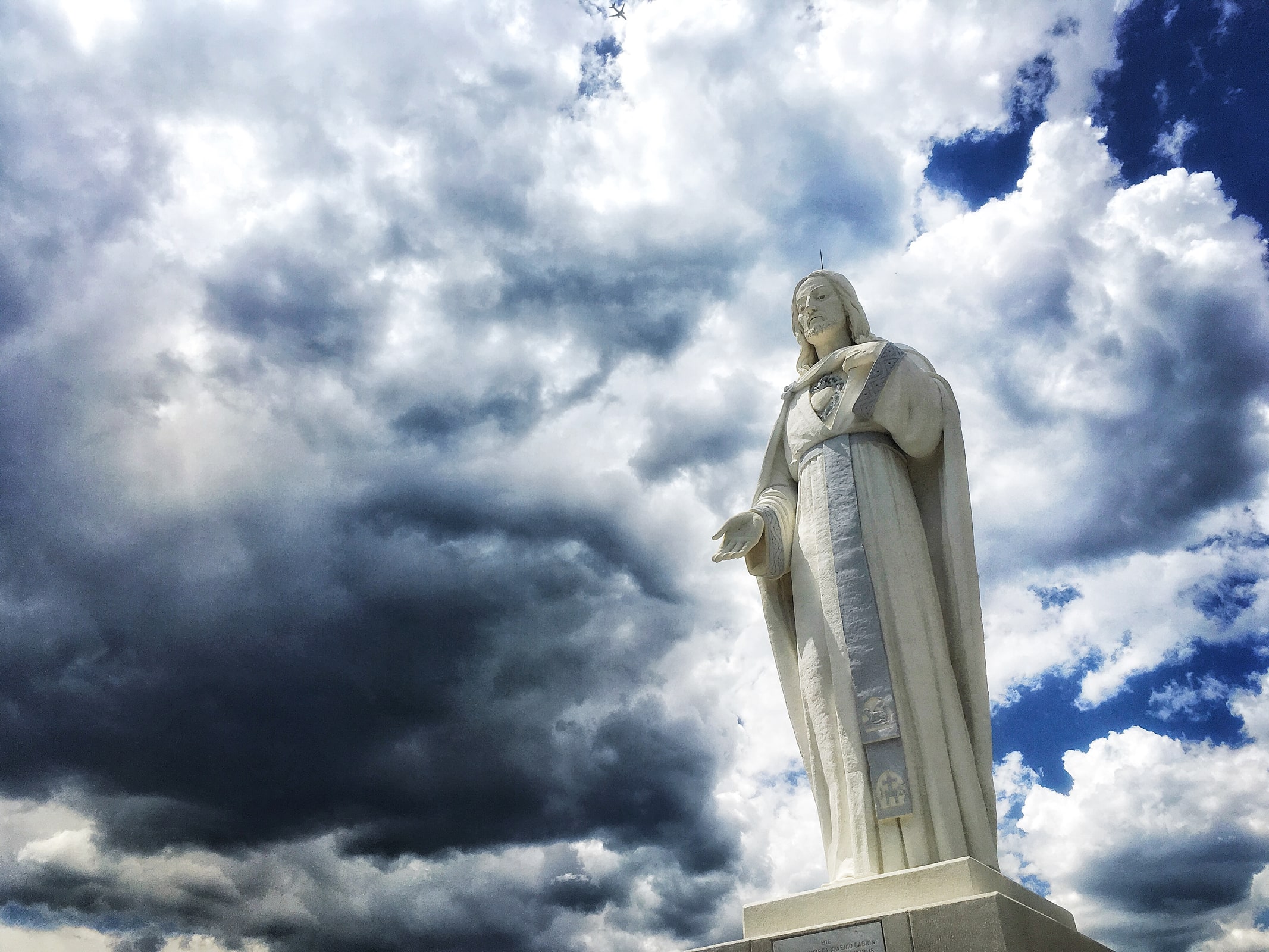
The pilgrimage landscape continued to develop after her death. A Lourdes-style grotto was erected over the spring in 1929; the present sandstone grotto replaced it in 1959. In 1954, a twenty-two-foot statue of the Sacred Heart of Jesus was placed on an eleven-foot base above the Heart of Stones. That same year work began on the Stairway of Prayer. Its 373 steps were completed in sixty-seven days and follow the path associated with Cabrini, the sisters, and the children. Stations of the Cross lead the ascent, followed by mysteries of the Rosary that direct prayer toward the life of Christ.
A good visit therefore has a spiritual order. Begin below at the spring and grotto, where the original problem of thirst becomes an invitation to prayer. Visit the historic Stone House and the museum if they are open. Then make the ascent slowly. The stairs are not merely transportation to a viewpoint. The mosaics, Stations, and Rosary mysteries turn physical effort into a devotional path. At the summit, the Sacred Heart statue and preserved stone heart interpret the whole mountain through the spirituality that animated Cabrini’s congregation.
This is demanding terrain. The shrine publishes daily grounds hours and a regular schedule of Mass and confession, but pilgrims should verify both before traveling because liturgies, events, weather, and mountain conditions can alter a visit. The campus includes steep grades and the 373-step route; anyone with limited mobility should contact the shrine about accessible approaches rather than assuming the stairs are the only way to pray there. The shrine also offers retreat spaces and overnight accommodations, making it possible to stay rather than treating the mountain as a hurried stop from Denver.
Cabrini died in Chicago in 1917. She was canonized by Pope Pius XII in 1946 and proclaimed patroness of immigrants in 1950. Those honors make the Colorado shrine more than a record of one resourceful religious sister finding water. The place belongs to a much larger Catholic story about migration: people uprooted from home, communities trying to preserve faith and dignity, and a woman who crossed oceans and continents to build institutions for those the prosperous world often overlooked. Her prayer before the tabernacle and her formidable administrative energy were not competing parts of her life. The first gave direction to the second.
From the summit, a pilgrim can look back toward Denver and remember the orphan girls for whom this property was purchased, the miners’ families Cabrini traveled to meet, and the sisters carrying water up a dry mountain. The shrine’s beauty came through service before it became a destination. That may be its sharpest lesson. Catholic pilgrimage is not only about finding places where something extraordinary is remembered. It is also about seeing how holiness responds to ordinary human need—with prayer, courage, intelligence, persistence, and a willingness to lift the rock and begin digging.
St. Frances Xavier Cabrini, pray for us.