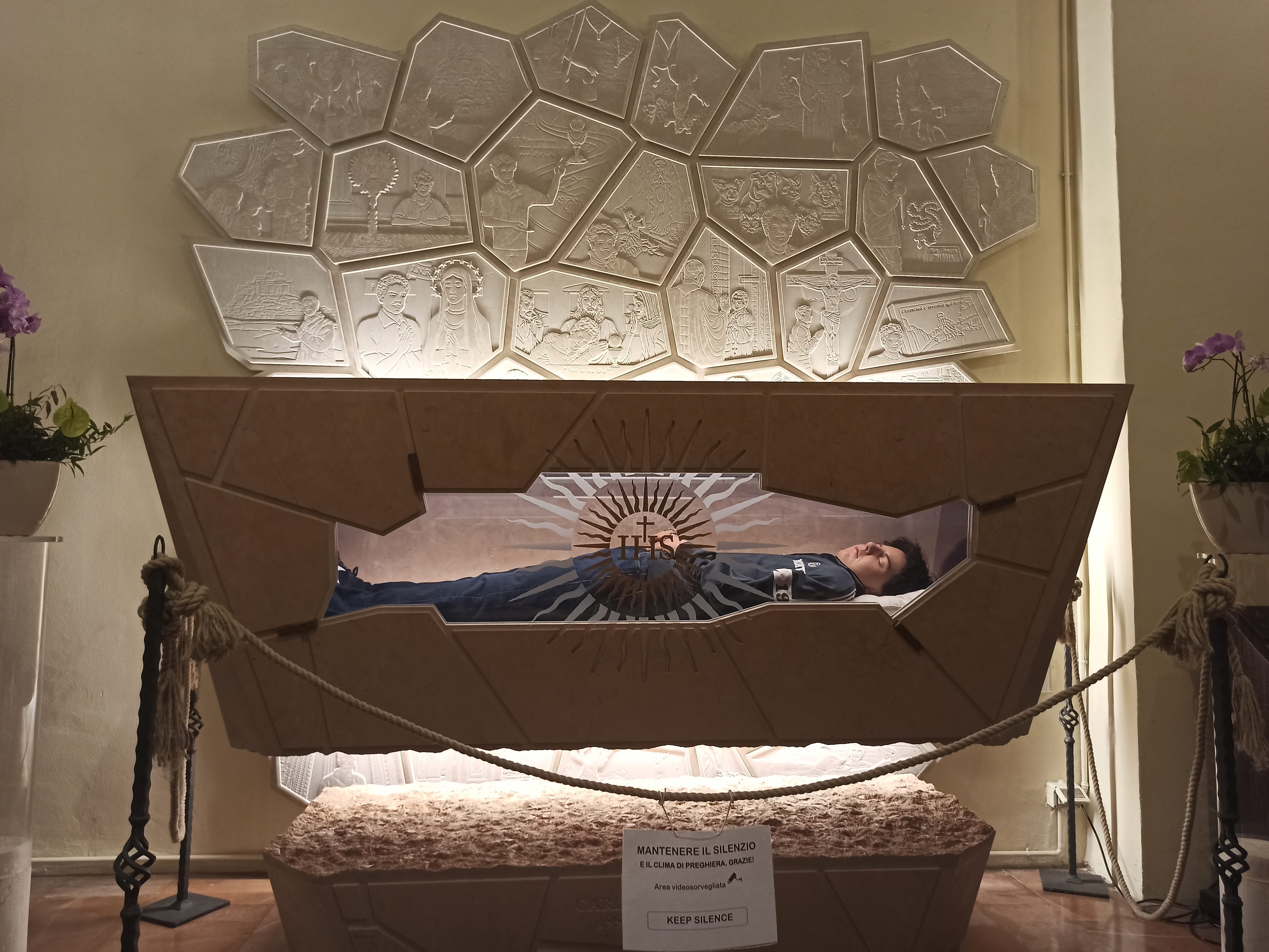
One year ago today, on September 7, 2025, Pope Leo XIV canonized Carlo Acutis in St. Peter’s Square alongside Pier Giorgio Frassati. The setting was immense; Carlo’s life had been remarkably ordinary. He was not a priest, founder, ruler, or scholar. He was a teenager who went to school, enjoyed computers and sports, loved his family and friends, and learned to build websites. What made that ordinary life extraordinary was its center: Jesus Christ, encountered especially in the Eucharist and served in the poor.
Carlo was born in London on May 3, 1991, while his Italian parents were living there for his father’s work. The family soon returned to Milan. He attended school, made friends, and developed the interests of a boy growing up at the turn of the millennium. The official Vatican biography does not describe a child withdrawn from modern life. It describes someone who integrated prayer, study, sport, charity, and technology. That integration is part of why his witness feels so close. Carlo did not become holy by escaping his century. He learned to live in it without allowing it to own his attention.
He received his First Communion at seven and developed a deep Eucharistic life. Daily Mass, Eucharistic adoration, frequent confession, and the Rosary were not accessories added to an otherwise separate existence. They shaped how he saw other people. He quietly helped classmates in difficulty and shared money with poor neighbors. The Vatican’s account of his life places love of the Eucharist beside concrete charity, not in competition with it. At his canonization, Pope Leo emphasized precisely that union: love for Christ in the Eucharist and love for Christ in the poor.
Carlo’s famous description of the Eucharist as his ‘highway to heaven’ can become a slogan if it is separated from that daily pattern. For him, the Eucharist was not merely a subject he promoted online. It was the source of a life reordered toward God. Prayer pulled his gaze away from self-absorption; confession taught him to begin again; charity made devotion visible. His use of technology grew out of this spiritual center.
As a student, Carlo learned how to design web pages while helping with his parish website. He later worked on other Catholic and volunteer projects. His best-known digital undertaking gathered accounts of Eucharistic miracles into an international exhibition. This was the early internet: long before social media feeds became the dominant way many people encountered the world, Carlo recognized that a computer could direct attention beyond itself. The screen could become a signpost. A website could invite someone to leave the website, enter a church, and kneel before the Eucharist.
That insight is easy to sentimentalize now that he is a saint. His project was not important simply because a teenager knew how to use a computer. Millions of teenagers did. What mattered was the intention governing the tool. Carlo did not use faith as content for building his own celebrity. He used his skill to help other people encounter Christ. The technology served the mission, and the mission remained larger than the technology.
In October 2006, Carlo was diagnosed with an aggressive leukemia. His health declined with terrifying speed. He received the Anointing of the Sick and offered his suffering for the pope and the Church. On October 12, he died at fifteen years and five months old. The shortness of his life is part of its challenge. There was no long period in which he could postpone conversion, service, or prayer. Holiness had to be practiced in the days he actually had—in school, at home, among friends, before a computer, at Mass, and finally in a hospital.
Carlo’s body was eventually brought to Assisi, the city whose Franciscan spirituality had influenced him. Since 2019 his mortal remains have rested in the Sanctuary of the Spoliation, within Santa Maria Maggiore. The location creates a striking conversation across the centuries. The sanctuary remembers Francis renouncing wealth and status so that his life could belong wholly to God. Carlo, raised in a very different world, points pilgrims toward a similar freedom: use what you have, including modern technology, without letting possession, popularity, or distraction determine who you become.
The Church did not canonize Carlo because he built an exhibition, nor because the internet needed a mascot. Canonization presents his whole life as a credible witness to the Gospel. The formal process examined his virtues and the miracles attributed to his intercession. He was beatified in Assisi in 2020 after recognition of the first miracle, and a second recognized miracle opened the way to canonization. On September 7, 2025, the Church placed his name among the saints.
For Catholic Tourist, this anniversary is personal. Carlo’s Eucharistic-miracles project helped show that digital work can become an act of evangelization when it sends people toward Christ rather than toward the creator. His exhibition remains his work and his legacy; we do not claim it as our own. But we like to think that, in a small way, this site carries a piece of that legacy forward. By mapping the places connected with Eucharistic miracles, distinguishing what can actually be visited, and giving pilgrims the history and Church recognition attached to each event, we hope to help people move from curiosity to pilgrimage and from a map to prayer.
That is an honor, and it is also a responsibility. Stories about miracles deserve careful sources, honest language, and respect for the Church’s actual judgments. A beautiful claim should never be made stronger than the evidence. Carlo’s example calls us to use the internet for truth as well as inspiration: to make the sacred easier to find without reducing it to something designed only for clicks.
A pilgrimage to Carlo’s tomb should therefore be more than a visit to the resting place of a famous young saint. Go to Mass if you can. Spend time in adoration. Pray for the courage to order your own habits, talents, and screens toward God. Then explore the Eucharistic-miracles collection not as a checklist of marvels, but as an invitation to the mystery Carlo loved most. The best way to honor what he began is to let it lead where he intended—to Jesus Christ, truly present in the Eucharist.
St. Carlo Acutis, pray for us.