Why pilgrims come
Enter a place shaped by prayer, community, and pilgrimage
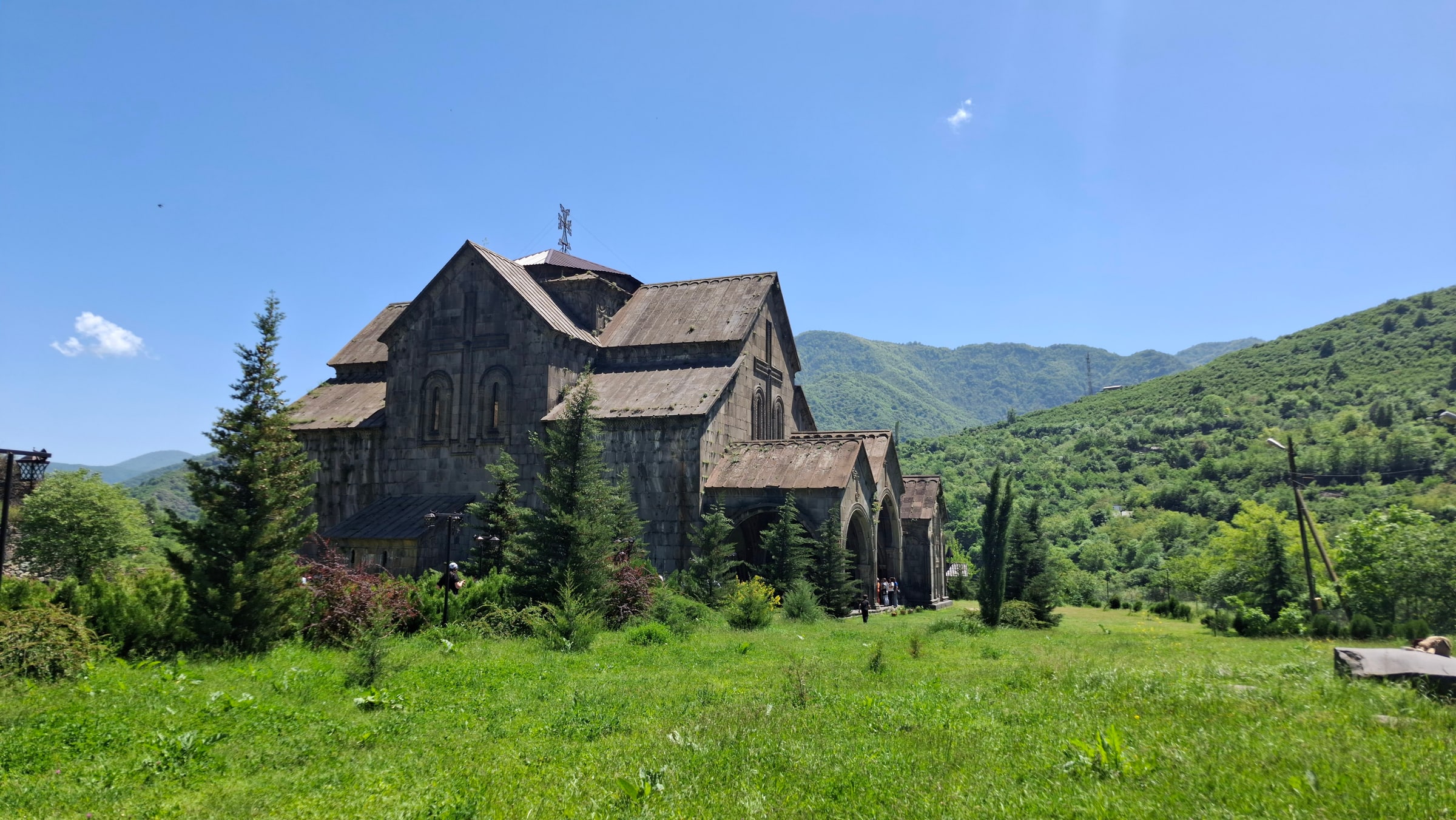
Akhtala is a fortified monastery complex on a rocky height above the town of the same name in Armenia’s Lori Province. Deep ravines protect three sides of the enclosure, while towers and walls guard the approach. The setting makes the site both a monastery and a defensive landscape: prayer, political power, borderland history, and sacred art meet within one compact precinct.
The complex has roots in the tenth century, but its most important surviving church belongs to the monastery’s transformation around the turn of the thirteenth century. The Church of the Holy Mother of God, Surp Astvatsatsin, was constructed in the late twelfth or early thirteenth century. Under the patronage of Ivane Zakarian, Akhtala became a major Armenian Chalcedonian center in northern Armenia.
That history requires careful language. Akhtala is an Armenian sacred monument now connected with the Armenian Apostolic Church, but the principal church and its paintings preserve a medieval Chalcedonian layer closely connected with Georgian Orthodox culture. “Armenian,” “Georgian,” “Byzantine,” “Apostolic,” and “Chalcedonian” describe different dimensions of the place; reducing Akhtala to only one of them erases the borderland Christian culture that produced it.
The church’s wall paintings are the reason Akhtala stands apart from many Armenian monasteries. Scholars date the principal fresco campaign to approximately 1205–1216 and connect it with Ivane Zakarian’s patronage. The paintings cover the sanctuary and large portions of the church with scenes from the Old and New Testaments, saints, hierarchs, angels, and the mysteries of Christ.
Among the surviving subjects are the trial of Jesus, scenes connected with the Passion, the Communion of the Apostles, the Virgin, and ranks of saints. Greek and Georgian inscriptions accompany parts of the program, while the iconography and artistic language draw from Armenian, Georgian, and Byzantine traditions. Deep blues, luminous highlights, solemn faces, and densely ordered sacred scenes turn the interior into a visual proclamation of Scripture and liturgy.
The frescoes should not be treated simply as decoration. They were created for worship, teaching, and the celebration of the mysteries of the Church. Enter slowly, allow your eyes to adjust, and read the interior from the sanctuary outward. Photography must remain secondary to prayer and to any rules posted by the present custodians.
Akhtala is not a Roman Catholic church. Catholic visitors should enter as guests of the Armenian Apostolic community, respect its Oriental Orthodox sacramental discipline, and never presume reception of Holy Communion. The medieval Chalcedonian history also should not be confused with the present identity of the Armenian Apostolic Church.
The site is a recognized Armenian cultural heritage monument, but it is not presently inscribed as a UNESCO World Heritage Site. Its importance does not need an inflated designation: the surviving fortress, church, frescoes, inscriptions, and continuing pilgrimages provide ample reason to visit and protect it.
The Mother See of Holy Etchmiadzin identifies a priest serving Akhtala and neighboring villages, and recent Armenian Apostolic pilgrimages have prayed and lit candles in the Holy Mother of God Church. Visitors should nevertheless verify current opening, service, restoration, and photography conditions locally because a historic monument does not operate like a museum with guaranteed hours.
Akhtala belongs naturally within a northern Armenia pilgrimage through the Debed Gorge. Haghpat and Sanahin, both UNESCO-listed monasteries, are the region’s best-known companions, while Odzun and other historic churches extend the route. Akhtala contributes something distinctive: a fortified sacred landscape and one of Armenia’s most remarkable surviving medieval fresco cycles.
For Catholics, the pilgrimage can become an act of gratitude for the Christian heritage of Armenia and a prayer for deeper unity among Christians. Admire the art without appropriating the church, learn the confessional history without turning it into a contest, and let the painted Communion of the Apostles return attention to Christ, who gathers His people and calls every disciple to holiness.
Enter one of northern Armenia’s most powerful fortified sacred landscapes and pray beneath a thirteenth-century fresco cycle joining Armenian, Georgian, and Byzantine Christian art.
What to notice
Look closely at the place and its story
A fortress above the ravines
Read Akhtala as both a monastic enclosure and a defensive landscape shaped by northern Armenia’s borderland history.
Church of the Holy Mother of God
Enter the principal church developed under Ivane Zakarian and dedicated to the Mother of God.
The 1205–1216 fresco cycle
Contemplate scenes of Christ, the Communion of the Apostles, saints, angels, and biblical history across the painted interior.
Three artistic worlds
Notice Armenian themes, Georgian inscriptions and ecclesial connections, and Byzantine color and iconographic language without flattening their differences.
Visit as an Orthodox guest
Honor the present Armenian Apostolic setting and observe Oriental Orthodox sacramental and devotional discipline.
Debed Gorge pilgrimage
Place Akhtala within a wider northern Armenia route through Haghpat, Sanahin, Odzun, and the Christian landscape of Lori.
How to read this page
Sources, tradition, and what is verified
The destination record was last checked on 11/19/2026.
This page records the site’s tradition as “Armenian Apostolic Church (Oriental Orthodox), with major medieval Armenian Chalcedonian and Georgian Christian layers.” That wording describes the nature of the claim and keeps devotional tradition distinct from independently verified history.
Continue nearby