Why pilgrims come
Encounter a place shaped by the memory of Christ’s Passion
Northwest of central Paris, the Basilica of Saint-Denys in Argenteuil preserves a woolen garment traditionally venerated as the seamless tunic worn by Christ during the Passion—the garment for which the soldiers cast lots in John 19:23–24. The spelling matters: this is Saint-Denys of Argenteuil, not the Basilica Cathedral of Saint-Denis, the royal necropolis on the opposite side of Paris.
The sanctuary presents the tunic as having remained at Argenteuil for roughly twelve centuries. According to the received tradition, the Byzantine empress Irene gave it to Charlemagne, who entrusted it in 803 to his daughter Théodrade, abbess of the monastery at Argenteuil. The garment was later hidden within a wall to protect it during Viking attacks and was rediscovered during work in 1156. That early journey belongs to the relic’s venerable tradition; it should not be described as an uninterrupted modern documentary chain.
The tunic’s later history is unusually concrete. During the French Revolution, the parish priest feared that the relic would be seized and destroyed. He cut it into pieces and concealed them separately. After the danger passed, the surviving pieces were recovered and sewn together, leaving the garment visibly incomplete. Generations of pilgrims—including French rulers and churchmen—had already made Argenteuil a center of devotion before the present basilica was built.
Architect Théodore Ballu designed the current neo-Romanesque church, constructed from 1862 to 1865 to replace an older church that had become too small and unstable. It received the title of minor basilica in 1898. Its significance therefore joins two stories: a nineteenth-century pilgrimage church and a relic whose local tradition reaches deep into the medieval life of Argenteuil.
Scientific examinations have studied the wool, weaving, stains, pollen, and chronology of the textile, but they have not produced universal agreement or conclusive authentication. Radiocarbon results and their interpretation have been debated, and similarities proposed between this relic and other Passion cloths do not prove that they touched Jesus. Catholic Tourist therefore uses the Church’s devotional language precisely: this is the garment traditionally venerated as Christ’s tunic, not an artifact whose identity has been established beyond dispute.
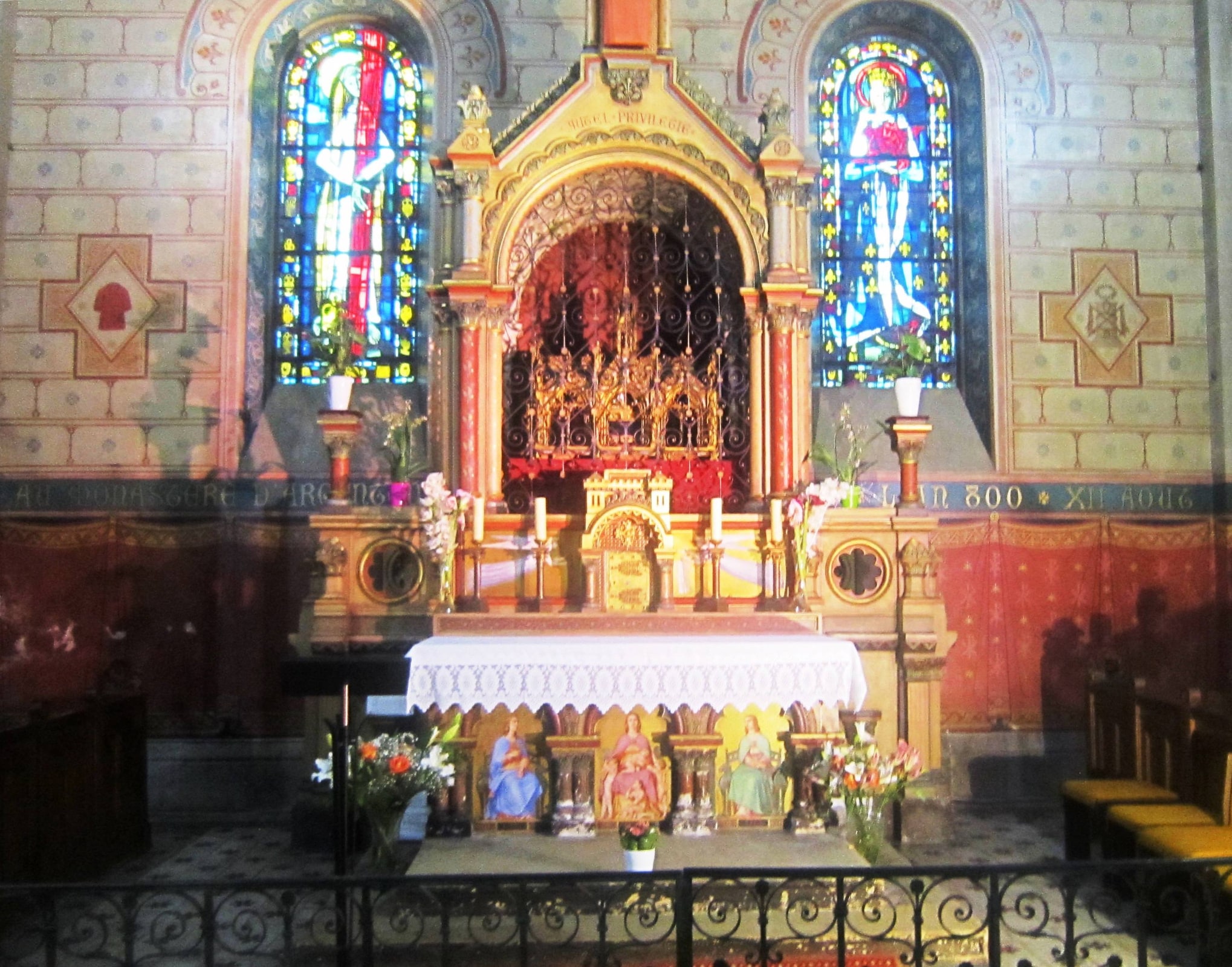
The ordinary pilgrimage is quieter than the great public exhibitions. The sanctuary says the relic can be venerated throughout the year in its dedicated chapel, where it is normally conserved rolled within its reliquary. On rare solemn ostensions it is unfolded for public view; the extraordinary Jubilee ostension from April 18 to May 11, 2025 followed the major 2016 exhibition. Pilgrims should not confuse year-round access to the chapel with a promise that the entire garment will be visibly displayed.
Begin with John’s account of the soldiers dividing Christ’s garments and casting lots for the seamless tunic. Then pray in the relic chapel without turning the garment into a curiosity or a substitute for faith. The deepest purpose of the visit is to contemplate the unity of Christ’s garment, the bodily reality of the Passion, and the love with which Christians believe he gave himself for the world.
Read John 19:23–24 before entering the chapel. Honor the relic as the garment traditionally associated with Christ’s Passion while keeping medieval custody, devotional tradition, and scientific claims distinct. Let the seamless tunic lead toward prayer for Christian unity and gratitude for Christ’s self-gift.
The sacred connection
People and objects remembered here
These relationships are part of the destination record, with feast days and catalog qualifications shown where available.
Passion relic · Medieval relic tradition under active Catholic custody; identification with Christ’s seamless tunic is not conclusively authenticated
The sanctuary says pilgrims may venerate the relic throughout the year, but full public display of the unfolded garment occurs only during announced ostensions. Confirm current access before travel.What to notice
Look closely at the place and its story
The Chapel of the Holy Tunic
Pray before the reliquary that preserves the woolen garment traditionally associated with Christ’s seamless tunic.
John 19:23–24
Begin with the Gospel account of the undivided garment for which the soldiers cast lots.
A medieval pilgrimage tradition
Trace the received Charlemagne and Théodrade story, the concealment during Viking danger, and the relic’s rediscovery in 1156 without confusing tradition with continuous documentation.
Survival through the Revolution
Understand why the priest divided and hid the tunic and why the garment now survives only in partially reassembled form.
The nineteenth-century basilica
Read Théodore Ballu’s neo-Romanesque church as a purpose-built setting for renewed pilgrimage to the relic.
Feasts, anniversaries & celebrations
How to read this page
Sources, tradition, and what is verified
The destination record was last checked on 9/23/2026.
This page records the site’s tradition as “Roman Catholic; diocesan shrine and Passion-relic pilgrimage.” That wording describes the nature of the claim and keeps devotional tradition distinct from independently verified history.
Continue nearby