Why pilgrims come
Encounter the Eucharistic tradition and its surviving evidence
The Roman destination connected with the Eucharistic tradition of 1610 is the Basilica of Santa Pudenziana al Viminale, not an unidentified church somewhere in the city. The received account points still more precisely to the Caetani Chapel inside the basilica, where marks associated with a Host are reported on the marble steps of the altar.
The St. Carlo Acutis Eucharistic Miracles exhibition tells the episode this way: in 1610 a priest celebrating Mass at Santa Pudenziana doubted the Real Presence. The consecrated Host slipped from his hands and fell onto the altar steps. The exhibition says blood appeared and left an imprint in the stone. It further states that the impression remains visible in the Caetani Chapel. Catholic Tourist presents this as the church’s received Eucharistic tradition and attributes the account to the exhibition; no formal diocesan decree judging the reported event supernatural was located in this research pass.
That boundary matters. The destination does not preserve a surviving Host that visitors should expect to see, and this page does not promise one. The physical focus is the reported mark in the chapel’s steps, part of the church fabric. Its continued identification and devotional significance are not the same thing as a modern scientific finding or a located canonical declaration. Pilgrims can approach it as a material memory that has directed prayer toward the Eucharist for centuries without claiming more than the sources support.
The date also must remain distinct from another Eucharistic story associated with Rome and sometimes presented on the same exhibition page. The sixth-century tradition linked to Pope St. Gregory the Great—often dated around 595—is a separate account. This page concerns only the reported event of 1610 at Santa Pudenziana’s Caetani Chapel.
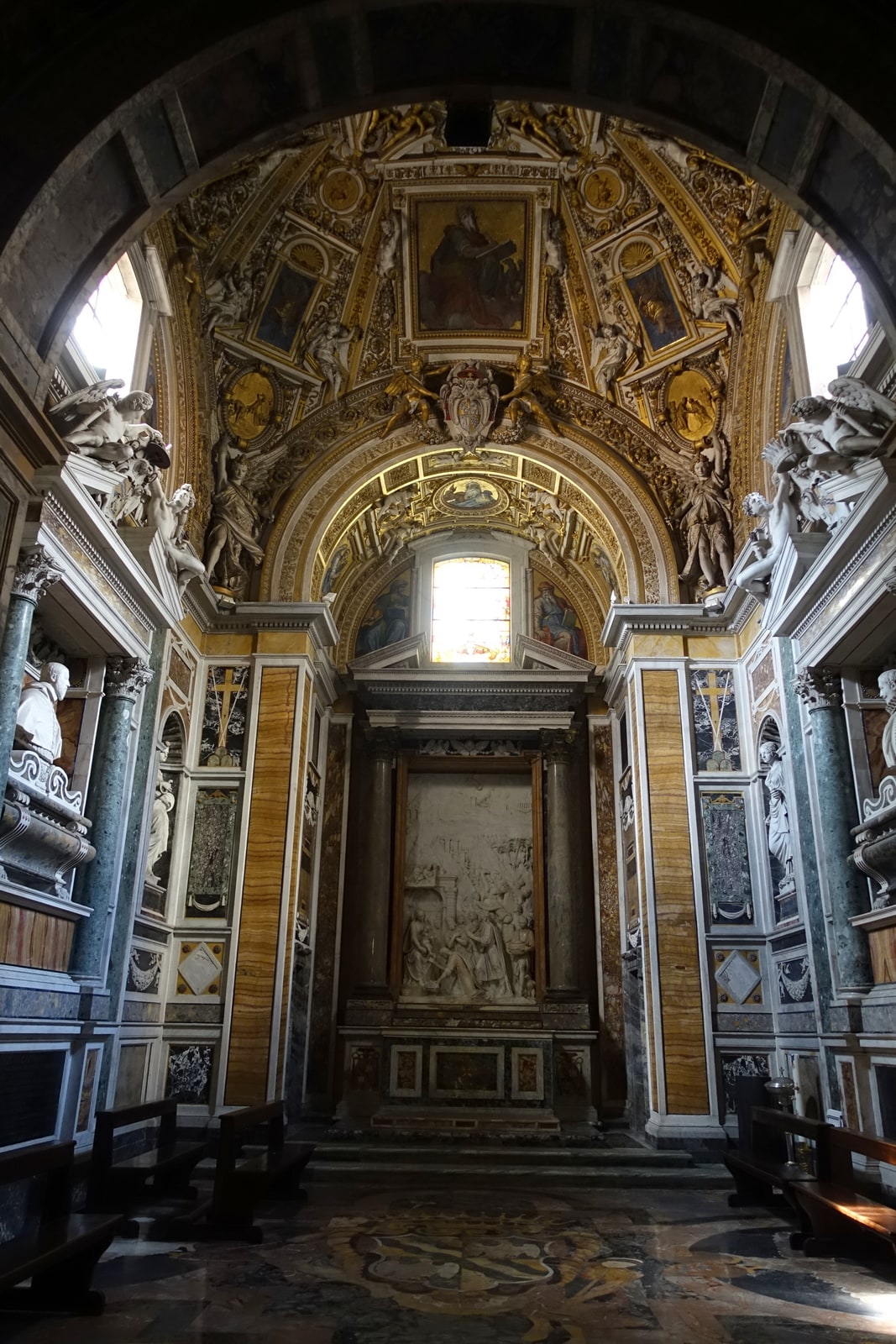
The chapel is itself a major work of late Renaissance Rome. Roma Segreta records that Cardinal Enrico Caetani commissioned it from Francesco da Volterra in 1588 and that Carlo Maderno completed the work. Its polychrome marble, mosaics, gilding, and dense stucco decoration create an unusually concentrated sacred interior. The relief of the Adoration of the Magi was begun by Pier Paolo Olivieri and completed by Camillo Mariani. The Eucharistic memory therefore occupies a chapel designed to lead the eye from costly materials to the mysteries celebrated at the altar.
Santa Pudenziana reaches much further back than 1610. Rome’s official tourism service describes it as one of the city’s oldest churches, established in the fourth century under Pope Siricius over structures connected with a second-century bath complex. Ancient Christian tradition associates the site with the house of the Roman senator Pudens and the hospitality offered there to St. Peter, although the historical development is more complex than the devotional legend alone. Archaeology, architecture, and received memory meet here without becoming interchangeable.
The apse mosaic, generally dated to the late fourth or early fifth century, is the basilica’s most important early Christian work. Christ appears enthroned among the apostles in a monumental heavenly city. The image survived later rebuilding and gives pilgrims a visual bridge to Christian Rome before the medieval basilicas took their familiar form. A visit should allow time both for this mosaic and for quiet prayer in the Caetani Chapel.
Santa Pudenziana is not merely an archaeological monument. It remains an active Roman Catholic basilica and serves Rome’s Filipino Catholic community. A 2026 Diocese of Rome announcement named its rector, Monsignor Gianfranco Basti, and included the church in the “Oltre la soglia” project for welcoming visitors into the spiritual, artistic, and pastoral life of historic churches. Visitors should respect liturgies, parish activity, and private prayer.
Rome’s tourism office currently publishes opening and worship information but warns that schedules can change. Confirm directly with the basilica before travel, especially if the Caetani Chapel, the reported imprint, or step-free access is essential to the visit. The church sits below the present street level at Via Urbana 160, a short walk from Santa Maria Maggiore. Enter as a pilgrim, avoid interrupting Mass, and do not touch the steps or other historic fabric.
Enter one of Rome’s oldest churches, pray before its ancient apse mosaic, and visit the exact Caetani Chapel associated with the received Eucharistic tradition of 1610. Keep devotion, art history, and the limits of the surviving evidence clearly distinguished.
The story & the place today
What happened here—and what a pilgrim can find now
Each record separates the devotional tradition from the present-day visitor evidence. A mapped locality remains visible even when an exact shrine or surviving object has not yet been verified.
The reported Host imprint in the Caetani Chapel
The St. Carlo Acutis exhibition records that a priest who doubted the Real Presence dropped a consecrated Host during Mass at Santa Pudenziana and that it left a blood-like imprint on the altar steps of the Caetani Chapel.
Caetani Chapel, Basilica of Santa Pudenziana al Viminale, Rome
The reported imprint on the altar steps in the Caetani Chapel; no surviving Host is promised
Caetani Chapel, Basilica of Santa Pudenziana al Viminale, Rome
No current annual program verified
Visitor note: Active basilica; confirm chapel access and current hours directly
Church wording: Received Eucharistic tradition preserved at the named chapel — Continuing Catholic custody and St. Carlo Acutis exhibition documentation; no formal diocesan decree located
The received 1610 account is distinct from the separate sixth-century Rome tradition associated with Pope St. Gregory the Great. The claim is attributed to the exhibition rather than presented as a located formal Church decree.
What to notice
Look closely at the place and its story
The reported imprint in the Caetani Chapel
Locate the altar steps identified by the St. Carlo exhibition as the material focus of the received 1610 tradition.
A Renaissance chapel by major Roman artists
Study the marble, mosaics, stucco, and Adoration of the Magi shaped by Francesco da Volterra, Carlo Maderno, Pier Paolo Olivieri, and Camillo Mariani.
An honest evidence boundary
The page preserves the tradition without promising a surviving Host or claiming a formal judgment that the research did not locate.
The ancient apse mosaic
Contemplate Christ enthroned among the apostles in one of Rome’s most important surviving early Christian mosaics.
A living Filipino Catholic community
Recognize Santa Pudenziana as an active place of worship and pastoral life, not only an ancient monument.
How to read this page
Sources, tradition, and what is verified
The destination record was last checked on 9/29/2026.
This page records the site’s tradition as “Roman Catholic minor basilica, early Christian church, and received Eucharistic tradition.” That wording describes the nature of the claim and keeps devotional tradition distinct from independently verified history.
Continue nearby