Why pilgrims come
Encounter the Eucharistic tradition and its surviving evidence
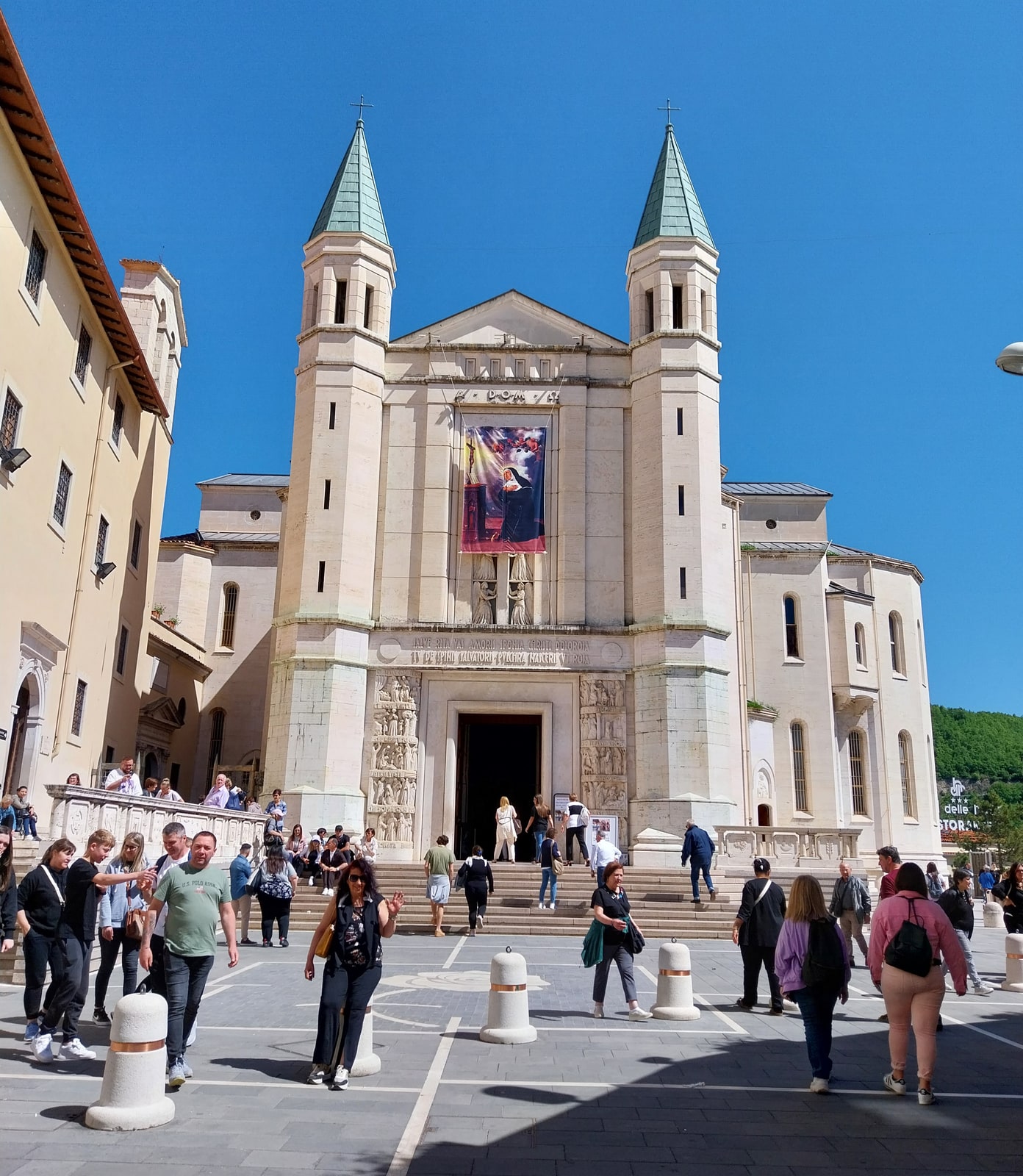
Cascia’s Eucharistic relic is preserved in the Lower Basilica of St. Rita, but the received event did not take place in Cascia. The tradition begins in the Sienese countryside in 1330 and reaches Cascia through the Augustinian friar Blessed Simone Fidati. Naming both places—Siena and Cascia—corrects the common shorthand “Miracle of Cascia” without diminishing the living devotion in the basilica that now safeguards the relic.
According to the Augustinian account transmitted through the St. Carlo Acutis exhibition, a priest was called to bring Communion to a sick person. He placed a consecrated Host carelessly between the pages of his breviary. When he opened the book, he found the Host altered and the two pages marked with blood. Distressed by his irreverence, he sought Simone Fidati, a respected Augustinian preacher and spiritual writer originally from Cascia.
The tradition says Simone heard the priest’s confession and received the stained pages. One remained within the Augustinian world at Perugia or Siena in later accounts; the other came to Cascia. The page preserved today is not displayed in the upper basilica beside St. Rita’s body. It is kept in the right transept of the Lower Basilica, in the chapel dedicated to the Eucharistic miracle and Blessed Simone Fidati.
That location matters for the visitor. The official sanctuary says the original crypt beneath the modern basilica was transformed into the Lower Basilica and inaugurated on May 19, 1988. The archbishop of Spoleto-Norcia placed the Eucharistic relic and Blessed Simone in the right transept at that time. The same lower church also contains the tomb of Blessed Maria Teresa Fasce, whose twentieth-century leadership helped make the present sanctuary possible.
Claims that a sorrowful face can be seen in the stains belong to devotional interpretation. Catholic Tourist does not enhance images, promise a visible portrait, or present pattern recognition as proof. The secure present facts are the sanctuary’s custody, the dedicated chapel, the Augustinian tradition linking the relic to Simone Fidati, and continued access for prayer.
The larger complex is already one of Italy’s major saint pilgrimages. St. Rita’s body is venerated in the upper basilica; the monastery preserves places tied to her life; the Penitentiary serves pilgrims seeking Reconciliation; and the Lower Basilica gathers the Eucharistic relic, Simone Fidati, and Maria Teresa Fasce. Site 129 focuses on the Eucharistic tradition while the existing St. Rita destination remains the principal page for Rita’s tomb.
The sanctuary publishes daily opening from 6:30 to 20:00, with the Lower Basilica closing shortly before the main basilica. These times can change for major feasts, winter operations, liturgies, or security. The official schedule should always be checked, especially around May 22 when crowds for St. Rita are exceptionally large.
This is a place to approach with humility. The received story begins with careless handling of Communion and turns toward confession, reparation, and renewed reverence. The strongest pilgrimage joins the lower chapel’s Eucharistic focus to St. Rita’s witness of forgiveness and Blessed Simone’s ministry of conversion rather than treating the relic as an isolated curiosity.
Descend to the Lower Basilica for the Eucharistic relic and Blessed Simone Fidati, then visit St. Rita’s tomb upstairs as a complementary—but distinct—devotion.
The story & the place today
What happened here—and what a pilgrim can find now
Each record separates the devotional tradition from the present-day visitor evidence. A mapped locality remains visible even when an exact shrine or surviving object has not yet been verified.
The Eucharistic relic of Siena–Cascia
The received Augustinian tradition says a Host carried irreverently in a breviary left blood stains on its pages. Blessed Simone Fidati received the priest’s confession, and one stained page is preserved at Cascia.
Sienese countryside, according to the received tradition
A stained page from the priest’s breviary
Chapel of the Eucharistic Miracle and Blessed Simone Fidati, Lower Basilica of St. Rita, Cascia
Devotion continues at the chapel; consult the current sanctuary programme
Visitor note: Venerated in the Lower Basilica during sanctuary opening
Church wording: Long-standing Augustinian Eucharistic tradition — Sanctuary of St. Rita and the Augustinian custodial tradition
A fourteenth-century Augustinian tradition centered on sacramental reverence, confession, and reparation.
The sacred connection
People and objects remembered here
These relationships are part of the destination record, with feast days and catalog qualifications shown where available.
Eucharistic contact relic · Preserved and venerated by the Augustinian sanctuary within the received 1330 tradition
Right transept of the Lower Basilica; verify opening and liturgical access.What to notice
Look closely at the place and its story
The Eucharistic chapel
Find the relic in the right transept of the Lower Basilica.
Blessed Simone Fidati
Understand the Augustinian friar’s role in the received account of confession and reparation.
Siena and Cascia distinguished
Remember that the event is placed near Siena while Cascia is the present custodian destination.
St. Rita upstairs
Join the Eucharistic visit to the distinct veneration of St. Rita’s body in the upper basilica.
No image enhancement
Approach perceived shapes in the stains as devotional interpretation, not manufactured visual proof.
How to read this page
Sources, tradition, and what is verified
The destination record was last checked on 9/30/2026.
This page records the site’s tradition as “Roman Catholic Augustinian Eucharistic devotion.” That wording describes the nature of the claim and keeps devotional tradition distinct from independently verified history.
Continue nearby