Why pilgrims come
Discover what makes Basilica Sanctuary of Saint Michael the Archangel a place of pilgrimage
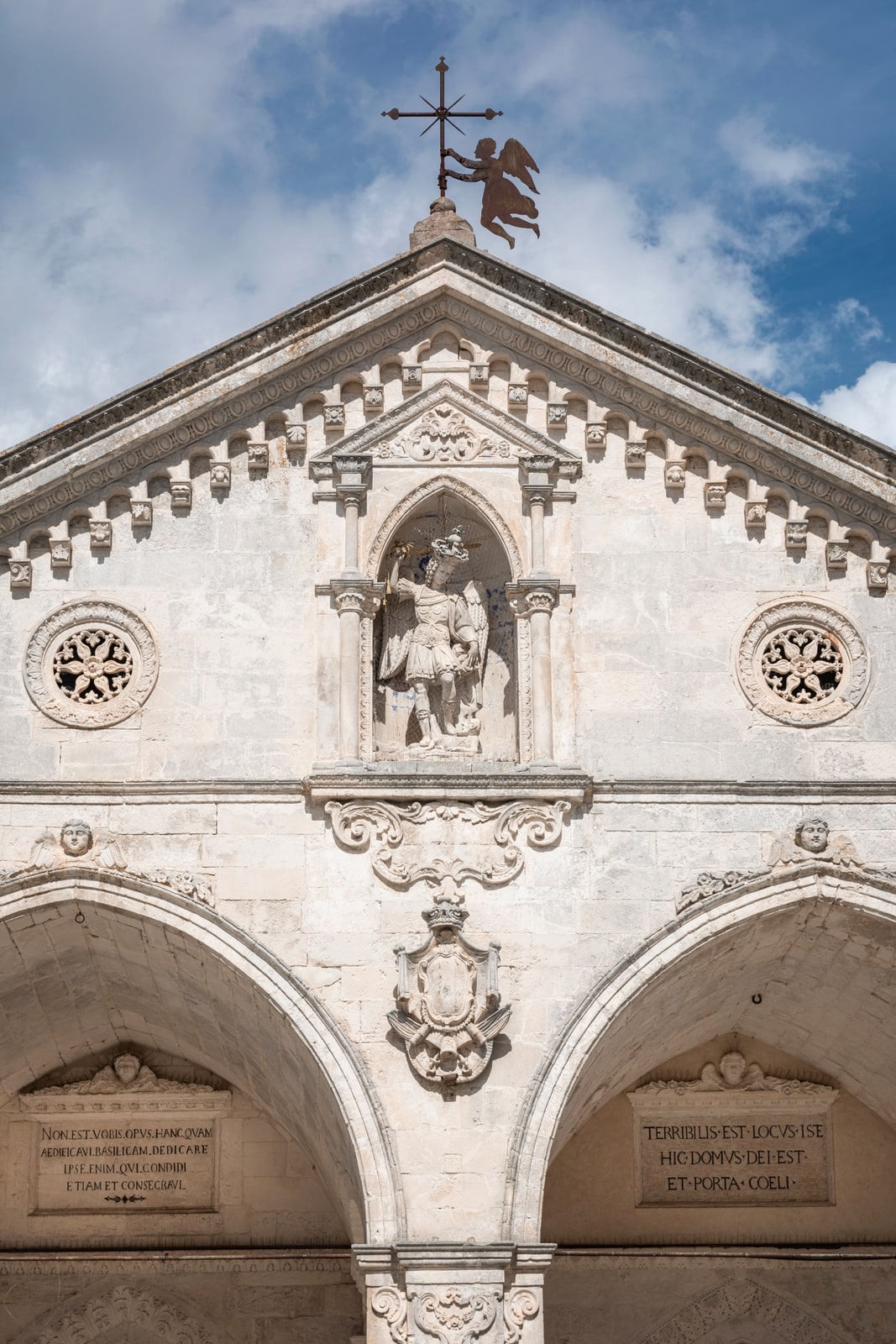
High above the Gulf of Manfredonia, pilgrims enter the Basilica Sanctuary of Saint Michael not by climbing toward a conventional high altar but by descending beneath the medieval town into a natural cave. The Sacred Grotto is the heart of Monte Sant'Angelo: a living Catholic sanctuary, one of Western Christianity's oldest and most influential centers of devotion to St. Michael, and the place from which Michaelian pilgrimage spread across medieval Europe.
The shrine's history needs two kinds of evidence held together honestly. Written witnesses establish a sanctuary here by the end of the fifth and beginning of the sixth century: the official history points to letters of Pope Gelasius I from about 493–496 and an entry in the early Martyrologium Hieronymianum. The vivid narrative of three angelophanies comes to us chiefly through the Liber de apparitione Sancti Michaelis in Monte Gargano, a text written down in the eighth century. The Church and sanctuary continue to commemorate this received tradition, but Catholic Tourist does not present it as if it were a modern apparition investigation supported by contemporary eyewitness files.
The first tradition, dated by the sanctuary to 490, is the famous episode of the bull. A wealthy man of Siponto discovered a missing bull kneeling at the mouth of a cavern on Monte Gargano. Angered by the animal's refusal to move, he shot an arrow toward it. The arrow inexplicably turned back and wounded the man's foot. Disturbed by what had happened, he went to the bishop of Siponto, St. Lawrence Maiorano, who ordered three days of prayer and penance. At their conclusion, according to the tradition, St. Michael appeared to the bishop and declared that he had chosen the cave, guarded it, and desired it dedicated to Christian worship as a place of prayer and forgiveness.
A second episode is remembered as the apparition of victory. The sanctuary's devotional chronology places it in 492 and associates it with the deliverance of Siponto after prayer and penance. Its own historical account also acknowledges that modern scholars commonly connect this memory with a later Lombard conflict against Byzantine forces in 662–663. That distinction matters: the tradition shaped the feast celebrated on May 8, while the historical chronology remains debated.
The third episode, traditionally dated to 493, explains why the grotto is called the Celestial Basilica. When St. Lawrence and the bishops of Apulia prepared to dedicate the cave, Michael reportedly told the bishop that the place had already been consecrated. The procession entered and, according to the Liber tradition preserved by the shrine, found a rough stone altar covered with a red pallium and surmounted by a cross, together with a footprint attributed to the Archangel in the rock. Mass was offered in the grotto. Because the sanctuary was believed to have been dedicated by the Archangel rather than by human hands, generations called it the Basilica Celeste—the Celestial Basilica.
The documented history that followed is no less remarkable. After the Lombards took control of the Gargano, the sanctuary became their national shrine. Rulers and pilgrims enlarged access to the cave, left inscriptions, and carried devotion to Michael along roads linking southern Italy with the wider Christian world. UNESCO includes Monte Sant'Angelo within the serial property Longobards in Italy: Places of the Power, recognizing the Lombards' architectural and spiritual contribution to medieval Europe. That inscription recognizes the site's history and surviving fabric; it is not a ruling on the supernatural authenticity of an apparition. The Gargano grotto became a model for other Michaelian sanctuaries, most famously Mont-Saint-Michel, whose medieval foundation story includes envoys traveling here for relics of stone and altar cloth.
The present pilgrimage is an encounter with both the mountain and the underworld of the cave. From the upper basilica entrance, a long monumental stair descends toward the grotto. The irregular rock, altar, traditional footprint, Lombard inscriptions, crypts, devotional museum, and centuries of additions should be read around the one reality that gives them meaning: this remains a church of Mass, confession, prayer, and reconciliation. The sanctuary is not principally a monument to a warrior angel. Its own early history remembers Michael as guardian, healer, defender, and the one who presents souls before God.
Two annual celebrations make that living continuity especially visible. May 8 commemorates the Apparitions on the Gargano with a novena and an expanded liturgical program. September 29 celebrates Saints Michael, Gabriel, and Raphael, with the sanctuary's current program normally including multiple Masses and a procession. These days can be deeply moving and very crowded; the official schedule should always be checked before travel. On ordinary days, the published timetable includes Mass and confession in the Archangel's Cave, but solar-time and summer-time schedules differ.
Monte Sant'Angelo pairs naturally with the sanctuary of St. Pio at San Giovanni Rotondo, yet neither place should be rushed. Mountain roads, regional buses, parking, feast-day traffic, and the long descent into the grotto require planning. The ordinary approach includes many stairs. Pilgrims with limited mobility should contact the sanctuary before traveling for the current assisted-access arrangement. The sanctuary also advertises a Casa del Pellegrino; room, meal, reception, and accessibility details should be confirmed directly.
The bull, the returning arrow, and the cave already dedicated by heaven belong to an ancient sacred narrative, not to a claim that can now be reproduced or tested. Yet the story's spiritual invitation is concrete. It calls the pilgrim away from anger and possession, into penance, prayer, forgiveness, and confidence in God's protection. Descend quietly. Bring what needs to be confessed. Ask for courage without spectacle and protection without fear. Then let devotion to St. Michael lead, as every true angelic devotion must, into worship of God.
Descend from the medieval town into the Sacred Grotto, the liturgical heart of one of Western Christianity's oldest and most influential centers of devotion to St. Michael. Read the place in three layers: living Catholic worship, the received apparition tradition, and the historically documented Lombard and medieval pilgrimage landscape.
What to notice
Look closely at the place and its story
The bull and returning arrow
Learn the shrine's received 490 foundation tradition: the kneeling bull, the arrow that wounded its owner, and St. Lawrence Maiorano's three days of prayer and penance.
The Sacred Grotto
Enter the natural cave that remains the sanctuary's altar, devotional center, and place of living liturgy.
The three angelophanies and Celestial Basilica
Follow the bull, victory, and dedication traditions through the grotto's altar and footprint while distinguishing the eighth-century Liber account from a modern canonical decree.
Lombard inscriptions and medieval pilgrimage
See how the shrine became an international destination and a model for Michael devotion across Western Europe.
A Gargano pilgrimage pairing
Combine Monte Sant'Angelo with St. Pio's sanctuary at San Giovanni Rotondo without rushing either place.
Feasts, anniversaries & celebrations
Apparition timeline
1 recorded apparition dates
Traditional angelophanies of St. Michael on Monte Gargano
The sanctuary officially advertises its Casa del Pellegrino; confirm present room, meal, accessibility, and reception arrangements directly before travel.
Accommodation details ↗How to read this page
Sources, tradition, and what is verified
The destination record was last checked on 9/29/2026.
This page records the site’s tradition as “Catholic.” That wording describes the nature of the claim and keeps devotional tradition distinct from independently verified history.
Continue nearby