Why pilgrims come
Discover what makes Church of San Francisco and Tomb of Blessed Sebastián de Aparicio a place of pilgrimage
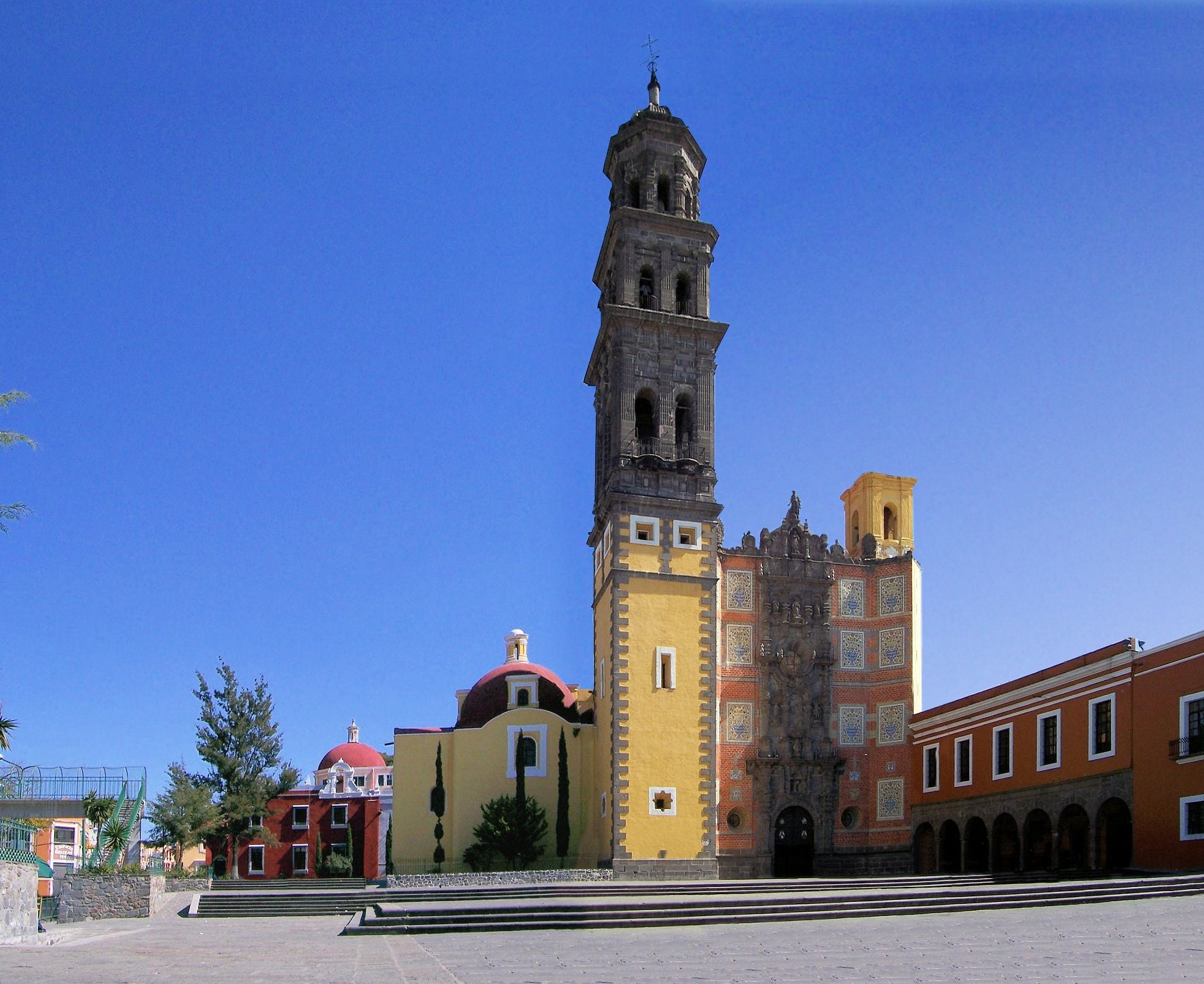
The Church of San Francisco—formally the Templo Conventual de las Cinco Llagas de San Francisco de Asís—belongs to the earliest Franciscan history of Puebla. The friars were present at the city’s foundation in 1531, and the complex developed over the following centuries along the old road toward Veracruz. Its soaring tower, carved stonework, brick, and panels of Puebla tile make the exterior one of the city’s most distinctive Baroque landmarks, but pilgrims come above all for the chapel of Blessed Sebastián de Aparicio.
Sebastián was born in A Gudiña, Galicia, in 1502 and emigrated to New Spain as a young man. He worked in agriculture and transport, helped open and improve roads, and organized ox-drawn carts capable of moving goods across difficult terrain. Franciscan accounts remember both his practical ingenuity and his generosity to the poor. The popular title “friar of the carts” and his later patronage among drivers and travelers grew from that long working life rather than from an abstract association assigned after his death.
His religious vocation came unusually late. After two marriages and decades of work, Sebastián gave substantial property to the Poor Clares and entered the Franciscan Order in his seventies. He professed as a lay brother in 1575 and served at Tecali and Puebla as porter, gardener, cook, sacristan, and especially alms collector. The same experience with roads, animals, and carts that had built his livelihood became a means of supporting a large religious community and assisting people throughout the surrounding countryside.
Blessed Sebastián died in the Puebla friary on February 25, 1600, at the age of ninety-eight. His reputation for humility, prayer, charity, hard work, and reported favors spread quickly. Pope Pius VI beatified him in 1789, and February 25 remains his liturgical commemoration. He is a blessed rather than a canonized saint; Catholic Tourist therefore uses his correct title and does not silently promote him to sainthood.
The adjoining chapel preserves his bodily remains in a glass-fronted urn. Mexican heritage authorities and Franciscan tradition describe the body as incorrupt, but that term must not be mistaken for “untouched” or “scientifically unexplained.” When the remains were uncovered during chapel work in 1617, intense relic-taking damaged them; the head was stolen, recovered in poor condition, and later covered with a wax mask. The shrine is therefore an ecclesially venerated body with a complicated physical history—not a pristine specimen or an object for sensational inspection.
The same chapel also preserves the Virgen Conquistadora, a small image associated by tradition with Hernán Cortés and later placed within the Franciscan complex. That title and colonial history require careful interpretation. The image belongs to the devotional and political world of early New Spain, whose evangelization, Indigenous experience, violence, alliances, and cultural transformation cannot be reduced to a triumphal slogan. The chapel’s double dedication invites both prayer and honest historical attention.
A pilgrimage should begin with the living church rather than the glass reliquary. Attend Mass if the current schedule permits, pray before the Blessed Sacrament, and then approach Sebastián’s chapel quietly. His late vocation is especially meaningful for people who believe they have missed the proper time to serve God; his work speaks to laborers, migrants, farmers, drivers, and those whose ordinary skills become instruments of charity.
Puebla’s municipal religious-heritage guide lists the church as open daily from 6:30 a.m. to 7:30 p.m., but schedules can change for liturgy, feast preparations, conservation, and parish needs. Verify locally before making a special journey. February celebrations commonly include Masses and pilgrimages for workers and transport communities; never assume that a festival timetable applies throughout the year.
Visit Puebla’s historic Franciscan church, pray at the chapel preserving Blessed Sebastián de Aparicio’s remains, and discover a late vocation shaped by work, roads, charity, and humble service.
The sacred connection
People and objects remembered here
These relationships are part of the destination record, with feast days and catalog qualifications shown where available.
principal shrine preserving his bodily remains
Feast: February 25first-class relic · ecclesiastically venerated; traditionally described as incorrupt
Remain behind glass; approach as a place of prayer and obey photography restrictions.What to notice
Look closely at the place and its story
The friar of the carts
Follow Sebastián from farmer and road builder to a lay brother who used the same practical skills to support his Franciscan community and the poor.
A vocation after seventy
Let his late entry into religious life challenge the belief that service to God has an expiration date.
The venerated remains
Pray at the urn while keeping its real physical history—including relic-taking, damage, and the wax mask—clearly distinguished from devotional shorthand.
Puebla Baroque
Study the tower, carved portal, brick, and Talavera panels that transformed the early Franciscan foundation over several centuries.
Virgen Conquistadora
Encounter the chapel’s second devotion with prayer and an honest awareness of the complex colonial history carried by its title.
Feasts, anniversaries & celebrations
How to read this page
Sources, tradition, and what is verified
The destination record was last checked on 10/7/2026.
This page records the site’s tradition as “Roman Catholic — Archdiocese of Puebla; Franciscan foundation.” That wording describes the nature of the claim and keeps devotional tradition distinct from independently verified history.
Continue nearby