Why pilgrims come
Discover what makes Croagh Patrick and St. Patrick’s Oratory a place of pilgrimage
Croagh Patrick rises above Clew Bay like a natural altar. Known affectionately as “the Reek,” the mountain is one of Ireland’s great penitential pilgrimage places. Christian tradition holds that St. Patrick fasted and prayed on the summit for forty days in 441, echoing Moses and Elijah and the forty days of Christ in the wilderness. The historical details cannot be reconstructed with modern precision, but the connection between Patrick and the mountain is ancient and has shaped Irish Catholic devotion for centuries.
The annual pilgrimage reaches its fullest expression on Reek Sunday, the last Sunday of July. Pilgrims climb from Murrisk toward the summit chapel, many carrying intentions of repentance, gratitude, grief, or intercession. The Archdiocese of Tuam describes the traditional stations and the long inheritance of prayer on the mountain. Westport Parish currently publishes hourly summit Masses and continuous confession during the principal Reek Sunday period, as well as liturgies on Garland Friday and the Assumption. Those schedules are annual and weather-dependent; they must be checked before travel.
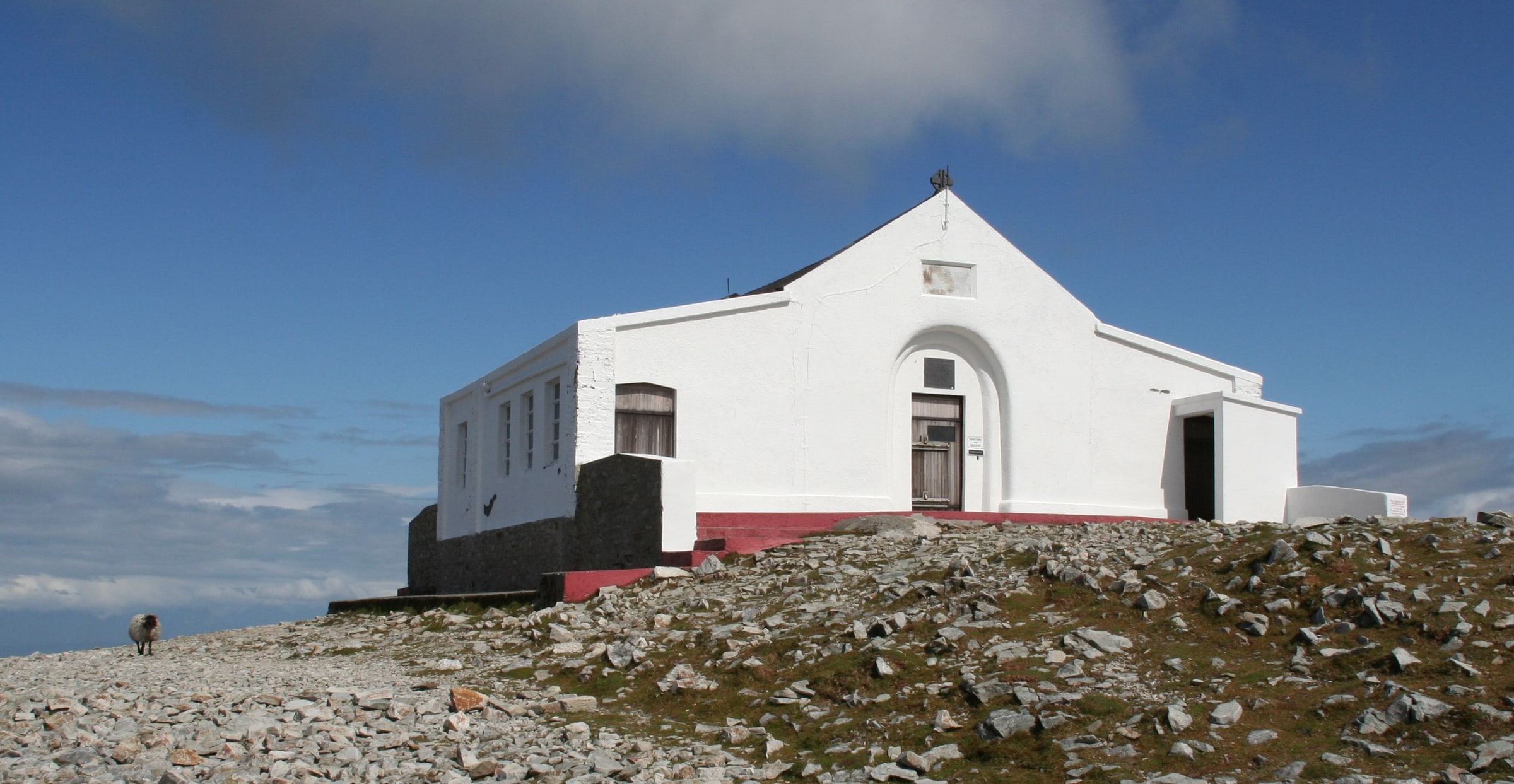
The small white oratory at the summit was dedicated in 1905, but archaeological work has found traces of earlier Christian use. Its simplicity is appropriate. There is no great basilica to shelter a visitor from the mountain. Wind, cloud, loose stone, fatigue, and the wide view of Mayo remain part of the pilgrimage. The climb turns prayer into something bodily: every step exposes impatience, weakness, perseverance, and dependence.
That physical reality must not be romanticized. The parish calls the route extremely challenging in places, especially on the cone, and advises fitness, proper footwear, weather checks, food, water, and respect for local guidance. The path crosses private working farmland; dogs are prohibited. Conditions at the summit can be radically different from those at the base. Barefoot ascent is a traditional act of penance for some pilgrims, but it should never be presented as expected or safe.
The best way to understand Croagh Patrick is to refuse the split between “hike” and “devotion.” The mountain is beautiful, but its Catholic significance lies in why generations have climbed it. Read the stations before setting out, carry a specific prayer, and allow the descent to become part of the pilgrimage. St. Patrick’s mission did not end on a summit; it returned to the people below.
Choose an intention before beginning the climb and read the traditional stations. The pilgrimage is demanding enough to expose the difference between consuming a view and offering an ascent.
The sacred connection
People and objects remembered here
These relationships are part of the destination record, with feast days and catalog qualifications shown where available.
traditional forty-day fast and prayer on the summit
Feast: March 17What to notice
Look closely at the place and its story
The Patrick tradition
Carry the ancient memory of Patrick fasting and praying for forty days on the summit.
The traditional stations
Use the posted prayers and rounds to keep the climb a pilgrimage rather than only a hike.
St. Patrick’s Oratory
Reach the white summit chapel dedicated in 1905 on a mountain with much older Christian use.
Reek Sunday
Join Ireland’s national penitential pilgrimage on the last Sunday of July only with current liturgical and safety information.
The descent
Let the return toward Clew Bay become a prayer for carrying conversion back into ordinary life.
Feasts, anniversaries & celebrations
How to read this page
Sources, tradition, and what is verified
The destination record was last checked on 9/17/2026.
This page records the site’s tradition as “Roman Catholic; Irish penitential pilgrimage.” That wording describes the nature of the claim and keeps devotional tradition distinct from independently verified history.
Continue nearby