Why pilgrims come
Encounter the Eucharistic tradition and its surviving evidence
Douai’s Eucharistic pilgrimage requires two places to be kept distinct. The received event of April 6, 1254 took place in the medieval Collégiale Saint-Amé. That church was destroyed during the French Revolution. The Host associated with the tradition is now kept at the Collégiale Saint-Pierre, which the Archbishop of Cambrai formally erected in 2026, ad experimentum for one year, as the Diocesan Sanctuary of the Most Holy Sacrament of the Miracle of Douai.
The diocesan pilgrimage archive presents the account through Thomas of Cantimpré, a Dominican theologian and suffragan bishop of Cambrai who said he went to Douai after hearing of the event. During Eastertide, a priest named Thomas Pikete was distributing Communion in Saint-Amé when he noticed a consecrated Host on the floor. As he knelt to retrieve it, the Host was said to rise and rest on the purificator. The priest called the people, who reported seeing the form of a living child.
Thomas of Cantimpré’s testimony adds an important restraint: those present did not all describe an identical image. In the received account he first saw the face of Christ crowned with thorns, then described different witnesses perceiving the Lord under differing forms. Catholic Tourist therefore does not turn the story into a single photographic-style claim or imply that every witness saw precisely the same thing. It is presented as the medieval testimony preserved and promoted by the Diocese of Cambrai.
The event belongs to Saint-Amé, but the surviving destination does not. Saint-Amé remained the center of the devotion until the Revolution. The diocesan archive says the Host was concealed during the upheaval; the old collegiate church’s tower fell in October 1798 and the rest of the building was demolished the following month. The confraternity and procession resumed at Saint-Jacques after public worship returned.
In October 1854, Canon Héroguer, dean of Saint-Pierre, found a Host with two accompanying notes in the Chapel of the Dead at Saint-Pierre. Cardinal René-François Régnier established a commission to examine whether it was the object formerly venerated at Saint-Amé and whether it had survived the Revolution. The pilgrimage archive publishes the questions and records behind that inquiry and treats the identification as canonically received. This is an ecclesial and historical chain of custody; Catholic Tourist does not recast it as modern laboratory dating.
The object’s twentieth-century history also reflects custody rather than spectacle. The diocesan archive reproduces records of its removal for safekeeping in 1940 under Archbishop Jean-Arthur Chollet, its temporary custody at Saint-Paul in Granville, and its sealed return. It also records that the archbishop had ordered it kept securely and not opened. Those details matter because they explain why casual close inspection should never be assumed.
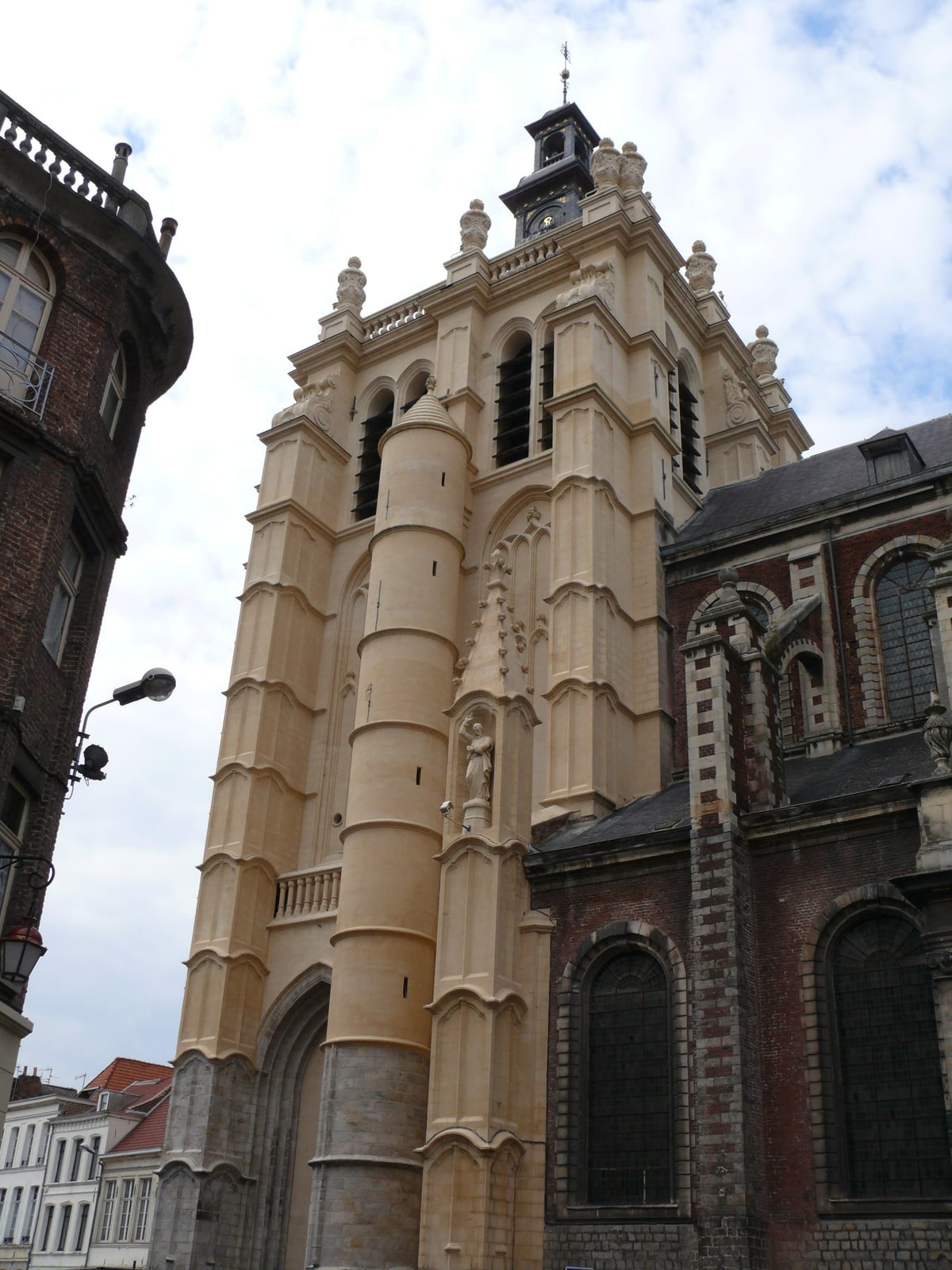
Saint-Pierre is now the proper pilgrim destination. The present building is an immense eighteenth-century church—112 meters long according to the City of Douai—whose interior joins Flemish Gothic memory with seventeenth- and eighteenth-century classicism. Its artistic holdings include a monumental organ case from Anchin Abbey, now containing a Cavaillé-Coll organ. Yet its newest identity is explicitly Eucharistic: the 2026 diocesan decree names it a sanctuary because it is a place of adoration and pilgrimage connected to the Host of the 1254 tradition.
The devotion remains part of ordinary parish life. The parish’s current schedule lists a Thursday morning Mass of the Saint-Sacrement de Miracle in the Chapel of Notre-Dame des Miracles, continuous adoration from Wednesday morning through Friday evening in the Saint-Amé chapel, Sunday Masses, confession periods, and daily opening hours. These schedules can change, so pilgrims should use the parish page immediately before travel rather than treating any copied timetable as permanent.
The most meaningful visit joins three layers: the medieval testimony at vanished Saint-Amé, the custody and rediscovery history that brought the Host to Saint-Pierre, and the living Eucharistic worship of the present sanctuary. Pray at Mass or adoration before studying the historical material. Ask sanctuary staff whether and when the Host itself is exposed; a church being open does not mean the object is continuously visible.
Douai also belongs to the wider development of modern Eucharistic pilgrimage. The diocesan archive records a national Eucharistic pilgrimage here in 1875, before the first International Eucharistic Congress at nearby Lille in 1881. Today the sanctuary designation gives that old devotion a clear pastoral home. The page therefore treats Douai neither as an abandoned medieval anecdote nor as an object available on demand, but as a living diocesan sanctuary where history is ordered toward worship.
Enter Saint-Pierre as the living diocesan sanctuary of a devotion born at the vanished Saint-Amé: begin with Mass or adoration, then follow the testimony, rediscovery, and custody history without confusing the two churches.
The story & the place today
What happened here—and what a pilgrim can find now
Each record separates the devotional tradition from the present-day visitor evidence. A mapped locality remains visible even when an exact shrine or surviving object has not yet been verified.
The Host of the Miracle at Saint-Amé in Douai
During Eastertide Communion at the former Collégiale Saint-Amé, a consecrated Host was reported to rise from the floor to the purificator, after which clergy and faithful described manifestations of Christ. Thomas of Cantimpré recorded the received testimony.
Former Collégiale Saint-Amé, Douai (demolished after the French Revolution)
The Host traditionally identified with the 1254 event
Collégiale Saint-Pierre, Diocesan Sanctuary of the Most Holy Sacrament of the Miracle of Douai
Living thursday devotion and corpus christi observance
Visitor note: Active sanctuary; confirm exposition and veneration arrangements with the parish
Church wording: Diocesan Eucharistic sanctuary and long-standing pilgrimage devotion — Archbishop of Cambrai and Diocese of Cambrai
The event site at Saint-Amé no longer exists. The present Host was rediscovered at Saint-Pierre in 1854 and examined through a diocesan commission; later custody records include wartime safekeeping in 1940.
The sacred connection
People and objects remembered here
These relationships are part of the destination record, with feast days and catalog qualifications shown where available.
titular patron of the present collegiate church and diocesan sanctuary
Feast: June 29Venerated Eucharistic species · Received in the Diocese of Cambrai through the 1854 canonical inquiry and subsequent custody records; not independently scientifically dated by Catholic Tourist
Do not assume continuous exposition. Contact the sanctuary for the present manner and times of veneration, and obey all Blessed Sacrament and photography restrictions.What to notice
Look closely at the place and its story
A sanctuary named in 2026
Read Saint-Pierre through its new diocesan mission as a place of Eucharistic adoration and pilgrimage.
Saint-Amé and Saint-Pierre are not the same site
Hold together the demolished medieval event church and the present sanctuary without collapsing their histories.
The testimony of Thomas of Cantimpré
Follow the received account while preserving its varied descriptions of what witnesses perceived.
The 1854 inquiry and custody trail
Understand how the post-Revolution rediscovery, diocesan commission, and later safekeeping shape the object’s present reception.
Living Eucharistic worship
Join the sanctuary’s Mass and adoration rhythm rather than approaching only as a historical visitor.
Feasts, anniversaries & celebrations
How to read this page
Sources, tradition, and what is verified
The destination record was last checked on 9/29/2026.
This page records the site’s tradition as “Roman Catholic diocesan sanctuary, Eucharistic adoration, and pilgrimage.” That wording describes the nature of the claim and keeps devotional tradition distinct from independently verified history.
Continue nearby