Why pilgrims come
Encounter the Eucharistic tradition and its surviving evidence
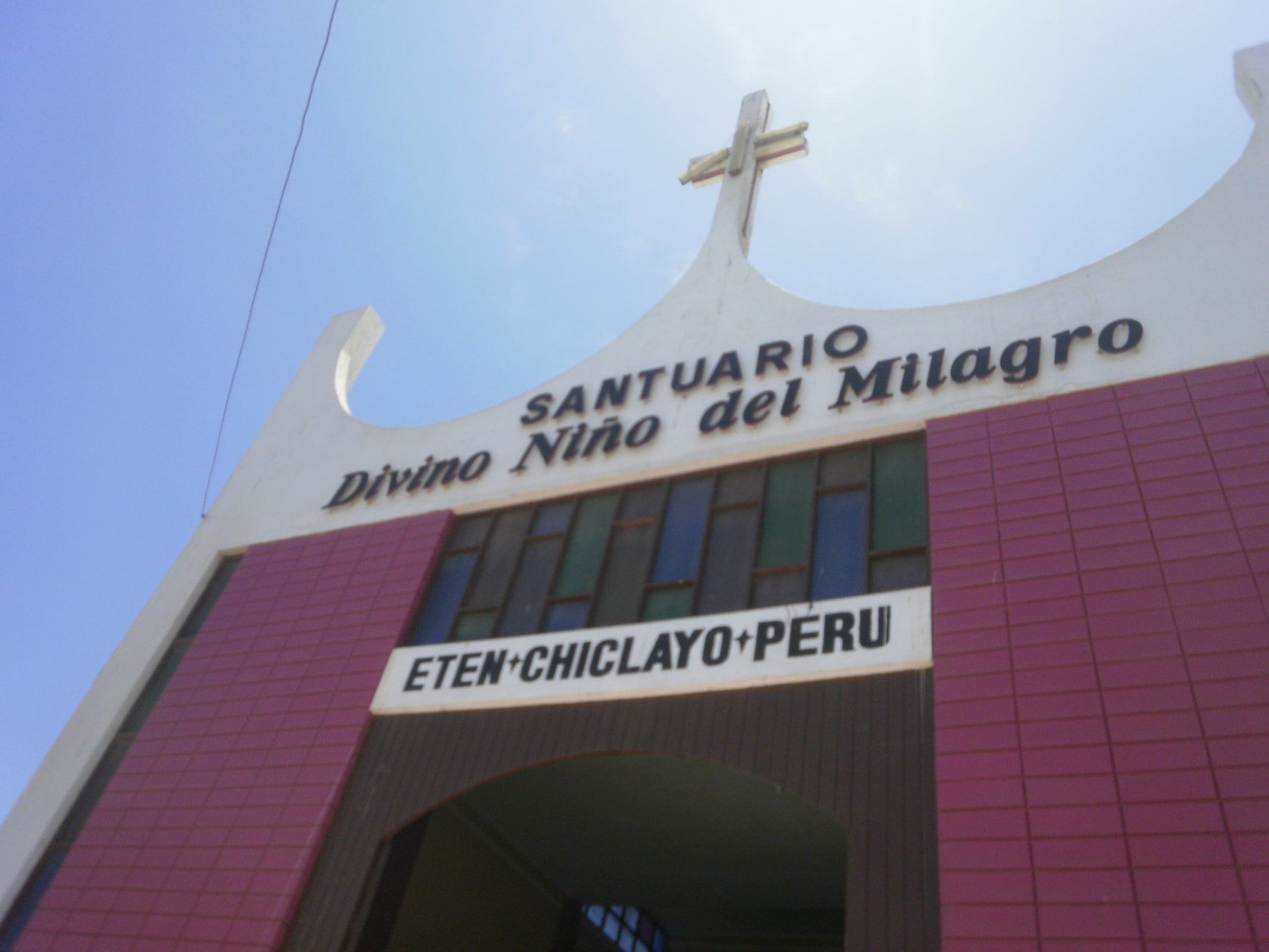
Eten’s Eucharistic pilgrimage has two connected places, and a useful destination page must not collapse them into one. The Santuario Divino Niño del Milagro stands at the old settlement near the coast, over and beside the remains of the colonial Franciscan church of Santa María Magdalena where the reported events of 1649 took place. The present parish church of Santa María Magdalena stands in Ciudad Eten’s main square and now keeps the devotional image around which the community’s worship and major celebrations are organized.
According to the Peruvian Episcopal Conference, the first reported event occurred on June 2, 1649, during the vigil of Corpus Christi. As the Eucharist was exposed before the gathered community, witnesses said that the figure of the Child Jesus appeared in the consecrated Host. The surviving account describes a child visible from the waist upward, with blond hair and a purple or dark-red garment. Bells and instruments sounded while the people acclaimed what they believed they had seen.
The report was not left only to later oral memory. The Episcopal Conference recounts that on June 25 the ecclesiastical judge Fernando de la Carrera y Daza, vicar of San Martín de Reque, arrived with a notary and witnesses to collect testimony. It points to forty-two folios preserved in the archive of the Franciscan Province of the Twelve Apostles of Peru. That archival trail is important evidence for the age of the tradition, but it should not be converted casually into a modern scientific test or a newly located universal Church decree.
A second reported manifestation took place on July 22, the feast of Eten’s patron St. Mary Magdalene. The Episcopal Conference describes priests reopening the tabernacle and exposing the Blessed Sacrament behind closed doors. Witness Marcos López said that the form of a child emerged within the Host and remained visible for about fifteen minutes. A later devotional account also describes three joined hearts. Catholic Tourist attributes those details to the received testimony rather than treating every visual description as independently established fact.
The church in which the events were reported no longer survives intact. Peru’s official tourism inventory explains that floods and coastal environmental change led the old community to move. Colonial remains, buried walls, and the footprint of the first Franciscan church remain around the current sanctuary. Archaeological work in 2009 found burials and painted colonial masonry beneath and around the site. The present chapel is therefore a memorial built over the historical location, not the original 1649 building preserved unchanged.
The same inventory distinguishes the current devotional object from the event itself. A later image of the Divino Niño del Milagro, donated in the twentieth century and framed in a monstrance-like setting, is now kept at Santa María Magdalena Parish in the city. Pilgrims should not describe that image as the consecrated Host of 1649. It is a devotional representation and focal point for prayer, processions, promises, thanksgiving, and the parish’s continuing Eucharistic life.
Current diocesan practice gives the tradition an unmistakably living ecclesial setting. The Peruvian Episcopal Conference reported that Bishop Robert Francis Prevost—now Pope Leo XIV—presided over pilgrimages and worked to make Eten better known as a Eucharistic city. It also reported annual pilgrimages, first-Saturday pastoral activity, and permission associated with plenary indulgences for participating pilgrims. In 2023 the diocesan administrator celebrated the second apparition’s anniversary with thousands of faithful at Santa María Magdalena Parish.
Those facts confirm active diocesan custody and public devotion; they do not remove the need for precise wording about formal recognition. This research pass did not locate the text of a canonical decree declaring the 1649 reports supernatural, nor did it verify a claim sometimes repeated online that Pope Innocent X personally certified them. The page therefore states what the Diocese of Chiclayo and the Peruvian Episcopal Conference presently celebrate and what the archival tradition reports, without enlarging those claims.
The calendar has two anchors. June 2 remembers the first reported manifestation and is associated with pilgrimage and Eucharistic worship. July 22 joins the second report to the feast of St. Mary Magdalene; the parish’s larger fair has run across part of July, but exact programs can change from year to year. Visitors should consult the parish before arranging travel around either celebration.
For the historical site, Peru’s tourism inventory currently lists free entry and daily visiting hours of 9:00 a.m.–6:00 p.m., while also describing an unpaved final approach and strong coastal sun. Treat those details as planning guidance, not a permanent promise. For Mass, confession, the devotional image, and festival information, contact Santa María Magdalena Parish directly. A complete pilgrimage visits both places: the old-site sanctuary to remember where the reports arose, and the living parish to encounter the community that carries the devotion today.
Make a two-stop pilgrimage: begin at the coastal sanctuary and archaeological remains marking the original 1649 church site, then pray with the living community and devotional image at Santa María Magdalena Parish in Ciudad Eten.
The story & the place today
What happened here—and what a pilgrim can find now
Each record separates the devotional tradition from the present-day visitor evidence. A mapped locality remains visible even when an exact shrine or surviving object has not yet been verified.
The two reported manifestations of the Child Jesus in the Host at Eten
The Peruvian Episcopal Conference reports manifestations of the Child Jesus in a consecrated Host on June 2 and July 22, 1649, at the former Franciscan church of Santa María Magdalena in old Eten, followed by ecclesiastical testimony-gathering in June 1649.
Former Franciscan church of Santa María Magdalena at old Eten, now marked by the Divino Niño del Milagro sanctuary
A later devotional image of the Divino Niño del Milagro is kept at the present parish; the Host of 1649 is not claimed to survive
Historical site at the Divino Niño del Milagro sanctuary; devotional image and principal liturgies at Santa María Magdalena Parish in Ciudad Eten
Annual june 2 and july 22 observances verified program varies
Visitor note: Two-stop pilgrimage; verify sanctuary access and parish liturgies separately
Church wording: Historic diocesan Eucharistic tradition with continuing public pilgrimage — Diocese of Chiclayo and Peruvian Episcopal Conference
The old church was lost after environmental change and settlement relocation. The modern sanctuary marks the event location, while a later image at the city parish carries the devotion. No formal supernatural decree text was located in this pass.
The sacred connection
People and objects remembered here
These relationships are part of the destination record, with feast days and catalog qualifications shown where available.
patron of Eten and titular patron of the historical and present parish churches
Feast: July 22What to notice
Look closely at the place and its story
The original-site sanctuary
Stand where the former Franciscan church and old settlement are remembered beneath and around the modern chapel.
The two dates of 1649
Keep the June 2 Corpus Christi vigil report and the July 22 St. Mary Magdalene report together without merging their witness accounts.
The archival testimony
Understand why the reported notarial inquiry and Franciscan archive matter while avoiding claims beyond the documents located.
The living parish devotion
Continue to Santa María Magdalena Parish, where the later devotional image and major liturgies are centered today.
A Eucharistic city in formation
See how diocesan pilgrimages, pastoral work, and plans for a larger sanctuary continue to shape Eten’s Catholic identity.
Feasts, anniversaries & celebrations
How to read this page
Sources, tradition, and what is verified
The destination record was last checked on 9/29/2026.
This page records the site’s tradition as “Roman Catholic diocesan pilgrimage and Eucharistic devotion.” That wording describes the nature of the claim and keeps devotional tradition distinct from independently verified history.
Continue nearby