Why pilgrims come
Encounter the Eucharistic tradition and its surviving evidence
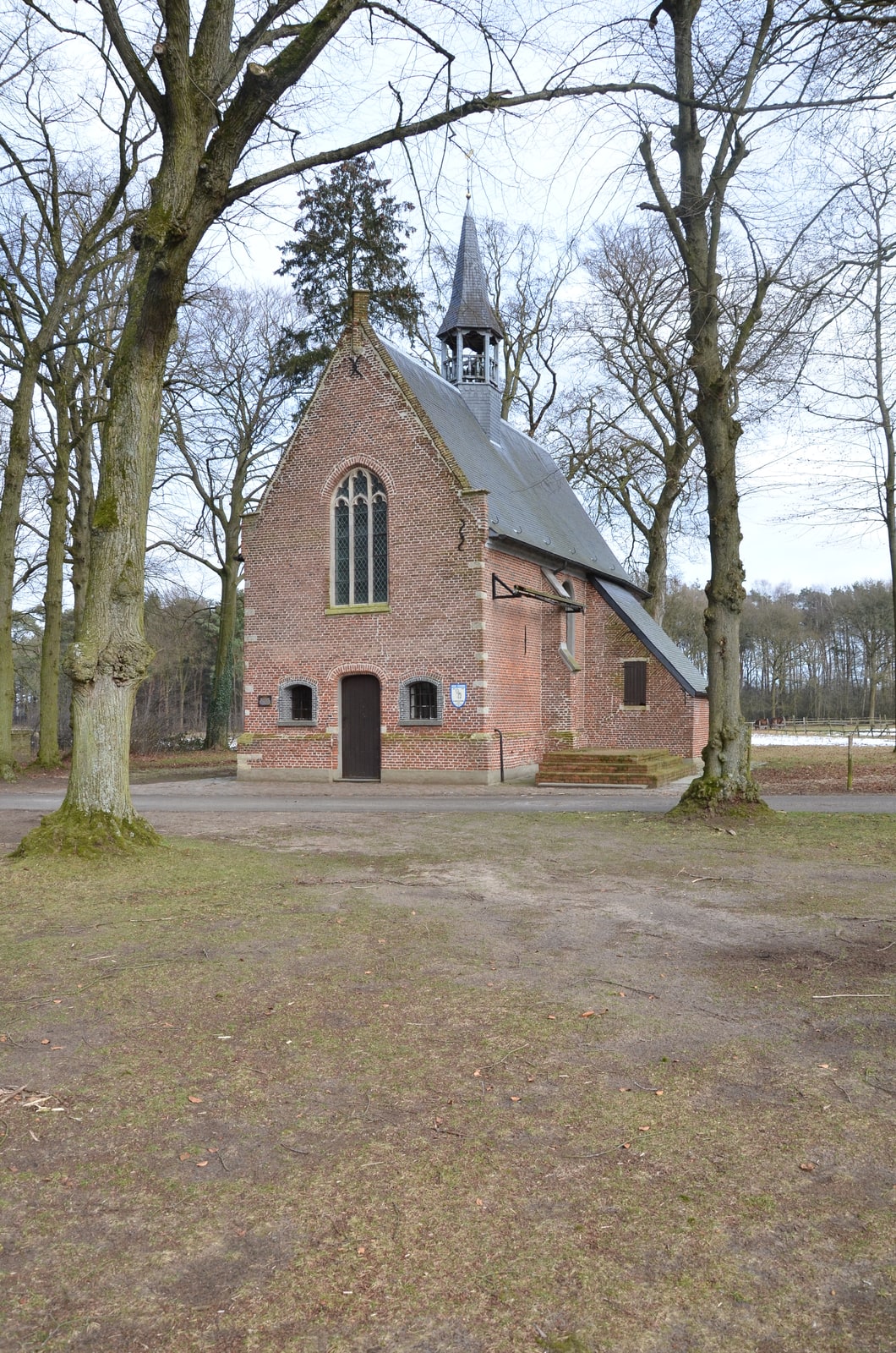
The Hegge Chapel in Poederlee is the precise pilgrimage destination behind the event often called the Eucharistic Miracle of Herentals. The older Catholic Tourist entry placed the pin in Herentals and said almost nothing beyond the year 1412. The full tradition moves through three places: a theft from the parish church of Wechelderzande, the recovery of five consecrated Hosts at De Hegge in Poederlee, and the arrest and judgment of the thief in Herentals. The late-Gothic chapel now standing among the trees marks the traditional recovery site.
According to the account preserved by the Municipality of Lille and the Hegge association, Jan van Langerstede stole a chalice and ciborium containing five consecrated Hosts in January 1412. He reportedly made his way toward Herentals but, near De Hegge, hid the Hosts in a rabbit burrow. After the stolen vessels were found in his possession, a magistrate questioned him. Facing execution, he disclosed the place where he had left the Eucharist and led clergy, officials, and townspeople back to the field.
The received tradition says the Hosts were recovered intact after exposure to winter weather and were found arranged in the form of a cross. Later retellings add radiance and other devotional details. Catholic Tourist presents these elements as the community’s centuries-old Eucharistic tradition, not as the conclusions of a modern scientific investigation. Even the oldest public summaries consulted differ on one small point: the Lille municipal history says the Hosts were found after eight days, while the Flemish intangible-heritage registry says seven days and nights. Rather than force false precision, this page preserves that difference openly.
The recovered Hosts were divided between the communities linked to the event. The heritage registry and the Church of St. Waldetrudis account say two went to Poederlee and three to St. Waldetrudis in Herentals. The Hegge association reports that the Hosts later disappeared during the iconoclasm of 1566. Pilgrims therefore come to a historic place of Eucharistic memory and prayer; the page does not promise that the miraculous Hosts survive or are available for veneration today.
The present chapel gives that memory a physical home. The Municipality of Lille calls it the oldest building in the municipality and says Jan van Vriesele, lord of Poederlee, commissioned it, with completion in 1442. The Flemish architectural inventory dates the core to the first half of the fifteenth century and records enlargement between 1442 and 1477. Damage during the sixteenth-century religious troubles was followed by restoration in the early seventeenth century, and a sacristy was added in 1672–1673.
Architecturally, the chapel is a compact late-Gothic brick building rather than a grand urban basilica. Its wooded setting and modest scale are part of its character. Inside, the protected heritage record highlights a Baroque high altar from 1685 and a painting representing the Hegge miracle. A nearby well also acquired a local reputation for healing. These later works show how the original account became embedded in the devotional landscape of Poederlee over generations.
The tradition remains living. An annual procession takes place on the Sunday after Corpus Christi, ordinarily moving from the parish church of Poederlee toward the chapel and concluding with prayer or an open-air Eucharistic celebration. The exact civil date changes each year, so Catholic Tourist does not hard-code a permanent date. The Hegge association and local programme should be checked for the current route, start time, and liturgical arrangements.
At wider intervals, Poederlee stages the great Hegge Ommegang. The Flemish intangible-heritage registry describes this large historical and religious procession as a twenty-five-year tradition, involving the local community in scenes that recount the event and its aftermath. The next grand Ommegang is expected in 2037. The scale of that observance makes clear that Hegge is not merely a story copied into a modern miracle catalogue; it is a local inheritance sustained by processions, art, volunteer stewardship, and communal memory.
The St. Carlo Acutis International Exhibition of Eucharistic Miracles includes Herentals among the Belgian accounts. That title explains why many modern summaries name only Herentals. A responsible pilgrimage page must go one step further: Herentals belongs to the history, but Hegge Chapel in Poederlee is the place to put on the map if the pilgrim wants to stand at the traditional recovery site.
Access should be planned rather than assumed. The chapel is actively cared for but does not publish dependable daily visiting hours. It opens for the annual procession, selected heritage events, and other announced occasions; groups may need to contact the local Hegge association or Lille tourism in advance. The site is not an ordinary museum with all-day admission, and worship or local preparations should take priority over sightseeing.
For a complete historical visit, begin with the Hegge Chapel and then consider the two related churches: the parish church at Wechelderzande, associated with the theft, and St. Waldetrudis in Herentals, associated with the investigation and the three Hosts traditionally taken there. Do not collapse those stops into one address. The strength of the Hegge pilgrimage is precisely that a regional story of wrongdoing, confession, recovery, reparation, and Eucharistic devotion can still be read across its real landscape.
Come with the right expectation. There is no surviving Host to inspect and no reason to treat the chapel as a curiosity cabinet. What remains is a protected fifteenth-century sanctuary, a local Catholic community that still walks in procession after Corpus Christi, and a tradition that has called generations to reverence for the Eucharist. The most fitting response is not sensationalism but prayer, historical attention, and gratitude for the people who have kept the chapel and its memory alive.
Visit the chapel at the traditional recovery site, then read the wider 1412 story across Wechelderzande, Poederlee, and Herentals without expecting a surviving miraculous Host.
The story & the place today
What happened here—and what a pilgrim can find now
Each record separates the devotional tradition from the present-day visitor evidence. A mapped locality remains visible even when an exact shrine or surviving object has not yet been verified.
Recovery of the five consecrated Hosts at De Hegge
The received local tradition says five consecrated Hosts stolen at Wechelderzande were hidden near De Hegge and later recovered intact. Public sources differ between seven nights and eight days; later devotional accounts add the cross-shaped arrangement and radiance.
De Hegge in Poederlee, at the site of the present Hegge Chapel
Five consecrated Hosts in the received 1412 account
The chapel marks the traditional recovery site; the Hosts are not extant.
Annual procession after Corpus Christi; grand Hegge Ommegang every twenty-five years, next expected in 2037.
Visitor note: Protected chapel generally accessed for processions and announced openings; confirm with the custodian or municipality.
Church wording: Long-standing local Eucharistic miracle tradition and pilgrimage — The Catholic community of Poederlee and the continuing Hegge pilgrimage tradition
Theft at Wechelderzande, recovery in Poederlee, arrest and judgment in Herentals, and division of the Hosts between Poederlee and Herentals.
What to notice
Look closely at the place and its story
The precise recovery site
Stand at the chapel in Poederlee rather than the older generic Herentals map pin.
The three-place story
Distinguish the theft at Wechelderzande, recovery at De Hegge, and judicial and devotional links to Herentals.
Fifteenth-century chapel
Read the late-Gothic brick building, later restorations, Baroque altar, and miracle painting as layers of continuing devotion.
Annual Corpus Christi procession
Join the living pilgrimage on the Sunday after Corpus Christi only after confirming the current programme.
The Hegge Ommegang
Understand the community-wide procession held every twenty-five years, with the next expected in 2037.
Honest evidence boundaries
Honor the tradition while recognizing the source disagreement over duration and the loss of the Hosts in 1566.
How to read this page
Sources, tradition, and what is verified
The destination record was last checked on 9/30/2026.
This page records the site’s tradition as “Roman Catholic Eucharistic pilgrimage and the local Hegge tradition.” That wording describes the nature of the claim and keeps devotional tradition distinct from independently verified history.