Why pilgrims come
Enter a place shaped by prayer, community, and pilgrimage
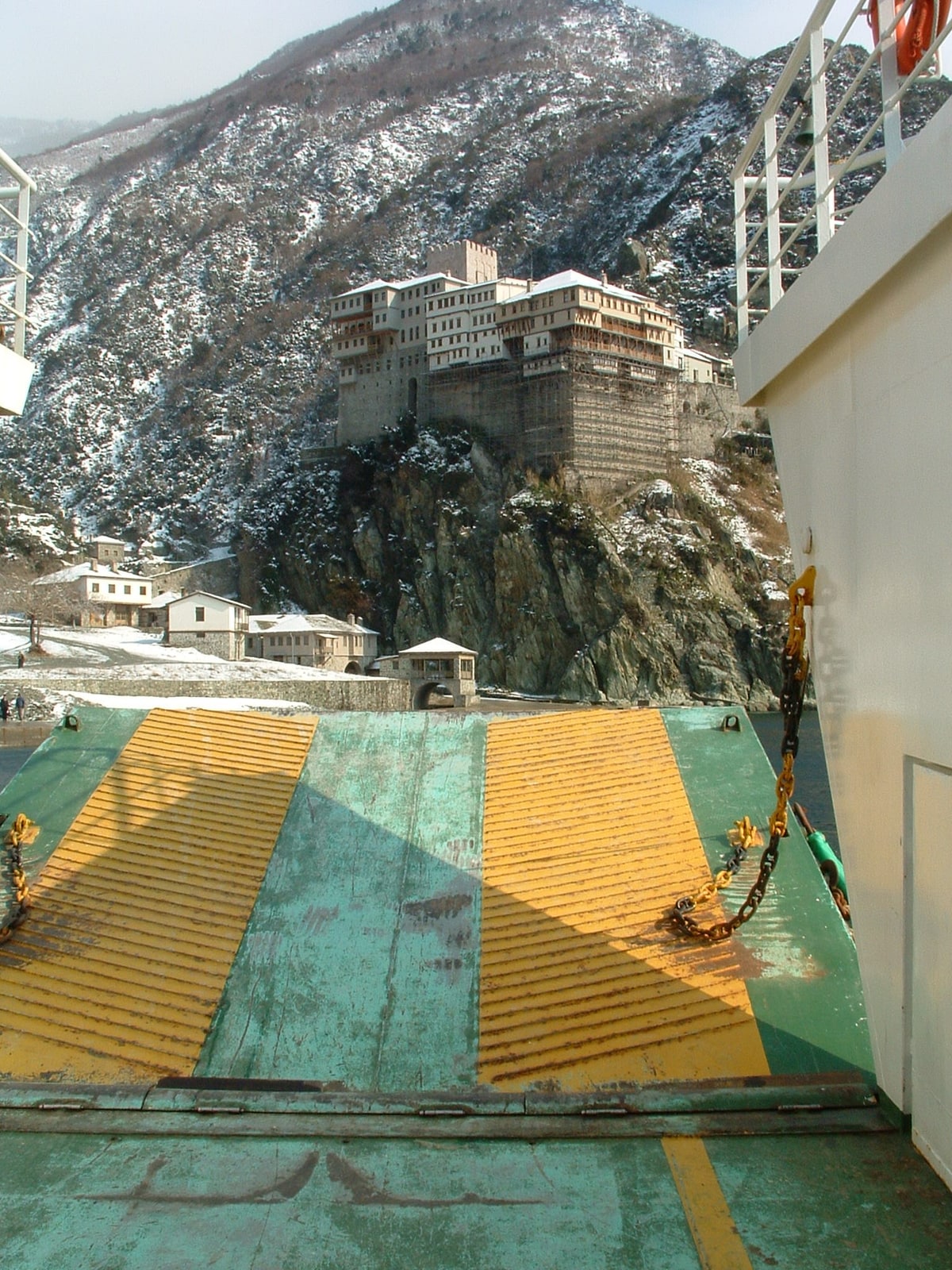
Dionysiou rises directly from the cliffs of Mount Athos, its compact buildings stacked above the Aegean like a fortress. The monastery is fifth in the traditional hierarchy of the twenty ruling Athonite monasteries and is dedicated to St. John the Baptist, whom Byzantine Christianity commonly calls the Forerunner. Its most important relic, according to the official Mount Athos digital pilgrimage, is the preserved right hand of St. John.
The relic connects the monastery to the Gospel figure whose whole life points away from himself. John baptized in the Jordan, called Israel to repentance, identified Jesus as the Lamb of God, and accepted martyrdom rather than make peace with a ruler's sin. A hand associated with the Baptist carries obvious symbolic force: the hand that gestures toward Christ, baptizes, blesses, and refuses to grasp for status. Pilgrims should approach the relic through that biblical vocation, not merely as an astonishing object.
The official Athonite presentation identifies the hand without claiming modern laboratory authentication. Catholic Tourist therefore records it as the right hand traditionally venerated and guarded by Dionysiou. The attribution belongs to the monastery's received ecclesiastical tradition and continuous liturgical custody. That is meaningful historical and devotional evidence, but it is different from scientific proof of personal identity.
The monastery was founded in the fourteenth century by St. Dionysios of Korisos with imperial support from Alexios III of Trebizond. Its katholikon is dedicated to the Nativity of St. John the Baptist. The church and chapels preserve major Byzantine and post-Byzantine art, manuscripts, liturgical vessels, icons, and relics. The cliffside architecture is not a picturesque shell around a museum: it is the home of an active brotherhood whose prayer orders every aspect of a visitor's stay.
Dionysiou is not an ordinary sightseeing destination. Entry to Mount Athos is governed by the Holy Community and requires a diamonitirion permit collected in Ouranoupolis. Current official guidance says reservations may be made months ahead, permits are date-specific and normally valid for four days, and non-Orthodox permits are limited. The monastery must also confirm overnight hospitality separately; the Mount Athos permit does not itself reserve a bed.
The Athonite avaton permits only male visitors, including minors under the published conditions, to enter the peninsula. Women cannot enter Mount Athos under the present rule. Women and families can still encounter the Holy Mountain from licensed coastal cruises that remain outside Athonite waters, and they can use the official digital pilgrimage to learn about Dionysiou and the relic. Catholic men may apply as non-Orthodox pilgrims, but should state their identity honestly and follow the monastery's Orthodox worship and hospitality rules. Eucharistic communion is governed by Orthodox discipline and should never be presumed.
The journey typically begins at Ouranoupolis by boat, continues along the western coast, and may involve a landing, transfers, steep paths, and stone stairs. Dress modestly, travel lightly, obey photography restrictions, and expect the monastery's schedule—not a tourist timetable—to shape the visit. Hospitality is traditionally offered without a hotel charge, though donations are customary and space must be reserved. Video recording is prohibited by current visitor guidance.
For those able to make the pilgrimage, Dionysiou belongs within the Catholic Tourist “Holy Mountains” route as an ecumenically significant witness to Christian monasticism and devotion to the Forerunner. The right way to arrive is with repentance, patience, and gratitude. The relic's meaning is clearest when it leads beyond itself to John's words: Christ must increase, and I must decrease.
Enter an active Athonite brotherhood dedicated to the Forerunner, where the right hand traditionally associated with St. John the Baptist is guarded within a life of prayer.
The sacred connection
People and objects remembered here
These relationships are part of the destination record, with feast days and catalog qualifications shown where available.
monastery patron; right hand traditionally preserved and venerated here
Feast: June 24fourteenth-century founder of the monastery
Feast: June 25Bodily relic — hand · Received Athonite and monastic tradition; officially identified by Mount Athos, not scientifically authenticated
Veneration depends on the monastic schedule and the visitor’s lawful admission to Mount Athos; never assume a private showing.What to notice
Look closely at the place and its story
The hand of the Forerunner
Venerate the right hand traditionally associated with St. John the Baptist within the monastery that claims it as its greatest relic.
A cliff above the Aegean
Approach one of Athos’s most dramatic monasteries as a living brotherhood, not a scenic hotel or museum.
The Nativity katholikon
Pray in a church dedicated to the birth of the saint who prepared the way for Christ.
A pilgrimage with real limits
Plan around the diamonitirion, avaton, monastery reservation, Orthodox discipline, and fragile mountain terrain.
Feasts, anniversaries & celebrations
How to read this page
Sources, tradition, and what is verified
The destination record was last checked on 9/29/2026.
This page records the site’s tradition as “Eastern Orthodox Athonite monastery dedicated to the Nativity of St. John the Baptist.” That wording describes the nature of the claim and keeps devotional tradition distinct from independently verified history.