Why pilgrims come
Meet the Catholic history preserved at this place
The Paris entry in St. Carlo Acutis’s Eucharistic-miracles exhibition points toward a real place, a real medieval cult, and a real history of violence—but those three realities must not be confused. The precise surviving site is the Church and Cloister of Les Billettes at 24 Rue des Archives, not a generic pin in central Paris. The property is no longer a Catholic shrine. It has served a Lutheran congregation since 1808, and the medieval cloister and eighteenth-century church are protected French monuments.
The received Catholic story says that at Easter in 1290 a Christian woman obtained a consecrated Host and delivered it to a Jewish moneylender. Later versions name the man and describe him piercing, striking, burning, and boiling the Host. The Host was said to bleed, resist destruction, rise from the water, or take the appearance of the crucified Christ. A woman then carried it to the parish priest of Saint-Jean-en-Grève.
Catholic Tourist records that narrative as a medieval devotional tradition and host-desecration accusation, not as a verified account of Jewish conduct. The distinction is not cosmetic. A Jewish man was accused, condemned, and burned. The story became a model for a wider class of anti-Jewish host-desecration tales in which a Jewish character reenacts the Passion against the Eucharist and is then exposed and killed. Historian Miri Rubin describes the pattern as a powerful medieval accusation whose narrative conclusion was punishment and often violence against Jews.
The surviving sources establish the growth of the tradition more securely than they establish the alleged supernatural event. A bibliographical notice in the Société de l’histoire de France identifies an early account written after 1299 and notes that contemporary chroniclers reported both the accusation and supposed miracles. The French Ministry of Culture catalogs an early-sixteenth-century manuscript that contains a longer relation of the “miracle of the holy Host” in the house on Rue des Jardins. These documents show that the story circulated and acquired liturgical, artistic, and institutional form. They do not give a modern investigator access to the event itself.
The vocabulary used by responsible sources reflects that limit. France’s official monument register says the Billettes site originated in the “legend of the miracle of the Holy Host.” The Protestant Museum says the first chapel was erected in memory of a miracle concerning a Host that “would have” escaped boiling water. Catholic Tourist therefore does not turn the accusation’s details into declarative biography, repeat the condemned man’s alleged motives as fact, or use medieval images as proof.
This responsible boundary also follows Catholic teaching. In Nostra aetate, the Second Vatican Council rejected hatred, persecution, and antisemitism directed against Jews at any time and insisted that Jews must not be presented as rejected or accursed by God. The Catechism likewise says that responsibility for Christ’s Passion cannot be laid on Jews indiscriminately. A Catholic page can discuss medieval Eucharistic devotion while clearly naming the anti-Jewish harm carried by this story.
The physical history begins shortly after the accusation. A chapel was built on the Rue des Jardins site in 1294 and became a popular place of pilgrimage. The Brothers of the Charity of Our Lady, later called the Billettes, served there from the end of the thirteenth century. Pilgrim gifts helped support a larger church in 1405, and a cloister followed in 1427.
That cloister is the strongest medieval survival. The present Lutheran congregation and the Protestant Museum identify it as the only medieval cloister still visible in Paris. Its pointed arcades and ribbed galleries preserve the scale of the former religious house even though the first chapel and later Gothic church have disappeared.
Carmelites assumed the site in 1633. The current church was built between 1754 and 1758, with a neoclassical façade and a nave bordered by two levels of galleries. France’s monument register dates the surviving cloister to the fifteenth century and the church to the eighteenth. The City of Paris completed a major restoration of roofs, façades, stained glass, and the cloister in 2023 after archaeological work beneath the nave revealed a filled crypt and fragments from earlier phases.
The Revolution ended Catholic possession. The church and convent were sold, and in 1808 Napoleon authorized the City of Paris to acquire the property for the Lutheran consistory. The present congregation belongs to the United Protestant Church of France. Visitors must therefore respect this as a living Lutheran church, not enter expecting Catholic Mass, Eucharistic adoration, a relic chapel, or a continuation of the old reparation cult.
The Host associated with the medieval tradition was not ordinarily kept at Les Billettes. Later Catholic accounts place it at the nearby parish church of Saint-Jean-en-Grève. That church was sold during the Revolution and demolished around the turn of the nineteenth century. No authoritative source reviewed for this page establishes that the Host, knife, or another first-generation miracle object survives in Paris today. Catholic Tourist lists no relic and promises no veneration.
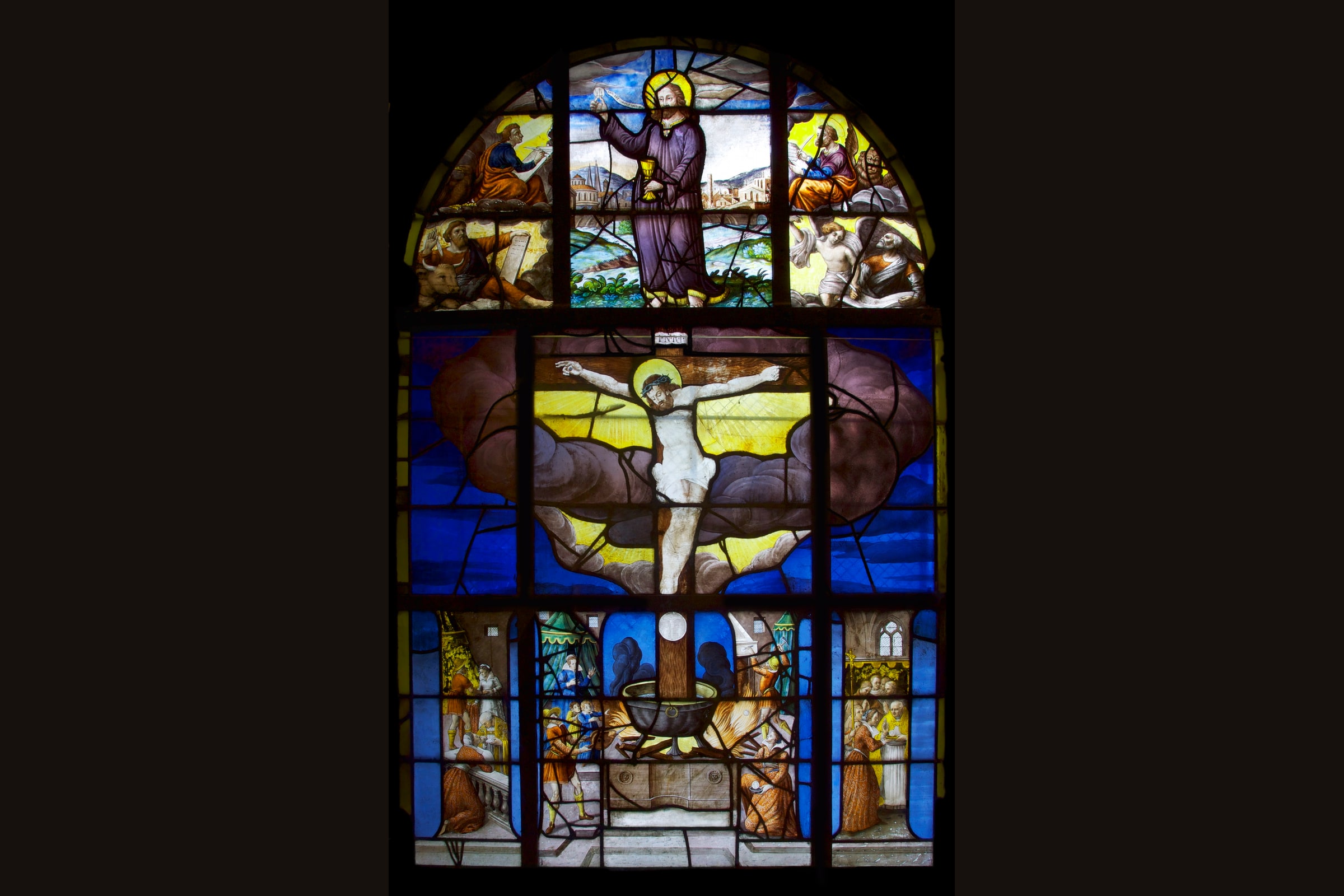
The best surviving Catholic interpretive object is at Saint-Étienne-du-Mont, about two kilometers south in the Latin Quarter. Its Chapel of the Catechisms preserves a large early-seventeenth-century painted-glass window narrating the Billettes story. The Archdiocese of Paris identifies Saint-Étienne as an active Catholic church with an exceptional ensemble of sixteenth- and seventeenth-century stained glass. The window reveals how later Catholics pictured the tradition; it is artistic evidence for memory, not eyewitness evidence for 1290.
This gives the visit two distinct stops. Begin at Les Billettes to encounter the actual site where the medieval chapel and cult developed, the surviving cloister, and the building’s later Lutheran life. Then visit Saint-Étienne-du-Mont to study the narrative window within an active Catholic church. Do not collapse the two places: Les Billettes is the historical site; Saint-Étienne holds the most important surviving Parisian Catholic image of the tradition.
A third geographic layer is the lost Saint-Jean-en-Grève, formerly near the Hôtel de Ville and the present Church of Saint-Gervais. Nothing resembling the original relic shrine remains there. Its disappearance is part of the history: the page concerns a tradition whose original church and reported object were lost, while architecture and art survived elsewhere.
Les Billettes does not publish dependable daily tourist hours. The congregation celebrates Lutheran worship and hosts concerts and exhibitions, while cloister access follows its current program. Check the official parish site before travel. At Saint-Étienne-du-Mont, consult the parish or Archdiocese of Paris for current opening, Mass, confession, and access to the Chapel of the Catechisms; a church being open does not guarantee that every chapel is accessible.
The image on this page is the surviving Billettes narrative window at Saint-Étienne-du-Mont, not the lost Host. Its scenes include imagery that can wound when detached from history. Catholic Tourist presents it to explain how a medieval accusation was transmitted, why the cult shaped two Paris churches, and why modern Catholic interpretation must unite Eucharistic reverence with truth, repentance, and friendship with the Jewish people.
Seen this way, the Paris entry becomes more serious than a sensational miracle claim. It is a pilgrimage through devotion, memory, art, accusation, punishment, loss, and changed custody. The faithful response is neither erasure nor credulity: pray with reverence for the Eucharist, refuse inherited antisemitism, mourn the man killed under the accusation, and read the surviving places in the light of the Church’s unequivocal rejection of hatred against Jews.
Read the actual Billettes site and its surviving medieval cloister together with the narrative window at Catholic Saint-Étienne-du-Mont, holding Eucharistic reverence and the Church’s rejection of antisemitism together.
The story & the place today
What happened here—and what a pilgrim can find now
Each record separates the devotional tradition from the present-day visitor evidence. A mapped locality remains visible even when an exact shrine or surviving object has not yet been verified.
The Eucharistic tradition associated with Paris
Catholic Tourist maps Paris as the geographical setting of a Eucharistic tradition documented in the St. Carlo Acutis exhibition. The place-specific historical and visitor audit is still in progress; this account records a devotional tradition rather than making an independent ecclesial, historical, or scientific judgment.
Paris, France; precise church or event location awaiting verification
Still being researched
No present-day veneration site has yet been verified
Still being researched
Visitor note: The mapped point represents the associated locality, not confirmed church access.
Church wording: Documented in the St. Carlo Acutis exhibition; no separate Church judgment has yet been verified for this catalog record. — Recognition wording awaiting a place-specific Church-source audit
This pin preserves the geographical and devotional history while the exact event site, any surviving object, and current public commemoration are researched. It should not be read as confirmation that an active shrine exists at the pin.
What to notice
Look closely at the place and its story
The exact historic site
Stand at the Rue des Archives property where the first commemorative chapel was built in 1294.
Paris’s surviving medieval cloister
Read the fifteenth-century Billettes cloister as the principal architectural survival of the former Catholic pilgrimage house.
Changed Christian custody
Recognize that the current church is Lutheran and has carried its own worship and cultural life since 1808.
The Saint-Étienne window
Continue to the Catholic church that preserves the most important surviving Parisian image of the Billettes narrative.
Truthful Jewish-Christian memory
Confront the anti-Jewish accusation and execution through the Church’s modern rejection of antisemitism.
How to read this page
Sources, tradition, and what is verified
The destination record was last checked on 9/29/2026.
This page records the site’s tradition as “Medieval Catholic Eucharistic cult and host-desecration accusation; present Lutheran custody; Catholic artistic memory at Saint-Étienne-du-Mont.” That wording describes the nature of the claim and keeps devotional tradition distinct from independently verified history.
Continue nearby