Why pilgrims come
Discover what makes Notre-Dame Basilica of Montréal a place of pilgrimage
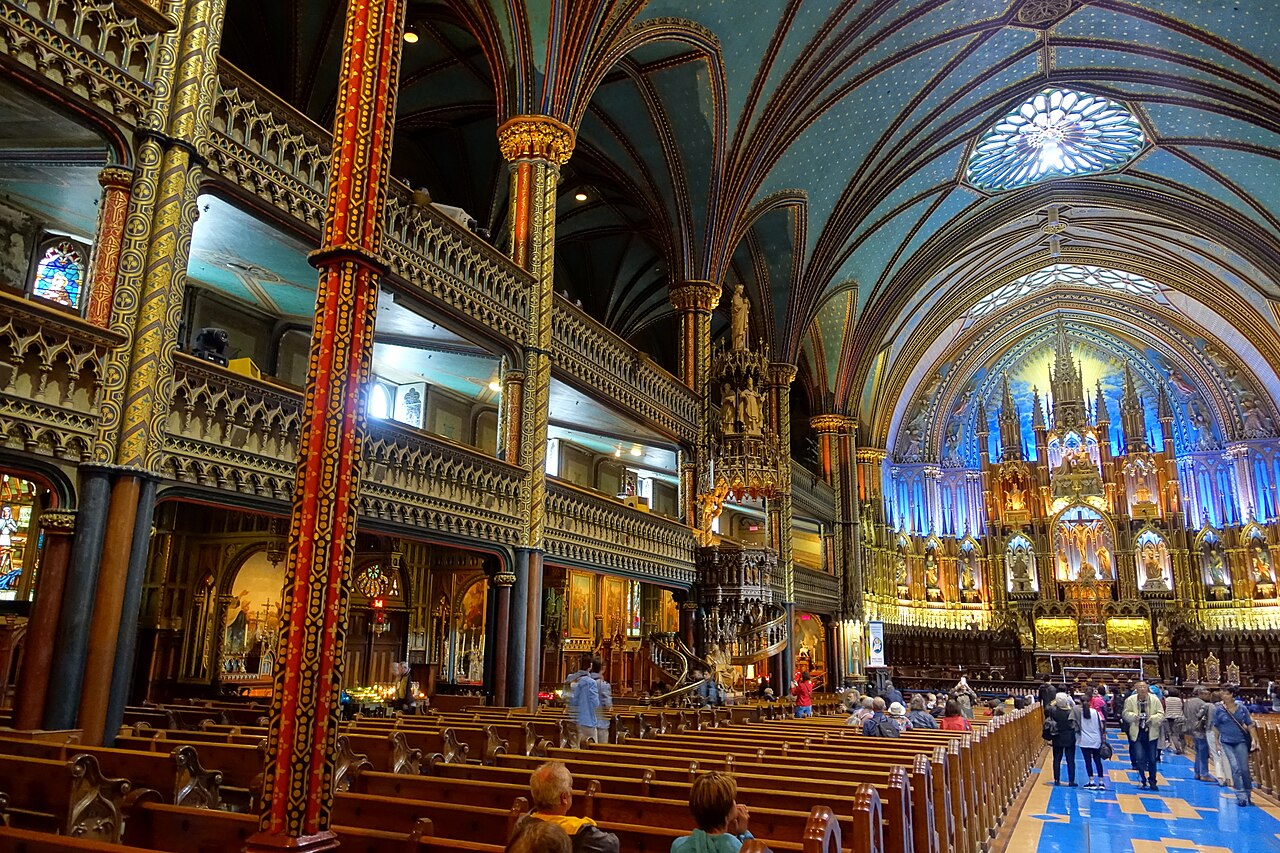
Built from 1824 to 1829, Notre-Dame is Montréal’s historic mother church and the first Gothic Revival church in Canada. Designed by Irish-born New York architect James O’Donnell for a congregation that had outgrown the seventeenth-century parish church, it was the largest place of worship in North America until 1879. Its famous blue-and-gold sanctuary, narrative stained glass, monumental Casavant organ and Chapel of Notre-Dame du Sacré-Cœur make it both a landmark of Canadian architecture and a living place of Catholic worship.
Begin Old Montréal at the Catholic church inseparable from the city’s own history. The first Notre-Dame opened in 1683, but by 1819 it could hold only 3,000 of the parish’s 15,000 worshippers. James O’Donnell’s far larger church rose in just 35 working months between 1824 and 1829; its twin towers followed in 1841 and 1843. O’Donnell, originally a Protestant, converted to Catholicism before his death in 1830 and is buried in the basilica crypt. Enter today for prayer as well as architecture: the building remains an active parish even while it welcomes visitors from around the world.
What to notice
Look closely at the place and its story
Canada’s first Gothic Revival church
James O’Donnell designed the new Notre-Dame to hold about 8,000 worshippers. Built between 1824 and 1829, it was then the largest place of worship in North America; the west tower, Perseverance, was completed in 1841 and the east tower, Temperance, in 1843.
The blue-and-gold sanctuary
The exterior is comparatively sober, but Victor Bourgeau’s 1870–1900 interior transformation drew inspiration from Paris’s Sainte-Chapelle, filling the sanctuary with carved wood, rich color, gold-leaf motifs and a starry blue vault.
Windows that tell Montréal’s story
Installed for the church’s 1929 centennial, the ground-floor stained-glass windows portray the religious history of Ville-Marie and notable parishioners rather than functioning only as a conventional biblical cycle.
The great Casavant organ
Completed by Casavant Frères in 1891, the monumental four-manual instrument now has 7,000 pipes and 92 ranks. Its scale and the basilica’s acoustics remain central to Notre-Dame’s musical life.
Chapel of Notre-Dame du Sacré-Cœur
Opened in 1891 for smaller ceremonies, the chapel was devastated by fire in 1978 and reopened in 1982. Its reconstructed historic lower levels rise beneath a modern vault and Charles Daudelin’s 20-tonne bronze altarpiece; today it is used for daily Masses, adoration, meditation, and private ceremonies.
A basilica that is still a church
Pope St. John Paul II raised Notre-Dame to the rank of minor basilica in 1982. Choose Mass, confession or adoration when possible so the visit remains a pilgrimage, not only an encounter with a celebrated interior.
How to read this page
Sources, tradition, and what is verified
The destination record was last checked on 9/29/2026.
This page records the site’s tradition as “Catholic.” That wording describes the nature of the claim and keeps devotional tradition distinct from independently verified history.
Continue nearby