Why pilgrims come
Encounter the Eucharistic tradition and its surviving evidence
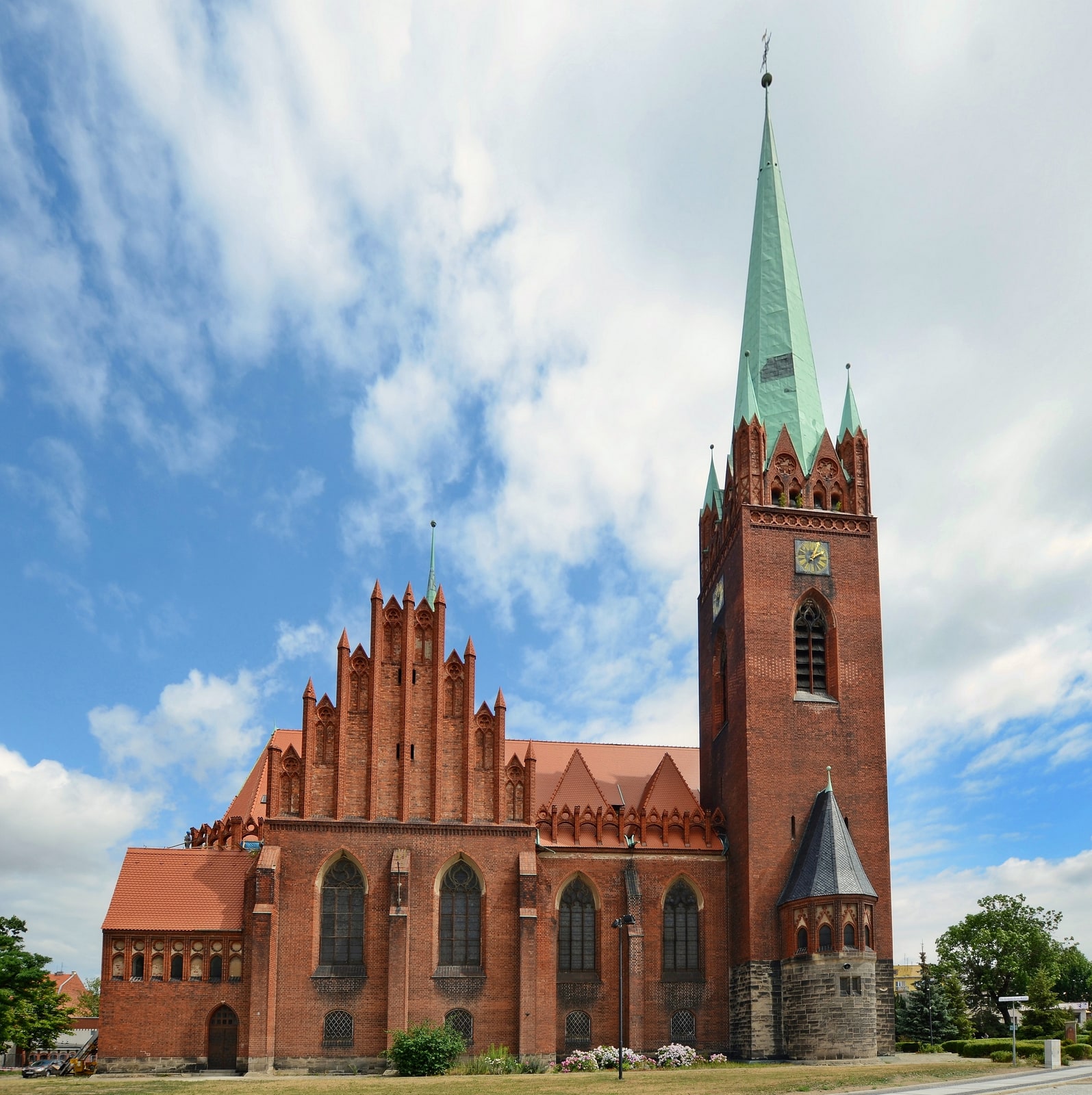
Legnica’s Eucharistic destination is not a museum label or a generic point in the city. It is the active Sanctuary of St. Hyacinth on Nadbrzeżna Street, beside the Kaczawa River. The parish celebrates Mass every day, hears confessions, maintains a twenty-four-hour adoration chapel, receives organized pilgrimages, and permits prayer before the material associated with the 2013 event during the sanctuary’s published opening hours.
The event began during Mass on Christmas Day, December 25, 2013. A consecrated Host fell to the floor while Communion was being distributed. It was recovered and placed in a vessel of water, following the Church’s procedure when a consecrated Host cannot be consumed. After some time, a red discoloration appeared. Later parish and exhibition accounts attach slightly different January dates to the first observation, so this page follows the diocesan communiqué’s more careful wording rather than inventing a precision the primary public statement does not provide.
Bishop Stefan Cichy, then Bishop of Legnica, appointed a commission to observe the phenomenon. The official communiqué states that in February 2014 a fragment of the red-colored material was separated and placed on a corporal. The commission then commissioned sampling and examination by competent institutions. Popular summaries sometimes give a more exact sampling day, but they do not agree; February 2014 is the date stated by the bishop’s published text.
The communiqué reports that a forensic-medicine opinion described fragmented portions of striated muscle whose overall image was most similar to heart muscle, with changes often accompanying agony. It also reports that genetic testing indicated human origin. These are the findings as quoted by the diocesan authority. Catholic Tourist has not inspected the complete raw laboratory reports, chain-of-custody documentation, slides, or underlying datasets and therefore does not present an independent scientific conclusion.
The ecclesial wording requires equal care. On April 10, 2016, Bishop Zbigniew Kiernikowski publicly announced that the event “ma znamiona cudu eucharystycznego”—literally, that it has the signs, characteristics, or hallmarks of a Eucharistic miracle. He wrote that he had presented the case to the Congregation for the Doctrine of the Faith and, following recommendations of the Holy See, directed the pastor to prepare a suitable place where the material could be displayed for veneration and where pilgrims could receive sound Eucharistic catechesis.
That statement is a substantial diocesan act, but it should not be inflated into a claim that the Holy See issued a separate public decree formally declaring a miracle. “Following recommendations of the Holy See” and “formally approved by the Vatican” are not interchangeable statements. This page preserves the bishop’s actual recognition boundary: the event has the hallmarks of a Eucharistic miracle, the material may be publicly venerated, and catechesis and the recording of reported graces were ordered.
On July 2, 2016, Bishop Kiernikowski led the public presentation of the material. Diocesan Catholic reporting describes adoration at Legnica Cathedral followed by a procession to St. Hyacinth’s and a gathering of thousands. The material is now presented in a chapel in the church’s left aisle. The sanctuary calls it the Relic of the Eucharistic Event and, in its pilgrim information, the Relics of the Body of the Lord. Catholic Tourist uses those custodial names while making clear that the object is the red-colored material separated from the Host, not an ordinary saint’s bodily relic.
July 2 has become a local anniversary of public veneration. Reports from multiple years describe an anniversary Mass and returning pilgrim groups, including a group from Kalisz. Because schedules can change, the date belongs in the pilgrimage calendar as an annual local Eucharistic observance to confirm with the sanctuary, not as a universal feast or an unconditional promise of a special program every year.
The sanctuary’s patron adds another Eucharistic dimension. St. Hyacinth, or Jacek Odrowąż, was a thirteenth-century Polish Dominican missionary traditionally remembered for carrying the Eucharist and an image of the Virgin to safety during danger at Kyiv. His August 17 patronal observance long predates the Legnica event. The saint’s story and the 2013 event are related in the sanctuary’s spiritual interpretation, but they are historically distinct and should never be collapsed into one narrative.
The building itself also has a layered identity. It began as the Kaiser Friedrich Memorial Church in the city’s Protestant landscape and was transferred for Catholic use after the Second World War. Church records describe its 1948 dedication to St. Hyacinth and its neo-Gothic character. That history makes the sanctuary a witness not only to the recent event but also to the demographic upheaval, displacement, and rebuilding of Catholic parish life in postwar Legnica.
The present destination is unusually visitable for a site of this kind. The sanctuary currently publishes opening hours of 6:30 a.m.–7:00 p.m. Monday through Friday, 8:15 a.m.–7:00 p.m. Saturday, and 7:00 a.m.–7:00 p.m. Sunday. The material can be venerated during those hours. The adjoining adoration chapel, entered from the river side, is advertised as open continuously, twenty-four hours a day.
The published Mass schedule is 7:00 a.m., noon, and 6:00 p.m. on weekdays; 9:00 a.m., noon, and 6:00 p.m. on Saturdays; and 8:00 a.m., 10:30 a.m., noon, and 6:00 p.m. on Sundays and holy days. Confession is offered thirty minutes before Masses and during them, with a shorter fifteen-minute lead on Sundays. These details were checked on September 29, 2026, but every pilgrim should recheck the first-party site before traveling.
Organized groups are asked to register in advance. The sanctuary says registration helps it provide a priest to explain the event, offer catechesis, and help arrange a group Mass when appropriate. It also describes a Pilgrim Haven where a group may request coffee or tea and assistance arranging a meal. Those practical provisions make advance contact particularly worthwhile rather than merely bureaucratic.
During Mass, the sanctuary specifically asks visitors not to move through the church and disturb worshippers. Modest dress and a prayerful manner are requested. Do not treat the chapel as a scientific display, touch the reliquary, or assume close photography is permitted. The ordinary Blessed Sacrament in the perpetual-adoration chapel and the material connected with the 2013 event are two distinct objects of devotion and should not be confused.
A responsible visit begins with the ordinary Eucharistic life of the parish: attend Mass if possible, make use of confession, or spend time in adoration. Then read the bishop’s communiqué before approaching the left-aisle chapel. Its restrained language prevents both sensationalism and dismissal. The point of the diocesan instruction was not simply to exhibit unusual matter, but to deepen Eucharistic faith through worship, information, and continuing catechesis.
Legnica is important precisely because the evidence and the boundaries can be named. There is a dated event in a surviving church, an official commission, published diocesan language, reported institutional findings, a bishop-authorized place of public veneration, a continuing anniversary, and a living sanctuary with extensive pilgrim provisions. There is also no basis here for Catholic Tourist to claim possession of the raw scientific record or a separate Vatican declaration that has not been published.
Presented that way, Legnica becomes more than a one-line “modern miracle.” It is a contemporary Catholic pilgrimage destination where visitors can distinguish event from interpretation, diocesan judgment from internet embellishment, and extraordinary claims from the ordinary Eucharistic worship that the bishop explicitly wanted the event to serve.
Pray in the living Sanctuary of St. Hyacinth, read the bishop’s careful communiqué, and distinguish the publicly venerated event material from the ordinary Blessed Sacrament in the sanctuary’s perpetual-adoration chapel.
The story & the place today
What happened here—and what a pilgrim can find now
Each record separates the devotional tradition from the present-day visitor evidence. A mapped locality remains visible even when an exact shrine or surviving object has not yet been verified.
The 2013 Eucharistic Event at St. Hyacinth’s Church
A consecrated Host fell during Communion, was placed in water, and later developed a red discoloration. A diocesan commission obtained samples, and the bishop’s communiqué reports forensic findings most similar to human heart muscle with changes often accompanying agony.
Church of St. Hyacinth, now the Sanctuary of St. Hyacinth, Legnica
Red-colored material separated from the Host and placed on a corporal in February 2014
Left-aisle chapel, Sanctuary of St. Hyacinth, Legnica
Annual july 2 anniversary reported confirm current program
Visitor note: Available for prayer during published sanctuary hours; groups should register and all liturgical and photography restrictions apply
Church wording: Has the hallmarks of a Eucharistic miracle; public veneration authorized by the diocesan bishop — Bishop Zbigniew Kiernikowski, Bishop of Legnica, April 10, 2016 communiqué
The diocesan communiqué reports examination by competent institutions and presentation of the case to the Congregation for the Doctrine of the Faith. It says the event has the hallmarks of a Eucharistic miracle and cites Holy See recommendations; no separate published Holy See declaration was identified.
The sacred connection
People and objects remembered here
These relationships are part of the destination record, with feast days and catalog qualifications shown where available.
patron of the sanctuary and Polish Dominican associated in tradition with Eucharistic devotion
Feast: August 17Venerated Eucharistic-event material · Authorized for public veneration by the Bishop of Legnica, who stated that the event has the hallmarks of a Eucharistic miracle; not independently scientifically authenticated by Catholic Tourist
Do not move around the church during Mass, touch the reliquary, or assume close photography is permitted. Organized groups should register in advance.What to notice
Look closely at the place and its story
The bishop’s exact boundary
Read the 2016 communiqué’s statement that the event has the hallmarks of a Eucharistic miracle without expanding it into an unpublished Vatican decree.
The left-aisle chapel
Pray before the material separated from the Host and placed under diocesan custody after the 2013 event.
Perpetual adoration
Continue from the extraordinary event to ordinary Eucharistic worship in the river-side chapel open around the clock.
St. Hyacinth’s patronage
Meet the Polish Dominican patron whose separate medieval tradition emphasizes protecting the Eucharist in danger.
A living pilgrimage church
Join daily Mass or confession and arrange group catechesis instead of treating the destination as a static exhibit.
Feasts, anniversaries & celebrations
How to read this page
Sources, tradition, and what is verified
The destination record was last checked on 9/29/2026.
This page records the site’s tradition as “Roman Catholic sanctuary, Eucharistic pilgrimage, and perpetual adoration.” That wording describes the nature of the claim and keeps devotional tradition distinct from independently verified history.
Continue nearby