Why pilgrims come
Discover what makes Sanctuary of St. Juliana of Cornillon — Birthplace of Corpus Christi a place of pilgrimage
Liège belongs in the St. Carlo Acutis collection, but not for the reason the old Catholic Tourist page implied. The exhibition panel headed “Corpus Christi — Liège, Belgium, 1374” does not describe a bleeding Host, a transformed species, or a relic created by a miracle in 1374. Its own text tells the earlier and better documented story of St. Juliana of Cornillon, the diocesan institution of the Feast of Corpus Christi in 1246, Pope Urban IV’s extension of the feast in 1264, and its renewed universal observance under Pope John XXII in 1317.
Catholic Tourist has therefore anchored this destination to the Sanctuary of St. Juliana of Cornillon at Rue de Robermont 2. This is the surviving place where Juliana lived, prayed, served the sick, and received the mystical insight that eventually helped give the universal Church the Solemnity of the Most Holy Body and Blood of Christ. The official sanctuary describes Mont-Cornillon as a place of prayer for more than eight centuries and identifies its medieval chapel as the center of the present complex.
Juliana was born near Liège around 1192 or 1193 and was orphaned young. She and her sister were entrusted to the women serving the leprosarium and hospice at Mont-Cornillon. That setting matters. Her Eucharistic spirituality grew within a community that combined prayer, common life, and care for people isolated by disease. She later became prioress, and the site’s history joins contemplation to practical mercy rather than treating her vision as a detached supernatural episode.
According to the tradition summarized by Pope Benedict XVI, Juliana repeatedly saw a brilliant full moon crossed by a dark line. She came to understand the moon as the Church’s liturgical year and the dark portion as the absence of a feast dedicated specifically to the Eucharist. She kept the experience private for years, then shared it with trusted churchmen and women, including the canon John of Lausanne, the recluse Blessed Eve of Saint-Martin, and Jacques Pantaléon of Troyes, then an archdeacon in Liège.
The decisive local act came in 1246. Bishop Robert de Thourotte introduced the Eucharistic feast in the Diocese of Liège after Juliana and her companions urged its adoption. St. John Paul II’s letter for the feast’s 750th anniversary explicitly dates that diocesan institution to 1246 and names Juliana, Eve, and other women of Liège as its advocates. The first celebration belonged to Liège before it became a feast for the whole Latin Church.
Jacques Pantaléon later became Pope Urban IV. On August 11, 1264, he issued the bull Transiturus de hoc mundo, extending the celebration of Corpus Christi to the universal Church. Benedict XVI noted that the bull alludes discreetly to Juliana’s mystical experiences and corroborates their authenticity. Urban also asked St. Thomas Aquinas to prepare the liturgical texts traditionally associated with the feast, including a theological and poetic inheritance still heard in Catholic worship.
The feast’s early reception was uneven after Urban IV died. Pope Benedict XVI explained that it continued in parts of Europe before Pope John XXII restored or confirmed its universal observance in 1317. This makes 1246, 1264, and 1317 the key dates. No first-party sanctuary, diocesan, or Vatican source reviewed for this page identifies a separate Eucharistic miracle at Liège in 1374.
That correction is important because the number 1374 was previously treated as though it named an event. It does not fit the chronology printed on the St. Carlo exhibition panel itself. Catholic Tourist retains the page in the Carlo Acutis collection because the panel is part of that international exhibition and because the present sanctuary owns and displays the exhibition. But the classification is now Eucharistic heritage and liturgical history, not a claimed material miracle.
Nor should the panel’s photograph of a monstrance be misread as a surviving “miracle relic” from 1374. The sanctuary has a living tradition of Mass, adoration, and Eucharistic devotion, but Catholic Tourist found no authoritative evidence for a surviving Host, corporal, or other object tied to a distinct 1374 miracle in Liège. The page therefore lists no such relic and makes no claim of diocesan recognition for one.
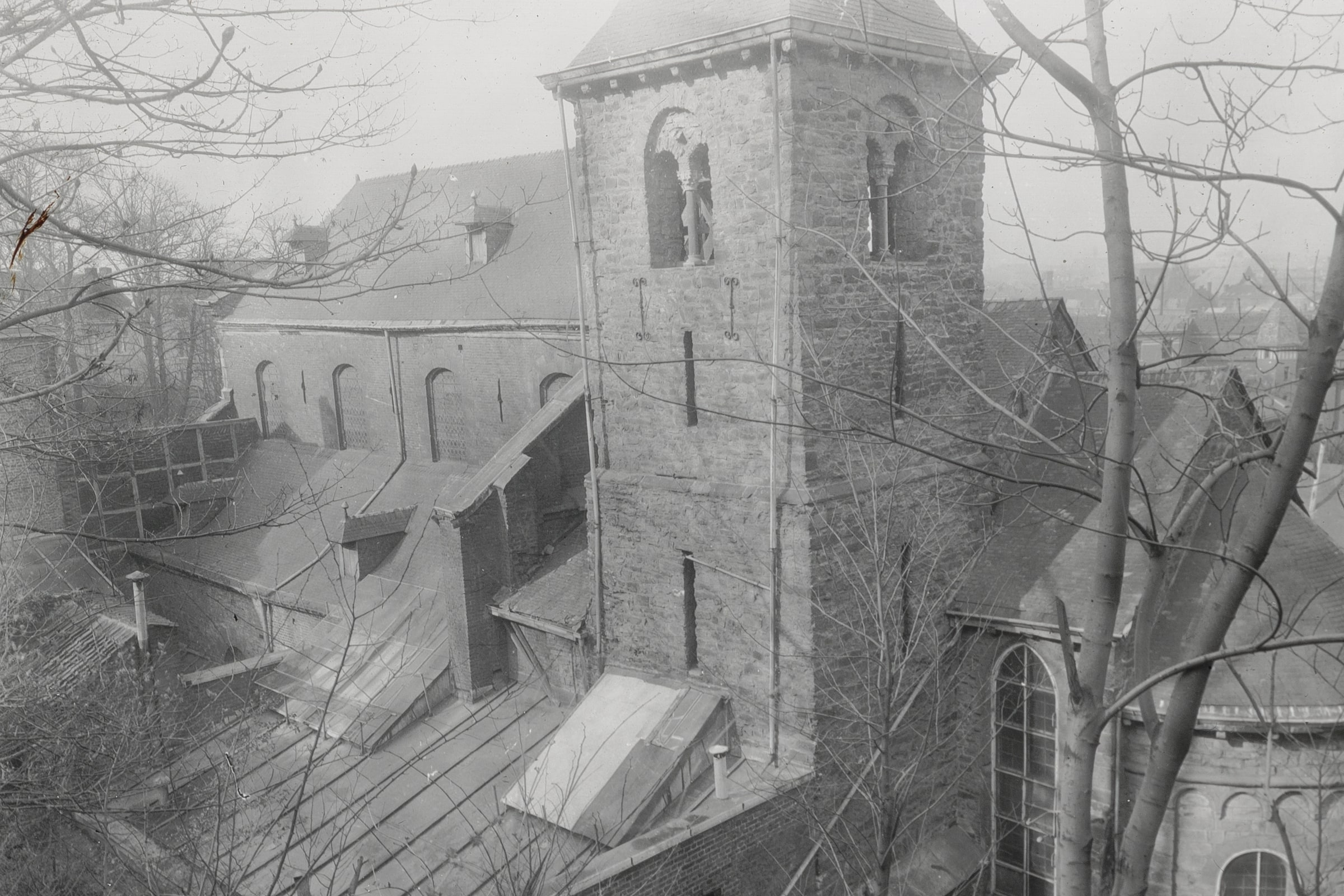
The present sanctuary is a layered complex. Its origins lie in the medieval hospital and leprosarium. The official history says the chapel was consecrated in 1116, while architectural research dates the surviving Romanesque choir to about 1185. A seventeenth-century nave and a robust Romanesque tower preserve the form of an old institutional church rather than a modern devotional replica.
After the French Revolution, Carmelite nuns returned religious life to Cornillon in 1860 and remained until 2017. The Diocese of Liège and a lay sanctuary association then assumed stewardship, and Poor Clare sisters took up the monastic life. Today the sanctuary includes the medieval chapel, the Poor Clare monastery, a host-making workshop, a contemporary beguinage, a reception hall, and the St. Francis pilgrim hostel.
The sanctuary describes three inseparable missions: contemplative prayer and adoration; hospitality for pilgrims and retreatants; and a contemporary form of community life. The Poor Clares celebrate the Liturgy of the Hours and the Eucharist, make altar breads, and maintain a rhythm of adoration. That continuity makes this more than a museum to Juliana. It remains a place where the worship she promoted is practiced daily.
The regular schedule published March 29, 2026 lists Mass at 8:00 on Sunday, Monday, Wednesday, Friday, and Saturday. Tuesday lists an 8:00 Mass parenthetically and an 18:00 Mass; because the parentheses may signal variability, pilgrims should verify the Tuesday morning celebration. Thursday Mass is at 8:00 and a 19:00 youth Mass. The same page lists daily offices beginning with Lauds and adoration at 6:30, followed by prayer through Compline at 19:00, with additional periods of Eucharistic adoration.
The church is published as open from 8:00 to 18:30, while the wider sanctuary has been described as accessible from 7:00 to 20:00. Those hours can change for liturgies, retreats, construction, and community needs. The official schedule should be checked shortly before travel. No stable weekly confession hour is currently listed; the sanctuary announces confession for particular celebrations, and pilgrims seeking the sacrament should contact the sanctuary in advance.
Egliseinfo identifies the sanctuary as accessible to people with reduced mobility and equipped with a hearing loop. Because the complex contains old buildings, sloping grounds, monastic areas, and a medieval chapel, visitors with specific mobility needs should still contact the sanctuary before arrival. Public access never extends automatically into the Poor Clares’ enclosure.
The St. Francis pilgrim hostel makes a longer retreat possible on the same grounds. Reservations are handled separately by the sanctuary’s hospitality team, and the official practical page should be used for current room, arrival, meal, and accessibility details. It is religious hospitality connected to the sanctuary, not an ordinary hotel booking made on arrival.
Liège’s complete Corpus Christi pilgrimage has a second essential stop: the Basilica of St. Martin. Blessed Eve lived there as a recluse and supported Juliana’s mission. The Belgian Catholic directory says the feast was instituted at St. Martin in 1246, that the basilica became a continuing pilgrimage place for the Fête-Dieu, and that it received the title of minor basilica in 1886. The annual Liège celebration still begins its solemn procession at St. Martin and proceeds through the city toward St. Paul’s Cathedral.
The two places should not be collapsed into one. Mont-Cornillon is Juliana’s home, chapel, and present sanctuary. St. Martin is the church of Eve and the historic public center of the feast in Liège. A serious visit begins at Cornillon with Juliana’s prayer and service, then continues to St. Martin to understand how a private insight entered the Church’s public worship.
The annual Fête-Dieu is movable. In the universal calendar Corpus Christi falls on the Thursday after Trinity Sunday; in Belgium it is ordinarily solemnized on the following Sunday because Thursday is not a civil holiday. Liège’s program may span several days and include Mass, adoration, conferences, and a procession. Catholic Tourist records the observance as movable and requires yearly verification rather than hard-coding one recurring civil date.
The sanctuary also celebrates St. Juliana locally on August 7. That sanctuary observance should not be confused with Corpus Christi itself. One honors the woman whose perseverance shaped the feast; the other celebrates the Eucharistic mystery for which she labored.
Seen accurately, Liège does not need an invented 1374 miracle to be extraordinary. Its claim is both humbler and larger: a woman formed in prayer and service recognized a missing act of worship; a local bishop acted; an archdeacon who knew the cause became pope; and a diocesan feast entered the universal calendar. The living sanctuary at Cornillon lets pilgrims return to the place where that history began.
Visit Mont-Cornillon as the living home of St. Juliana and the birthplace of Corpus Christi, then continue to St. Martin’s Basilica to follow the feast from Juliana’s prayer into Liège’s public worship.
The story & the place today
What happened here—and what a pilgrim can find now
Each record separates the devotional tradition from the present-day visitor evidence. A mapped locality remains visible even when an exact shrine or surviving object has not yet been verified.
The Eucharistic tradition associated with Liège
Catholic Tourist maps Liège as the geographical setting of a Eucharistic tradition documented in the St. Carlo Acutis exhibition. The place-specific historical and visitor audit is still in progress; this account records a devotional tradition rather than making an independent ecclesial, historical, or scientific judgment.
Liège, Belgium; precise church or event location awaiting verification
Still being researched
No present-day veneration site has yet been verified
Still being researched
Visitor note: The mapped point represents the associated locality, not confirmed church access.
Church wording: Documented in the St. Carlo Acutis exhibition; no separate Church judgment has yet been verified for this catalog record. — Recognition wording awaiting a place-specific Church-source audit
This pin preserves the geographical and devotional history while the exact event site, any surviving object, and current public commemoration are researched. It should not be read as confirmation that an active shrine exists at the pin.
The sacred connection
People and objects remembered here
These relationships are part of the destination record, with feast days and catalog qualifications shown where available.
lived, served the sick, prayed, and received the Eucharistic vision at Mont-Cornillon; principal patron of the sanctuary
Feast: August 7What to notice
Look closely at the place and its story
The date correction
Understand why the exhibition heading “1374” is not treated as a documented miracle date and why 1246, 1264, and 1317 matter.
Juliana’s medieval chapel
Pray where the woman who inspired Corpus Christi lived within Liège’s hospital and leprosarium community.
A living Poor Clare monastery
Hear the Liturgy of the Hours and encounter the daily Eucharistic rhythm that continues Juliana’s devotion.
From Cornillon to St. Martin
Follow the relationship between Juliana, Blessed Eve, and the basilica where the Liège feast entered public worship.
Pilgrim hospitality
Consider an overnight retreat at the St. Francis hostel within the sanctuary complex.
Feasts, anniversaries & celebrations
The St. Francis pilgrim hostel is located within the sanctuary complex. Reserve through the sanctuary hospitality team and confirm room, meal, arrival, and access details.
Accommodation details ↗How to read this page
Sources, tradition, and what is verified
The destination record was last checked on 9/29/2026.
This page records the site’s tradition as “Roman Catholic sanctuary, Poor Clare monastery, Eucharistic adoration, and birthplace of the Feast of Corpus Christi.” That wording describes the nature of the claim and keeps devotional tradition distinct from independently verified history.
Continue nearby