Why pilgrims come
Encounter the Eucharistic tradition and its surviving evidence
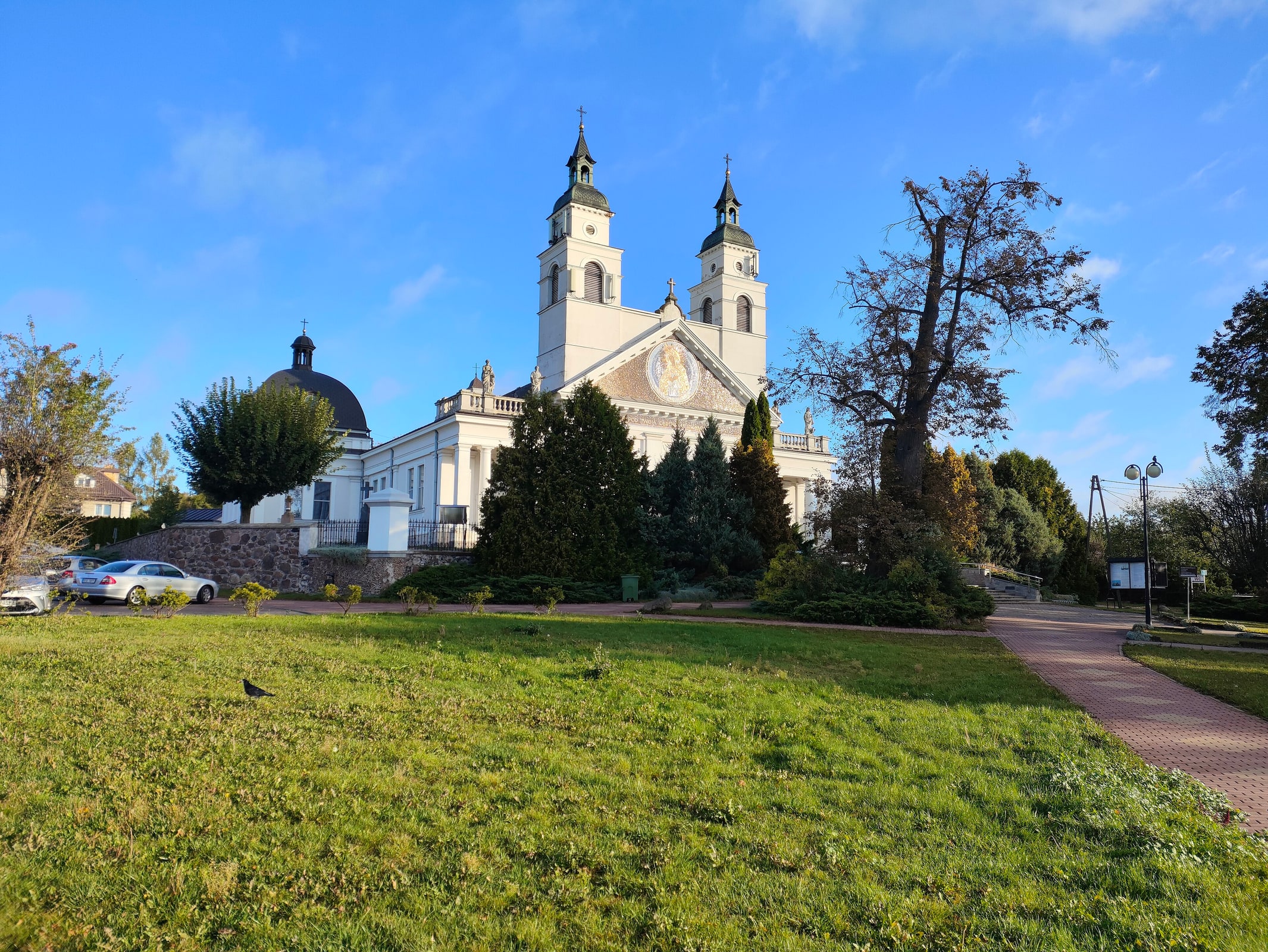
Sokółka’s Eucharistic destination is the Sanctuary of the Blessed Sacrament at the Church of St. Anthony of Padua, an active parish and collegiate church at Grodzieńska 47 in northeastern Poland. The church is not merely the place where the 2008 event began. It is also the present place of custody, public adoration, daily Mass, confession, organized pilgrimages, and the Archdiocese of Białystok’s annual Eucharistic Day.
The received chronology begins on Sunday, October 12, 2008, during the 8:30 a.m. Mass. While Communion was being distributed, a consecrated Host fell onto an altar step. The priest stopped, recovered it, and placed it in a vasculum containing water so that the species of bread could dissolve. After Mass, Sister Julia Dubowska, the sacristan, transferred the contents to another vessel and secured it in the sacristy safe at the pastor’s direction.
On October 19, Sister Julia opened the safe. The Metropolitan Curia’s later communiqué records that a spot appearing like blood was visible on the Host. The sanctuary’s fuller narrative says the water itself remained clear while a raised, intense-red mark appeared near the center of the partially dissolving Host. The local clergy notified Archbishop Edward Ozorowski, Metropolitan Archbishop of Białystok, who ordered that the Host be protected and observed.
On October 29, the vessel was moved to the tabernacle in the rectory’s Divine Mercy chapel. The following day, by the archbishop’s decision, the Host was removed from the water, placed on a small corporal, and kept in the tabernacle. The sanctuary reports that the changed portion dried naturally and retained its form. It remained under restricted custody until its solemn transfer into the church on October 2, 2011.
On January 7, 2009, a sample was taken. The October 14, 2009 communiqué says two professors specializing in pathomorphology at the Medical University of Białystok examined it independently. Their concordant opinion, as quoted by the Curia, said that the material indicated heart-muscle tissue—or, among the tissues of living organisms, most closely resembled it. The commission also reported that the sampled Host was the same object transferred from the sacristy and that it found no interference by outsiders.
This page treats those statements as the findings reported by the ecclesiastical commission. Catholic Tourist has not independently examined the full laboratory documentation, microscopy, sampling record, or chain-of-custody file. The sanctuary publishes additional scientific interpretation, including claims about agonal myocardial tissue and the interpenetration of bread and tissue; those remain attributed to the sanctuary and its cited experts rather than converted into an independent conclusion by this site.
The Church’s public judgment is careful and should be quoted accurately. The commission concluded that the Sokółka event “does not contradict the faith of the Church, but rather confirms it.” It presented the event as a call for ministers to distribute the Eucharist with faith and attention and for the faithful to receive with reverence. That formula is not identical to a formal declaration that every scientific or popular claim about the event is proven.
The communiqué also says the case file was transmitted to the Apostolic Nunciature in Warsaw. Transmission to the nunciature is not, by itself, a published Vatican decree or papal recognition. Sokółka does have clear diocesan acts: Archbishop Ozorowski appointed the commission; the church became a collegiate church on April 9, 2009; public veneration began with the solemn transfer on October 2, 2011; and the Archdiocese of Białystok formally established it as a diocesan sanctuary in 2017.
The object now presented is described by the sanctuary as the Cząstka Ciała Pańskiego, the Particle of the Body of the Lord. It rests on the small white corporal inside a specially designed gold custody that resembles both a reliquary and a monstrance. A glass face reveals the corporal and a brown-red mark; kneeling angels support the circular vessel. This is the event material in ecclesial custody, not an ordinary first- or second-class relic of a saint.
The custody is associated with the Chapel of Our Lady of the Rosary. Archdiocesan reporting says the particle has been available for adoration with the Blessed Sacrament since the 2011 transfer. Visitors should nevertheless follow every direction at the church, never touch the custody, and never assume that close photography is permitted. The Eucharistic species reserved or exposed for ordinary adoration and the event material displayed in the custody are distinct and deserve precise language.
The church’s history predates the event by generations. The present building was raised between 1840 and 1848 and consecrated in 1850. Side aisles and chapels were added in the early twentieth century, giving the sanctuary the form pilgrims encounter today. Its dedication to St. Anthony of Padua supplies a separate patronal tradition, celebrated on June 13, alongside the newer Eucharistic identity.
The sanctuary now publishes a full liturgical schedule. Sunday Masses are at 6:30, 8:00, 9:30, 11:00, 15:00, and 18:00. Saturday Masses are at 6:30, 7:15, and 18:00. On other weekdays Mass is at 6:30, 7:15, 15:00 in the Blessed Sacrament chapel, and 18:00. Confession is available during every Mass on Sundays and weekdays. These times were checked on September 29, 2026, but pilgrims should recheck the first-party schedule before departure.
The site also describes daily Eucharistic adoration from the morning until the evening Mass, the Divine Mercy Chaplet at 15:00, Thursday Eucharistic Vespers at 17:30, Tuesday devotion to St. Anthony at 17:30, and other recurring devotions. Because the published page contains a minor inconsistency in its reference to the morning exposition time, Catholic Tourist records the stable sequence—morning exposition through the evening Eucharist—without inventing a corrected minute.
The Archdiocesan Eucharistic Day is the principal annual public observance connected with the event. It is organized near the anniversary of the October 2, 2011 transfer rather than on one immutable civil date; the sanctuary’s 2026 calendar schedules it for October 4 after a Forty Hours devotion from October 2–4. The event therefore belongs in the calendar as movable and annually verified, while October 2 remains the historical transfer date.
The parish feast of St. Anthony is June 13. Pilgrims should distinguish it from the Eucharistic Day and from the anniversary of the original October 12, 2008 event. Each marks a different layer of the sanctuary’s life: patronal devotion, public Eucharistic pilgrimage, and historical memory.
Organized groups are asked to contact the Pilgrim Service Office, which currently publishes weekday office hours of 10:00 a.m.–2:00 p.m. and coordinates group registrations, intentions, days of recollection, and other needs. This is the best route for a group seeking catechesis or a structured visit. Individual pilgrims can normally build their visit around the public Mass, confession, and adoration schedule.
The most coherent pilgrimage begins with the commission’s communiqué. Read what it actually says, then enter the church for ordinary worship. Attend Mass, make use of confession, or remain for adoration before approaching the custody. This order protects the event from becoming a detached curiosity and reflects the Curia’s own emphasis on reverent reception of the Eucharist.
Sokółka is especially valuable because several distinct forms of evidence remain visible: a dated event narrative, named witnesses, an ecclesiastical commission, a published curial conclusion, reported expert opinions, a preserved object under Church custody, a formal diocesan sanctuary, and a continuing public liturgical life. Those strengths do not require exaggeration. The official formula, the limits of the public scientific record, and the absence of a separately published Vatican declaration should all remain explicit.
Approached with those boundaries, Sokółka becomes a serious contemporary pilgrimage destination. It invites the visitor to consider an extraordinary reported event, but it directs attention back to what the Church celebrates every day: Christ’s Eucharistic presence, the reverence owed at Communion, repentance, adoration, and a parish community gathered around the altar.
Visit Sokółka as a living Eucharistic sanctuary: read the Curia’s restrained conclusion, attend the ordinary liturgy, and approach the custody in the context of confession and adoration rather than spectacle.
The story & the place today
What happened here—and what a pilgrim can find now
Each record separates the devotional tradition from the present-day visitor evidence. A mapped locality remains visible even when an exact shrine or surviving object has not yet been verified.
The 2008 Eucharistic Event at St. Anthony Church in Sokółka
A consecrated Host fell during Communion, was placed in water, and one week later displayed a red mark. An ecclesiastical commission examined witnesses and expert opinions and reported that sampled material indicated, or most closely resembled, heart-muscle tissue.
Church of St. Anthony of Padua, Sokółka
The altered Host material on its small corporal, displayed in a specially designed custody
Sanctuary of the Blessed Sacrament at St. Anthony Church, Sokółka
Movable archdiocesan eucharistic day near october 2
Visitor note: Associated with public adoration in the active sanctuary; verify current access and register organized groups
Church wording: The event does not contradict the faith of the Church, but rather confirms it; public cult and diocesan sanctuary established — Metropolitan Curia of Białystok communiqué, October 14, 2009; Archdiocese of Białystok sanctuary decree, 2017
The 2009 communiqué reports independent examination by two pathomorphologists and no outside interference found by the commission. It says the file was sent to the Apostolic Nunciature; this is not equivalent to a separately published Holy See declaration.
The sacred connection
People and objects remembered here
These relationships are part of the destination record, with feast days and catalog qualifications shown where available.
patron of the parish church and its annual June 13 feast
Feast: June 13Venerated Eucharistic species and event material · Maintained in archdiocesan custody after an ecclesiastical commission concluded that the event does not contradict the faith and rather confirms it; not independently scientifically authenticated by Catholic Tourist
Follow the sanctuary’s directions, never touch the custody, and do not assume close photography. Groups should register with the Pilgrim Service Office.What to notice
Look closely at the place and its story
The Curia’s actual conclusion
Read the 2009 statement that the event does not contradict the faith but rather confirms it, without adding a decree it does not contain.
The public custody
See the specially designed vessel holding the corporal and brown-red event material under Church custody.
The 2017 sanctuary
Understand how the archdiocese turned an event site into a permanent diocesan destination for Eucharistic worship.
Ordinary adoration
Let the sanctuary’s daily Mass, confession, and Eucharistic adoration frame the extraordinary account.
St. Anthony’s older story
Keep the church’s nineteenth-century building and June 13 patronal devotion distinct from the 2008 event.
Feasts, anniversaries & celebrations
How to read this page
Sources, tradition, and what is verified
The destination record was last checked on 9/29/2026.
This page records the site’s tradition as “Roman Catholic diocesan sanctuary, Eucharistic pilgrimage, and St. Anthony devotion.” That wording describes the nature of the claim and keeps devotional tradition distinct from independently verified history.
Continue nearby