Why pilgrims come
Encounter the Eucharistic tradition and its surviving evidence
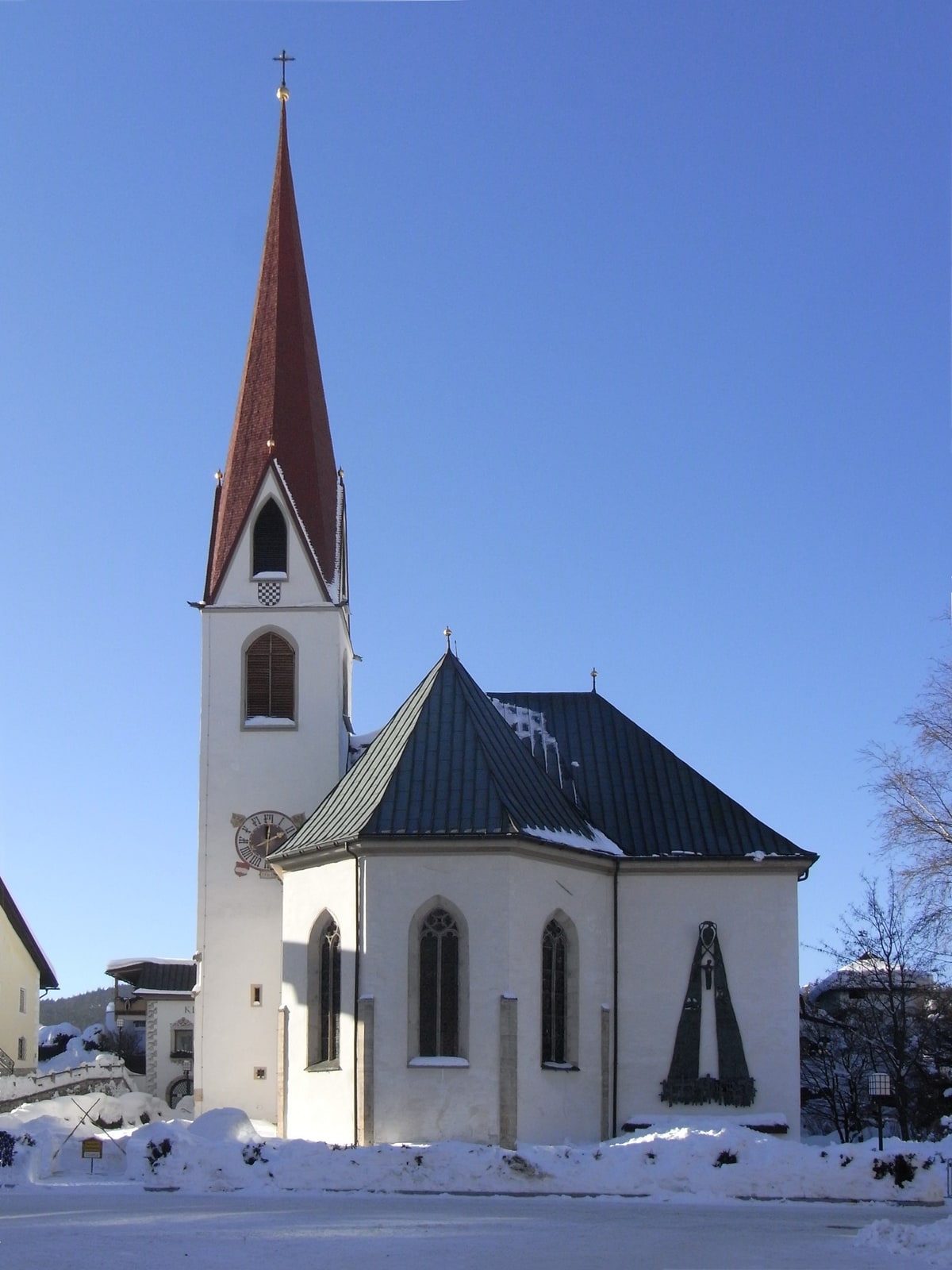
St. Oswald’s parish church stands at the center of Seefeld’s pedestrian zone and preserves the place-memory of the Host Miracle traditionally dated to Holy Thursday 1384. The church is not simply near the event: its sunken altar stone, hand impression, portal imagery, Holy Blood chapel, and late-Gothic enlargement were all shaped by the pilgrimage that followed.
According to the tradition presented by Seefeld’s official tourism authority, the nobleman Oswald Milser demanded the large priest’s Host during Mass as a mark of his status. When he received it, the Host was said to turn blood-red while Milser sank into the floor. He caught the altar stone with his hand, leaving the impression shown to visitors today. Later versions say he repented and lived as a penitent.
The official Seefeld history calls this a legend or reported miracle while also noting contemporary accounts. Catholic Tourist follows that careful distinction. The physical altar setting, hand impression, church, and pilgrimage history are observable; the supernatural interpretation belongs to the received Catholic tradition. Claims about the Host’s historical preservation should not be converted into a promise that it is permanently exposed today without current parish confirmation.
Pilgrimage transformed Seefeld. The earlier church, documented by the early fourteenth century, became too small. Duke Frederick IV began the present late-Gothic building in 1432, and work continued under Sigismund of Austria until completion in 1474. The Diocese of Innsbruck calls St. Oswald one of Tyrol’s most beautiful late-Gothic churches.
The art tells the story at multiple scales. A relief in the main portal depicts the Host Miracle. Inside are fifteenth-century frescoes, a carved pulpit dated 1524, a Gothic baptismal font, shrine figures, and a panel painting by Jörg Köderer from 1502. The Holy Blood chapel’s later altar and tabernacle also represent the event.
Seefeld’s current life is more than heritage tourism. St. Oswald remains a parish church where Mass takes priority over sightseeing. The regional tourism authority announced renovation work during 2026, with possible dust, noise, or altered access during the high season. Pilgrims should verify the current state rather than assuming every chapel or artwork is accessible.
The church is easy to reach on foot from Seefeld station and sits within a pedestrianized center. That convenience should not obscure alpine weather, winter surfaces, or construction conditions. Current liturgies and openings are best checked through the parish or Diocese of Innsbruck.
The narrative’s spiritual center is not Milser’s social rank but his humiliation and repentance before the Eucharist. A responsible visit looks closely at the altar and portal, listens to the place’s medieval history, and joins the living worship of the parish without staging the tradition as a spectacle.
Read the miracle tradition through the altar, hand impression, portal relief, and late-Gothic church while respecting the active parish and current renovation conditions.
The story & the place today
What happened here—and what a pilgrim can find now
Each record separates the devotional tradition from the present-day visitor evidence. A mapped locality remains visible even when an exact shrine or surviving object has not yet been verified.
The Host Miracle of Seefeld
The received tradition says Oswald Milser demanded the large Host on Holy Thursday, after which it turned red and he sank beside the altar, leaving a hand impression as he grasped the stone.
Predecessor church on the site of St. Oswald, Seefeld
The Eucharistic tradition, historic altar setting, and associated devotional art
St. Oswald Parish Church and its Holy Blood chapel
Traditionally associated with Holy Thursday
Visitor note: Active parish church; verify current access and renovation conditions
Church wording: Historic Tyrolean Eucharistic pilgrimage tradition — Parish tradition within the Diocese of Innsbruck
Pilgrimage drove construction of the present church between 1432 and 1474.
The sacred connection
People and objects remembered here
These relationships are part of the destination record, with feast days and catalog qualifications shown where available.
Eucharistic pilgrimage memorial · Historic parish tradition with surviving altar setting and hand impression
Renovation or liturgy may restrict access; verify directly.What to notice
Look closely at the place and its story
Sunken altar and hand impression
See the physical setting through which the received 1384 story is remembered.
Portal relief
Read the Host Miracle in the church’s exterior sculptural programme.
Late-Gothic pilgrimage church
Understand how pilgrim growth led to the 1432–1474 rebuilding.
Holy Blood chapel
Find the later devotional setting and imagery associated with the tradition.
Living parish
Join worship respectfully and verify renovation access rather than treating St. Oswald as a museum.
How to read this page
Sources, tradition, and what is verified
The destination record was last checked on 9/30/2026.
This page records the site’s tradition as “Roman Catholic Tyrolean Eucharistic pilgrimage.” That wording describes the nature of the claim and keeps devotional tradition distinct from independently verified history.