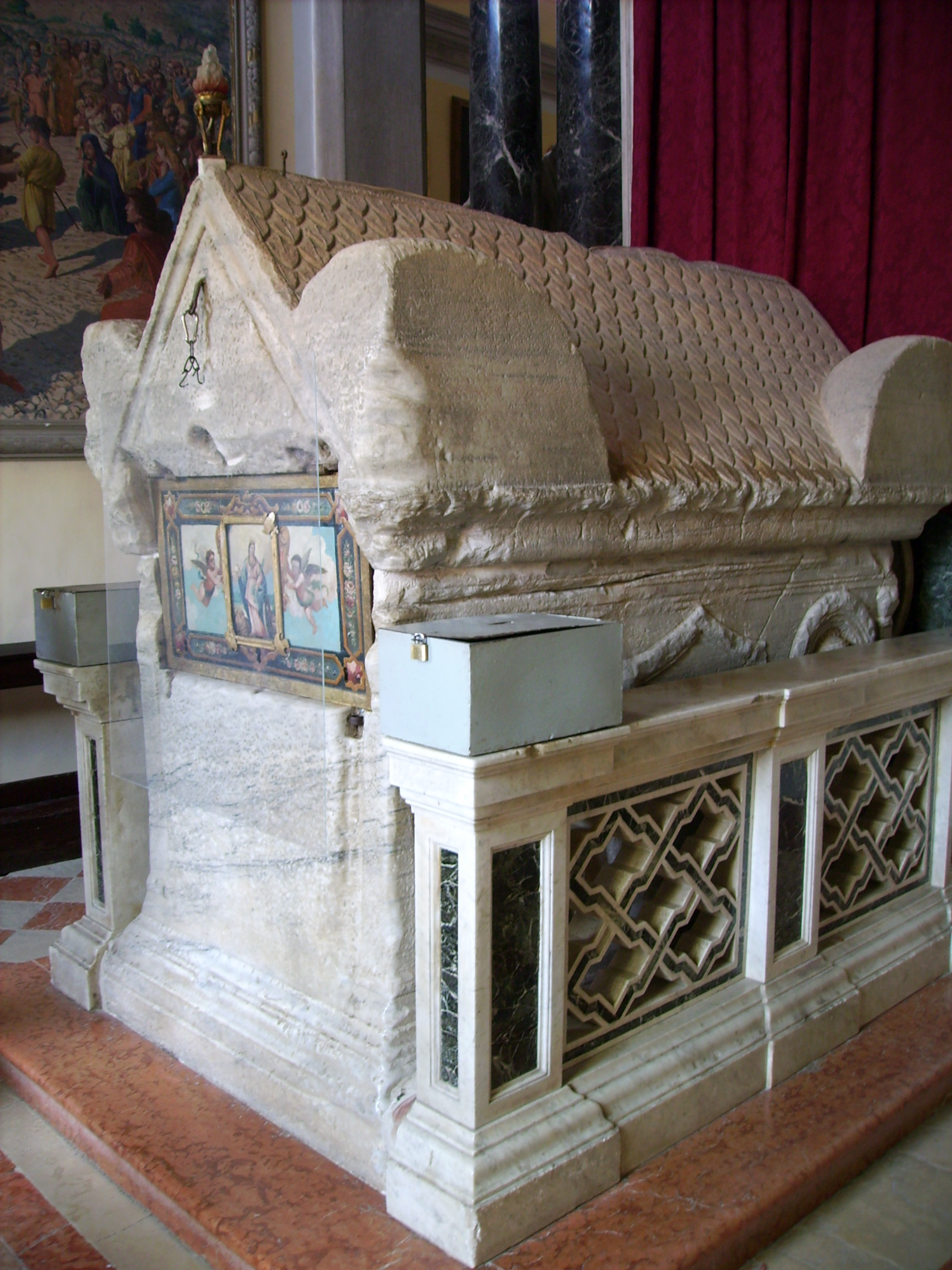
From Rovinj’s harbor, the Church of St. Euphemia seems almost to grow out of the old town. Its bell tower rises above a steep tangle of stone lanes, weathered facades, and glimpses of the Adriatic. Many visitors make the climb for the view. A pilgrim has another reason: behind an altar inside the church stands a marble sarcophagus associated with a teenage martyr whose story reaches from the persecutions of the Roman Empire to one of Christianity’s defining councils—and then, by a much-loved local tradition, across the sea to this Istrian hilltop.
Euphemia lived in Chalcedon, across the Bosporus from Constantinople, in the early fourth century. The surviving record of her life is not a modern biography, and responsible retellings should say so. Christian tradition remembers her as the daughter of a prominent family who refused to take part in pagan sacrifice during the persecution under the emperor Diocletian. She was arrested, tortured, and killed around the year 304. Later art often gives her a martyr’s palm, a wheel, and a lion—images drawn from the hagiographic account of her suffering. They tell us how Christians remembered her courage, even when the details cannot be treated like a contemporary court transcript.
What endured with unusual force was not only the memory of her death, but the place associated with her burial. A great basilica dedicated to Euphemia stood at Chalcedon, and in 451 it became the setting for the Council of Chalcedon. Hundreds of bishops gathered there amid a dispute over how Christians should speak about Jesus Christ. The council’s teaching insisted that Christ is truly divine and truly human, united in one person without either reality being erased or divided. These can sound like distant theological formulas. Yet the bishops met under the roof of a martyr—a young woman who had already staked her life on the identity of the Christ they were struggling to confess faithfully.
That setting matters. The council was not simply an academic conference held in a convenient hall. Christian memory placed the Gospel and the witness of a martyr at the center of a debate about who Christ is. Euphemia had no imperial office and left no theological treatise. Her authority came from fidelity unto death. Her sanctuary joined doctrine to discipleship: the Church’s words about Christ were spoken in the presence of someone who had suffered for him. Centuries later, Christians of East and West continued to honor her, and her name became inseparable from Chalcedon itself.
The story of her relics becomes more complicated after that. Traditions describe their movement to Constantinople during periods of war and danger, followed by further upheaval during the iconoclast controversies. Different Christian communities preserve different claims about relics associated with Euphemia. That is why Catholic Tourist uses careful language: Rovinj publicly venerates relics attributed to St. Euphemia in a sarcophagus under Catholic custody, but longstanding devotion is not the same thing as a complete, scientifically documented chain of custody from fourth-century Chalcedon.
Rovinj’s own account begins with the sea. Local tradition says that on July 13 in the year 800, a stone sarcophagus appeared off the coast after a storm. The townspeople tried to drag the enormous object uphill, but neither human strength nor teams of animals could move it. Then, according to the beloved story, a young boy came with two heifers and brought it to the church. The arrival was received as a miracle, and Euphemia became the city’s patroness alongside St. George.
It is a beautiful story, but its date and its earliest written witness are not the same thing. Rovinj’s tourism office notes that the earliest known written version survives in a thirteenth-century text preserved in the capitular archive—centuries after the supposed arrival. That does not make the tradition meaningless. It tells us how to read it: as the inherited memory through which a city understood its bond with its patron, rather than as an eyewitness report written in the year 800. Historical honesty does not diminish devotion; it prevents devotion from depending on claims the evidence cannot carry.
The building pilgrims enter today is itself the result of centuries of that devotion. An earlier church on the hill became too small as pilgrimage grew. The present Venetian Baroque church was rebuilt principally between 1725 and 1736, and the sarcophagus was moved to the place where pilgrims now encounter it behind the altar dedicated to Euphemia. The church still dominates Rovinj’s skyline, but inside, the city’s most important treasure is not the panorama. It is the memory of a witness.
For a Catholic pilgrim, the best visit begins by resisting the temptation to treat the church as merely the final viewpoint on an old-town walk. Enter quietly. Find the sarcophagus. Read the labels and local account with the distinctions intact: the martyrdom belongs to ancient Christian tradition; the council at Chalcedon is firmly historical; the arrival by sea belongs to received Rovinj legend; the present public veneration is visible and living. Each layer says something different, and together they explain why this place has mattered for so long.
If you can plan around September 16, the feast of St. Euphemia brings saint, parish, and city together through procession and solemn Mass. At other times, allow space for prayer before climbing the bell tower or returning to the lanes below. The approach is steep and cobbled, and the tower adds more than two hundred narrow wooden steps, so pilgrims with limited mobility should confirm current access before setting out. Worship and parish events should always take priority over sightseeing.
Euphemia’s story finally asks a simple and difficult question. What does it mean to confess Christ when that confession costs something? The bishops at Chalcedon answered with carefully chosen words. The martyr answered with her life. Rovinj answered by carrying her memory through generation after generation. A pilgrim standing before the sarcophagus does not have to pretend that every detail is equally certain. The deeper invitation is to receive the documented history, the local tradition, and the living devotion truthfully—and then ask for the courage to remain faithful in one’s own time.
St. Euphemia of Chalcedon, pray for us.