Why pilgrims come
Discover what makes Abbey District of St. Gall — Cathedral and Abbey Library a place of pilgrimage
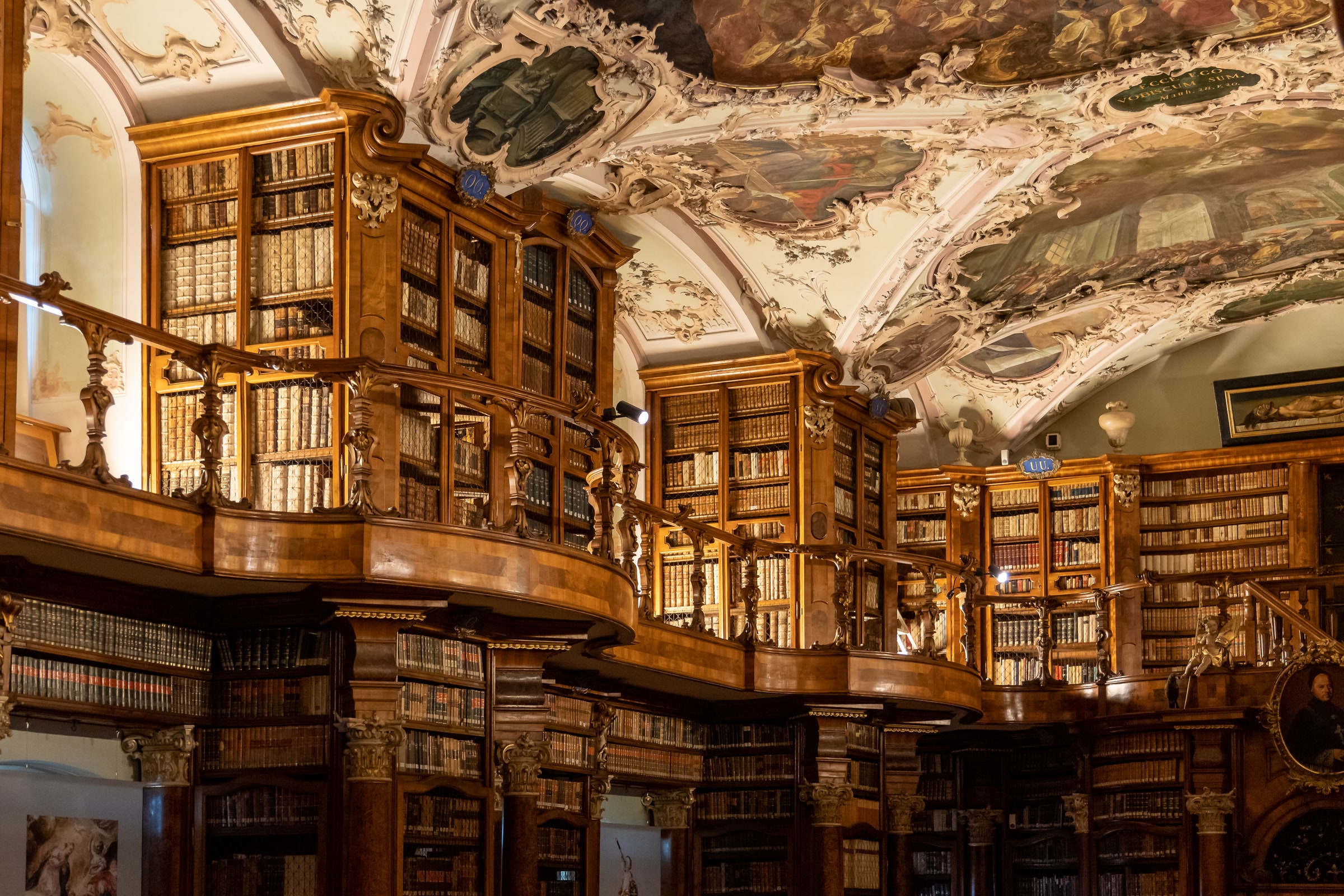
The library hall first catches the eye: a luminous Rococo room of carved wood, painted ceilings, curved galleries, and shelves that seem to turn learning itself into architecture. Yet the deepest story of the Abbey District of St. Gall begins far earlier, with one monk, a small hermitage, and a conviction that prayer and study belong together.
Around 612, the missionary monk Gall withdrew to the Steinach valley and established a hermitage on the ground now occupied by the cathedral. The traditional image of Gall sharing bread with a bear belongs to hagiography, but the historical center is secure: a community formed around his cell and tomb, and the settlement that became St. Gallen took his name. The Diocese of St. Gallen celebrates him on October 16 and remembers him as a missionary who learned the language of the people he served.
About a century later, Otmar was called to rebuild the community. In 719 he organized a monastery at the place of Gall’s memory, and around 747 the house adopted the Rule of St. Benedict. Otmar’s work joined monastic discipline to concrete mercy. The diocesan account says he established lodging for the poor and a hospital for people with leprosy—among the earliest known institutions of its kind in Europe. Conflict with Frankish authorities ended in imprisonment and his death in exile on the island of Werd on November 16, 759. His remains were returned to St. Gall ten years later, and he is honored with Gall as a founding saint of the monastery.
From these beginnings grew one of medieval Europe’s great centers of prayer, scholarship, music, and manuscript production. The Abbey Library reports more than 2,100 manuscripts. Its independent manuscript production began in the middle of the eighth century under Otmar and his successor Johannes, and from the eighth through the eleventh century St. Gall became a leading intellectual center. The holdings range from Scripture, liturgy, the Church Fathers, monastic rules, saints’ lives, theology, law, medicine, mathematics, and music to works of classical antiquity. They allow scholars to reconstruct the spiritual and intellectual life of a medieval monastery with exceptional continuity.
The collection’s survival has its own saint. Wiborada, a consecrated recluse enclosed beside the church of St. Mangen, was trusted as a spiritual adviser by townspeople, monks, abbots, and rulers. According to the Diocese of St. Gallen, she foresaw the Hungarian raid of 926. Her warning allowed people and precious books to be moved to safety. Wiborada refused to abandon her cell and was killed on May 2, 926. Pope Clement II canonized her in 1047, making her the first woman formally canonized by a pope. She is honored as patroness of libraries and book lovers. The monastery’s profession book contains a contemporary entry recording her martyrdom and is itself treated as a relic.
The physical complex pilgrims see today is principally Baroque. The present cathedral and abbey buildings were reconstructed from 1755 to 1768. The library’s celebrated Rococo hall was created from 1758 to 1762 by artists also engaged on the church. That distinction matters: the room is not a surviving medieval scriptorium. It is an eighteenth-century home for a collection whose roots reach back to the early Middle Ages. The oldest known architectural plan on parchment—the Plan of St. Gall—is among the documentary treasures associated with the collection, although exhibitions rotate and no visitor should assume a particular manuscript will be on display.
The Benedictine abbey itself no longer functions. The newly formed Canton of St. Gallen dissolved it in 1805. Its Catholic life, however, did not disappear. The former abbey church became a parish church and, after the Diocese of St. Gallen was established in 1847, its cathedral. The Catholic Denomination within the Canton of St. Gallen now administers the Abbey Library as a modern research library. UNESCO inscribed the Abbey of St. Gall as a World Heritage Site in 1983, recognizing the ensemble and the extraordinary continuity of its cultural tradition.
For a Catholic pilgrim, the cathedral is not simply the architectural companion to a famous library. It is an active diocesan and parish church where the Eucharist is celebrated daily, confession is regularly offered, sacred music continues the abbey’s musical inheritance, and the Heart of Jesus Chapel provides a place for quiet prayer and adoration. The diocesan historical materials identify relics of St. Gall in the Gallus altar and crypt, including a reliquary associated with his cranium and remnants of his penitential objects. St. Otmar’s remains were returned here in 769 and have been venerated at St. Gall for centuries. These claims come from the local Church’s own historical and liturgical tradition; Catholic Tourist does not present modern scientific authentication beyond that ecclesial custody.
A good visit should hold worship and learning together. Begin in the cathedral, preferably outside a sightseeing rush. Locate the Gallus altar, pray for missionaries and pilgrims, and remember Otmar’s care for the poor. If the liturgical schedule allows, attend Mass or remain for the cathedral’s music and prayer. Then enter the ticketed Abbey Library and related exhibitions. Let the manuscripts be more than beautiful objects: generations of monks copied texts by hand so that Scripture, theology, prayer, music, and useful knowledge could be carried forward.
Wiborada gives the library a particularly human face. She did not preserve books because parchment was more valuable than life; she warned the community so that people and memory could survive together, then accepted martyrdom rather than abandon her vocation. Her witness makes this a natural pilgrimage destination for librarians, teachers, writers, students, archivists, and anyone responsible for preserving truth.
The cathedral and museum areas operate differently. The cathedral currently publishes broad daily opening hours, but tourism is not permitted during services or on Sunday mornings. The Abbey Library, Vaulted Cellar, and Exhibition Space are ticketed and currently open daily from 10 a.m. to 5 p.m. from October through June and to 6 p.m. from July through September, with specific closure dates and last admission fifteen minutes before closing. These arrangements can change. Consult the live official pages shortly before traveling rather than relying on a saved schedule.
All three exhibition areas are listed as wheelchair accessible, and an in-house wheelchair is available. Strollers must be left near the entrance. Private photography is generally permitted where not otherwise indicated, but without flash, tripod, or selfie stick; professional photography and filming require permission. Groups of ten or more visiting without an official guide must register in advance. Researchers seeking access to manuscripts or incunabula use a separate reading-room process and need prior authorization.
Do not rush this place as a decorative stop between Swiss cities. Its real coherence appears only when Gall’s missionary solitude, Otmar’s ordered mercy, Wiborada’s sacrificial guardianship, the monks’ patient copying, and the cathedral’s continuing sacramental life are seen as one story. The Abbey District is magnificent because beauty survived here—but also because faith kept turning memory into service.
Pray where St. Gall’s hermitage became a cathedral, venerate the founding saints, and enter the Rococo library that protects one of the world’s most continuous monastic manuscript collections.
The sacred connection
People and objects remembered here
These relationships are part of the destination record, with feast days and catalog qualifications shown where available.
missionary hermit whose c. 612 cell and tomb became the origin of the abbey and city
Feast: October 16SaintSt. Otmarfounding abbot who organized the monastery in 719 and established works for the poor and sick
Feast: November 16SaintSt. Wiboradarecluse and martyr whose warning helped preserve the community and its books during the Hungarian raid of 926
Feast: May 2Relic recorded in the catalog
Relic recorded in the catalog
What to notice
Look closely at the place and its story
The cathedral over Gall’s hermitage
Pray on the ground where the missionary Gall established his cell around 612 and where an active Catholic cathedral now serves the diocese.
Gallus altar and crypt
Venerate the relics entrusted to the local Church while keeping ecclesial custody distinct from modern scientific authentication.
The Rococo library hall
Enter an eighteenth-century architectural masterpiece built to house a manuscript tradition rooted in the eighth century.
More than 2,100 manuscripts
Encounter a collection spanning Scripture, liturgy, theology, music, medicine, law, mathematics, and classical learning; displays rotate for preservation.
St. Wiborada, guardian of books
Remember the recluse and martyr whose warning helped save the monastery’s people and manuscripts before the raid of 926.
Otmar’s ordered mercy
Let the first abbot’s care for poor and sick people keep this pilgrimage from reducing monastic culture to beautiful objects.
World Heritage without a living abbey
Understand the honest present: the monastery was dissolved in 1805, while its cathedral, Catholic library, archives, worship, and scholarship continue.
Feasts, anniversaries & celebrations
How to read this page
Sources, tradition, and what is verified
The destination record was last checked on 10/16/2026.
This page records the site’s tradition as “Roman Catholic — Diocese of St. Gallen and Catholic Denomination within the Canton of St. Gallen.” That wording describes the nature of the claim and keeps devotional tradition distinct from independently verified history.
Continue nearby