Why pilgrims come
Enter a place shaped by prayer, community, and pilgrimage
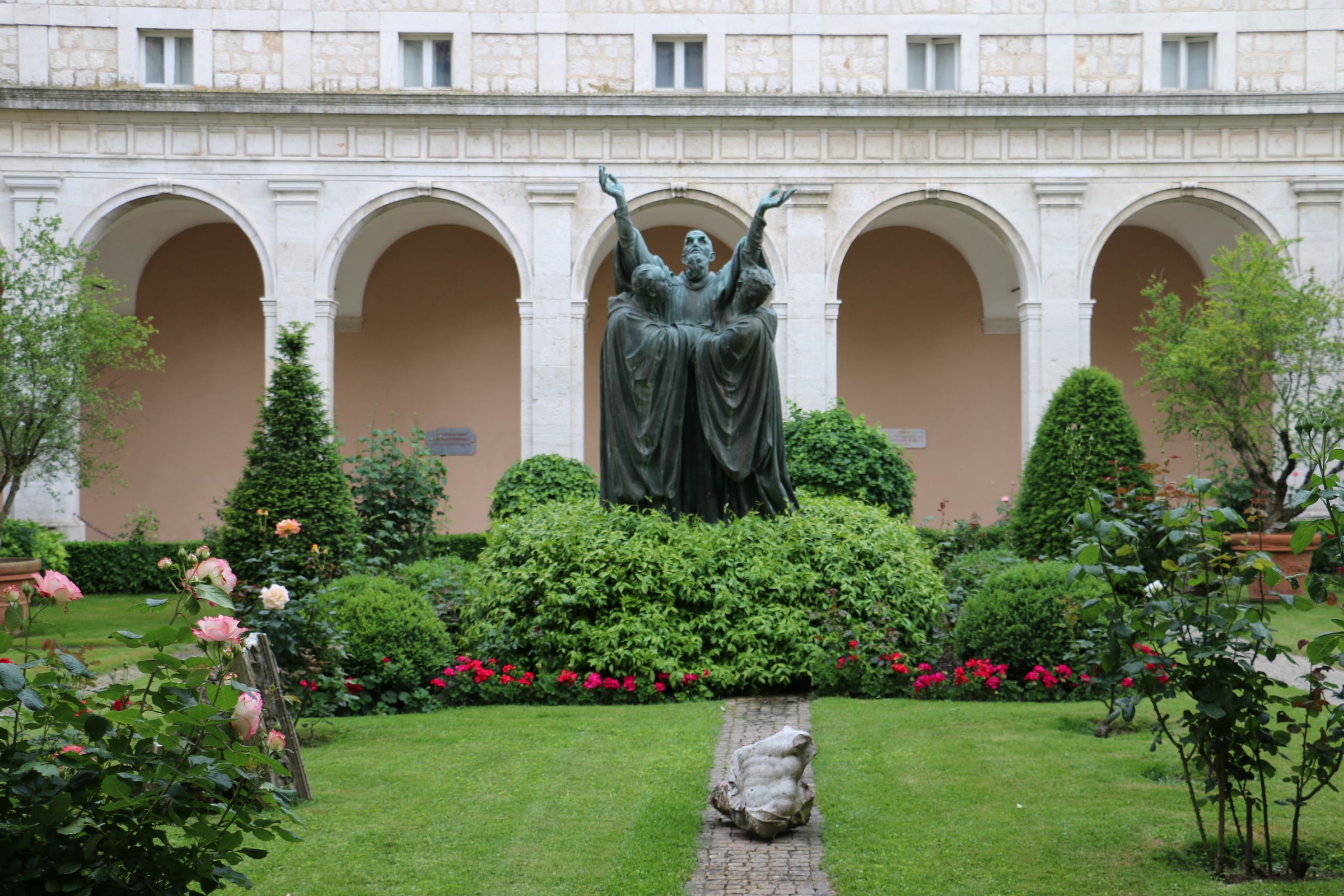
Montecassino is one of the foundational places of Western monasticism. Around the year 529, St. Benedict of Nursia established a monastery on the mountain above Cassino. The height was not chosen simply for scenery. In the Benedictine imagination the monastery becomes a school of service to the Lord: a place where prayer, work, study, hospitality, stability, and conversion can shape an entire life. The community that grew here helped carry the Rule of St. Benedict far beyond this single mountain.
The abbey’s history is not a straight line of peaceful continuity. Montecassino was damaged or destroyed repeatedly—by Lombards in the sixth century, Saracens in the ninth, earthquake in the fourteenth, political suppression, and finally the catastrophe of the Second World War. In February 1944 Allied bombers destroyed the historic complex during the Battle of Monte Cassino. The monks, warned before the attack, had helped move irreplaceable manuscripts, books, and works of art to safety. After the war the abbey was rebuilt according to the principle “where it was, as it was,” and Pope Paul VI consecrated the restored basilica in 1964.
For a pilgrim, the center of the visit is not the battlefield panorama but the basilica and crypt. Tradition venerates the tombs of St. Benedict and his twin sister St. Scholastica beneath the high altar. Their shared resting place gathers two related forms of consecrated life into one act of prayer. Benedict’s influence can feel vast and institutional when measured across centuries; the crypt restores the story to two human lives given to God.
The mountain also asks visitors to hold culture, war, and resurrection together. Montecassino preserved learning and fostered monastic life, yet its name is also inseparable from one of the most destructive campaigns of the twentieth century. The rebuilt church does not erase that wound. It witnesses that Christian memory can acknowledge devastation without allowing devastation to have the final word.
Plan the visit around prayer rather than fitting prayer around the tour. The abbey currently publishes Sunday Mass, Gregorian liturgy, Vespers, confession hours, museum access, and seasonal opening times. All are subject to change. The road climbs roughly eight kilometres from Cassino; a limited public bus is listed by the abbey, but travelers should verify the current timetable before relying on it.
Climb first for St. Benedict and St. Scholastica, not for the battlefield view. Pray in the basilica and crypt, then read the monastery’s repeated destruction and rebuilding as a history of Christian stability tested by catastrophe.
The sacred connection
People and objects remembered here
These relationships are part of the destination record, with feast days and catalog qualifications shown where available.
founder; traditionally buried in the abbey crypt
Feast: July 11traditionally buried in the abbey crypt with St. Benedict
Feast: February 10Saint tombs · Received Benedictine and Catholic tradition
Crypt access may be affected by liturgies; confirm with the abbey.What to notice
Look closely at the place and its story
The mountain of St. Benedict
Stand where Benedict established the monastery that became a mother house of Western monastic life.
Crypt of Benedict and Scholastica
Pray at the traditional resting place of the twin saints beneath the basilica.
The Rule made visible
Notice how choir, cloister, hospitality, work, and study embody a life ordered around prayer.
Destruction and reconstruction
Read the rebuilt abbey honestly against the 1944 bombing and the human cost of the battle below.
Gregorian prayer
Join Sunday sung Mass or Vespers when possible and let the living community—not the ruins—have the final word.
Feasts, anniversaries & celebrations
How to read this page
Sources, tradition, and what is verified
The destination record was last checked on 9/17/2026.
This page records the site’s tradition as “Roman Catholic; Benedictine.” That wording describes the nature of the claim and keeps devotional tradition distinct from independently verified history.
Continue nearby