Why pilgrims come
Visit the resting place and legacy of St. Clement I
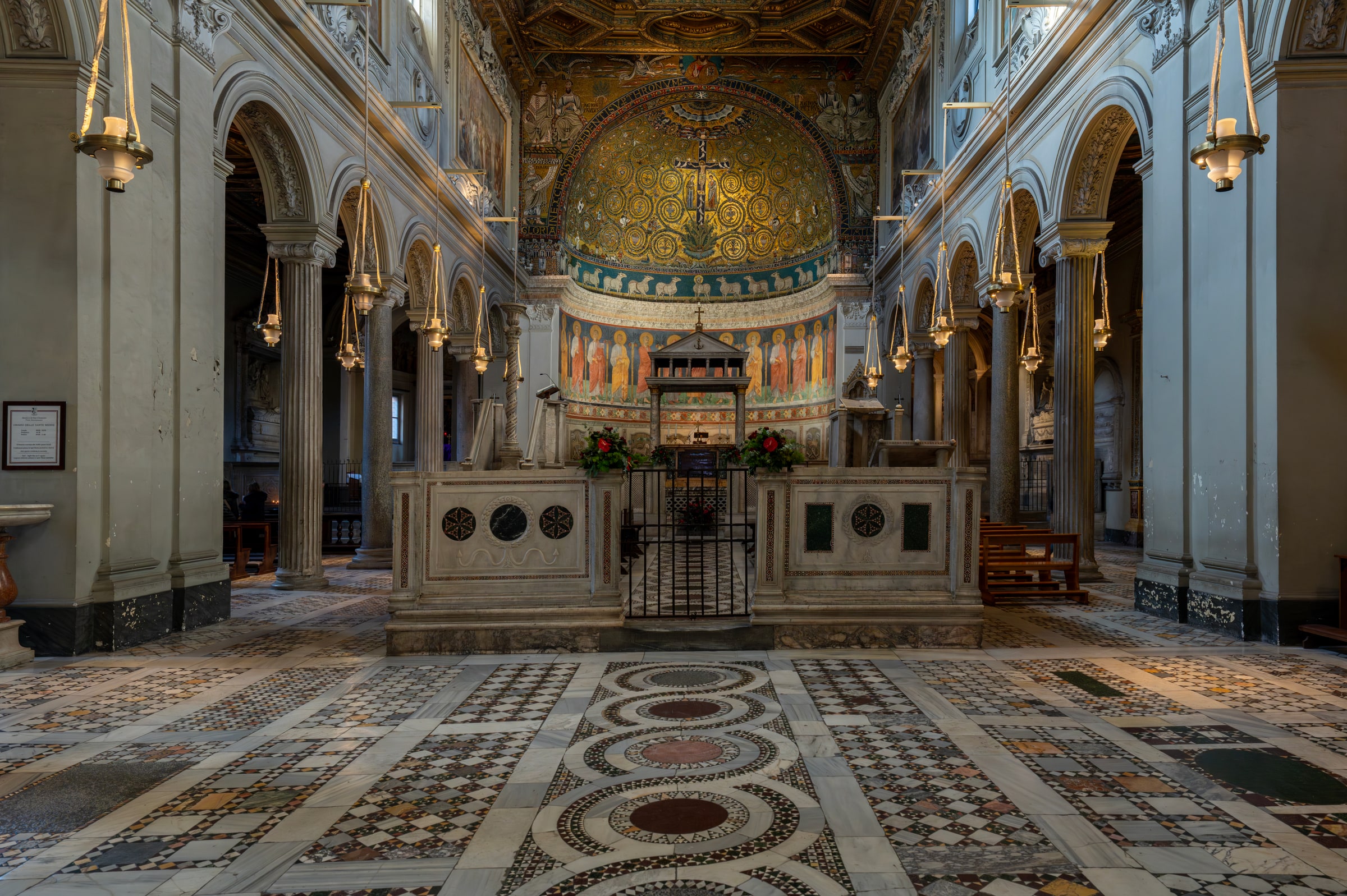
San Clemente is one of Rome’s most complete encounters with the layers of Christian memory. The present twelfth-century basilica stands above a fourth-century church, which itself rests over Roman buildings. A pilgrim can descend from living liturgy through early medieval frescoes toward the physical world in which Rome’s first Christian communities took shape.
The basilica is also a major shrine of saints. The relics traditionally identified with Pope St. Clement I and St. Ignatius of Antioch are venerated beneath the high altar. In the lower basilica, pilgrims visit the traditional tomb of St. Cyril, the ninth-century missionary who, with his brother Methodius, brought Scripture and liturgy to the Slavic peoples in their own language. Cyril died in Rome in 869 and was buried here at Methodius’s request. His relics were removed for safekeeping during the French occupation and largely lost; a surviving fragment was solemnly returned in the twentieth century and is venerated in the upper church.
The official basilica explains that Cyril and Methodius had earlier brought St. Clement’s relics from Crimea to Rome. An eleventh-century fresco in the lower church shows the solemn transfer. Nearby wall paintings form one of Rome’s richest surviving early-medieval cycles, while still deeper rooms preserve a Roman house, a Mithraic sanctuary, and flowing underground water.
Come first for prayer, not archaeology alone. Honor Clement’s witness, Ignatius’s journey toward martyrdom, and Cyril’s missionary intelligence; then descend slowly enough to see how successive Christian generations built literally upon what they had received. Excavation access is ticketed and opening times differ from worship hours, so consult the basilica before travel.
Pray first in the living upper basilica, then descend through the fourth-century church to St. Cyril’s traditional tomb and the earliest layers of Christian Rome.
The sacred connection
People and objects remembered here
These relationships are part of the destination record, with feast days and catalog qualifications shown where available.
relics traditionally venerated beneath the high altar and patron of the basilica
Feast: November 23traditional tomb in the lower basilica and surviving relic fragment in the upper church
Feast: February 14relics traditionally venerated beneath the high altar
Feast: October 17Bodily relics · Longstanding ecclesial tradition
Venerated within the basilica; St. Clement’s feast includes special exposition and procession according to the official basilica.First-class relic fragment · Ecclesiastically received and enshrined
The historic tomb is visited in the lower basilica; the surviving fragment is in the upper church.What to notice
Look closely at the place and its story
St. Cyril’s traditional tomb
Honor the Apostle of the Slavs in the lower basilica where he was buried in 869.
Clement and Ignatius at the high altar
Venerate the two early martyr-bishops traditionally associated with the basilica’s principal relics.
The fresco of St. Clement’s translation
Read the eleventh-century image of Cyril, Methodius, and Pope Adrian II bringing Clement’s relics into the church.
Three levels of Roman memory
Descend from the medieval basilica through an early Christian church to Roman structures below.
Feasts, anniversaries & celebrations
How to read this page
Sources, tradition, and what is verified
The destination record was last checked on 9/27/2026.
This page records the site’s tradition as “Roman Catholic basilica, martyr shrine, missionary-saint tomb, and early-Christian archaeological complex.” That wording describes the nature of the claim and keeps devotional tradition distinct from independently verified history.
Continue nearby