Why pilgrims come
Discover what makes Cathedral of San Lorenzo and the Santo Anello a place of pilgrimage
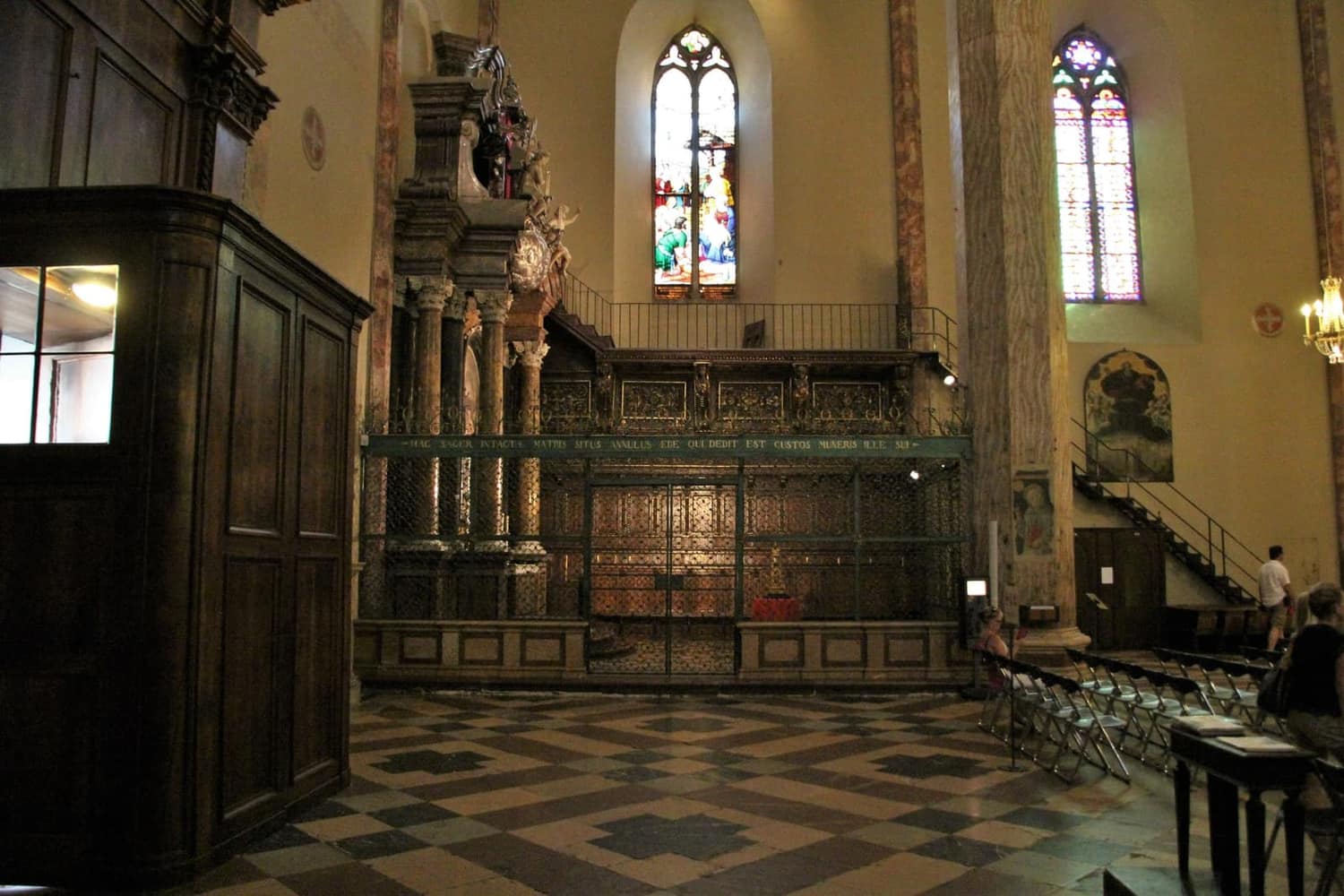
In the Cathedral of San Lorenzo in Perugia, fourteen keys protect a small object that has shaped the city’s devotional life for more than five centuries. The Santo Anello—Holy Ring—is a pale chalcedony ring traditionally associated with the marriage of the Virgin Mary and St. Joseph. It is kept high above the altar in the Chapel of St. Joseph and lowered for public veneration only on designated days.
The cathedral itself draws the pilgrim into the civic and religious heart of Perugia. Its principal entrance faces Piazza IV Novembre, beside the Fontana Maggiore and Palazzo dei Priori. Inside, the Chapel of St. Joseph is not simply another side chapel: it is the sanctuary built around the city’s custody of the ring. The locked reliquary and the ceremonial use of fourteen keys express how the object became a shared trust rather than private property.
The documented custody begins in Chiusi. According to the cathedral and diocesan histories, the ring was kept there until 1473, when the German friar Vinterio of Mainz brought it to Perugia. After years of conflict between the two cities, the ring was placed in San Lorenzo in 1488. Perugia commissioned major works of art and architecture for its new devotion, including Perugino’s Marriage of the Virgin, now in Caen, and a replacement painting by Jean-Baptiste Wicar. The adjacent Chapter Museum helps visitors follow that history without reducing it to a single object.
Catholic Tourist preserves the cathedral’s own evidence boundary. A 2004 gemological examination identified the material as chalcedony and judged the object likely to be an ancient signet ring, possibly of eastern origin and perhaps dating to the first century. That does not establish that Mary or Joseph wore it. The cathedral explicitly says that the traditional attribution lacks a real historical foundation and describes the ring as a devotional memorial of their marriage rather than a relic of faith in the strict sense.
That distinction is spiritually important. Christian marriage does not need an authenticated wedding ring from Nazareth in order to be holy. The Santo Anello can direct prayer toward the fidelity of Mary and Joseph, the hidden life of the Holy Family, and every couple seeking grace to keep a covenant. Devotion becomes most truthful when it accepts what is known, what is possible, and what remains tradition.
The principal annual lowerings, or calate, are connected with July 29–30 and September 12. The ring is brought down from its elevated protection and exposed for veneration according to the cathedral’s program. Dates, access, liturgies, and crowd arrangements should be confirmed on the official cathedral site before travel. At other times the chapel remains meaningful, but visitors should not expect a close view of the ring.
A strong visit joins the cathedral and the Chapter Museum. Begin with Mass, Reconciliation, or quiet prayer in San Lorenzo. Spend time in the Chapel of St. Joseph, asking for married couples, families, and those discerning a vocation. Then visit the museum to understand the long dispute with Chiusi, the art commissioned for the shrine, and the civic ritual that developed around the keys.
The ring’s unusual shape is part of the experience. It is not a modern wedding band but a thick, translucent stone object whose opening and form have prompted comparison with ancient seal rings. Let the physical difference slow the impulse to project a contemporary romance onto the object. The marriage of Mary and Joseph belongs first to the Gospel’s world of covenant, obedience, risk, protection, and shared trust in God.
Perugia’s custody also illustrates how medieval and Renaissance cities made sacred objects part of public identity. Processions, keys, commissioned paintings, legal conflict, and architectural patronage all gathered around the ring. The history can be uncomfortable as well as beautiful: devotion, civic rivalry, prestige, and genuine prayer are intertwined. The museum is therefore not an optional afterthought but the place where a pilgrim learns to see the tradition whole.
The cathedral currently publishes broad daily opening hours, regular Mass, and weekday and weekend Reconciliation, while the museum maintains a separate ticketed schedule. These can change for solemnities, funerals, conservation, and exposition days. Check both official sources shortly before arrival. The Santo Anello should be approached as the cathedral presents it: not as archaeological proof of the Gospel, but as a centuries-old invitation to contemplate a marriage wholly given to God.
Pray in the Chapel of St. Joseph before the carefully qualified Santo Anello tradition, then use the Chapter Museum to understand the ring’s documented history, art, and civic devotion.
The sacred connection
People and objects remembered here
These relationships are part of the destination record, with feast days and catalog qualifications shown where available.
the ring is venerated as a devotional memorial of her marriage to St. Joseph
Feast: September 12patron of the chapel and spouse remembered through the Santo Anello devotion
Feast: March 19What to notice
Look closely at the place and its story
Chapel of St. Joseph
Pray in the sanctuary where the Santo Anello is protected high above the altar.
Fourteen keys
Understand the civic and ecclesial custody expressed through the ceremonial opening of two safes.
A devotion with an honest boundary
Receive the ring as a memorial of Mary and Joseph’s marriage without claiming an ownership history the cathedral says cannot be proved.
Chapter Museum
Trace the ring’s arrival, the dispute with Chiusi, and the art commissioned for the shrine.
Feasts, anniversaries & celebrations
How to read this page
Sources, tradition, and what is verified
The destination record was last checked on 11/9/2026.
This page records the site’s tradition as “Roman Catholic — Archdiocese of Perugia-Città della Pieve.” That wording describes the nature of the claim and keeps devotional tradition distinct from independently verified history.
Continue nearby