Why pilgrims come
Encounter the Eucharistic tradition and its surviving evidence
Florence's Church of Sant’Ambrogio preserves the memory and reliquaries of two distinct Eucharistic traditions, one associated with consecrated wine in 1230 and the other with hosts recovered after a fire in 1595. The church stands east of the historic center near Santa Croce; it is the actual destination, not merely a point placed somewhere in Florence.
The first account centers on Father Uguccione, chaplain to the Benedictine nuns then attached to Sant’Ambrogio. On December 30, 1230, after a previous Mass, he reportedly found what appeared to be living, coagulated blood in the chalice. The material was placed in a crystal vessel. Bishop Ardingo Foraboschi examined and returned it to the convent in a precious case, and devotion spread through Florence.
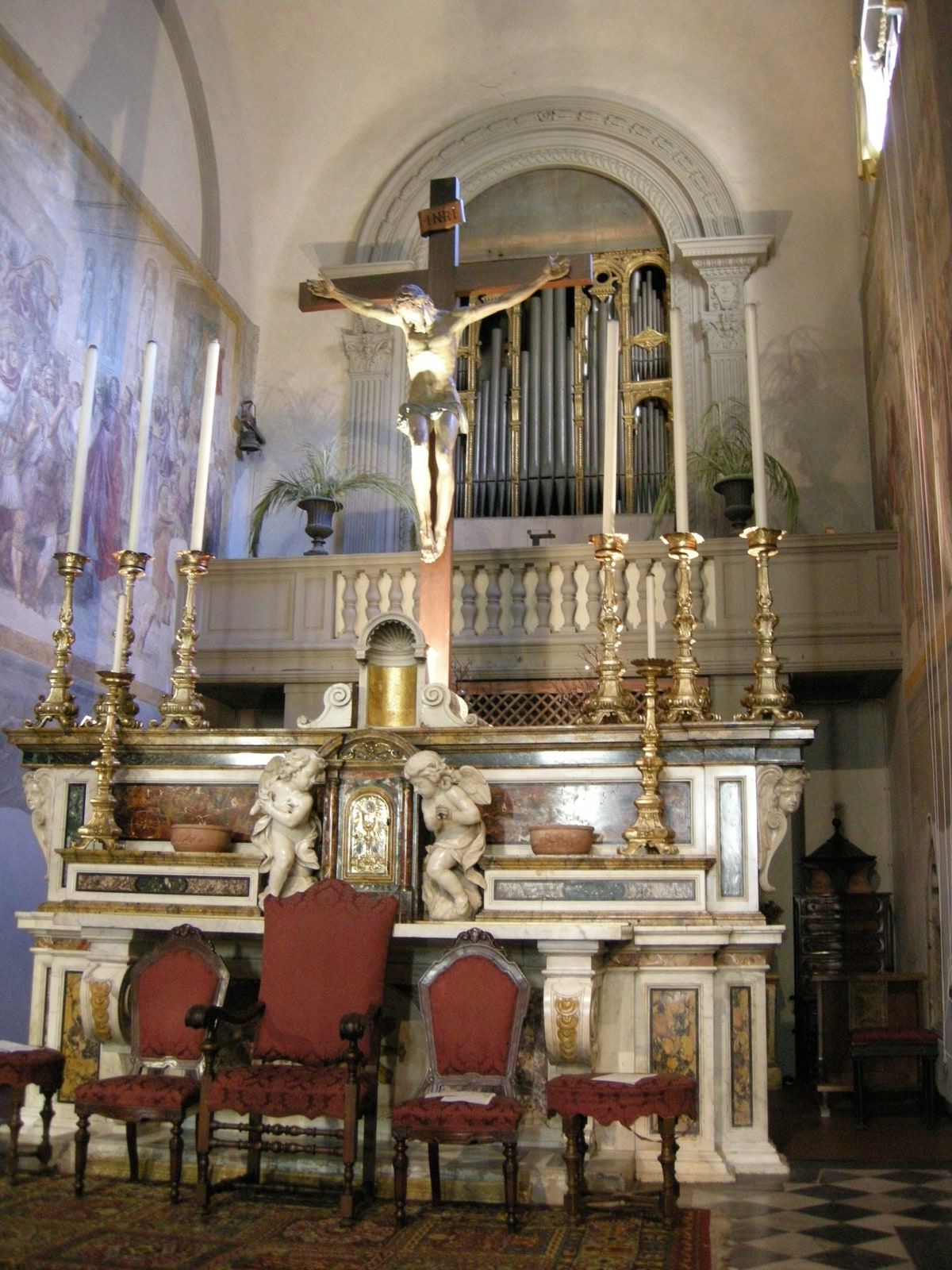
The church expanded in the late thirteenth century as pilgrimage and Eucharistic devotion grew. The Chapel of the Miracle was later formed beside the presbytery to house the ampoule. Its Renaissance program joins architecture, sculpture, and Cosimo Rosselli's fresco of the procession of the miraculous blood, turning the chapel itself into a visual record of Florence's public devotion.
The second tradition dates to Good Friday, March 24, 1595, when fire damaged the high altar and tabernacle. A pyx fell and opened; consecrated hosts were recovered from the carpet and were said to have remained intact despite the heat. The joined fragments were preserved in a separate reliquary at Sant’Ambrogio.
Catholic Tourist distinguishes the received event narratives from the facts that can be independently located today. Sant’Ambrogio is an active parish of the Archdiocese of Florence; the Chapel of the Miracle, the art created around the devotion, and the historic reliquaries are documented. Popular retellings differ in small chronological and descriptive details, so this page attributes the miracle accounts rather than presenting every embellishment as equally established.
The church reopened after recent structural and roof work, but current access to the chapel or reliquaries should still be confirmed with the parish. Come first for prayer or Mass. Then study the chapel slowly: Florence’s Eucharistic memory is expressed not only in the reported phenomena, but in centuries of worship, procession, patronage, and sacred art.
Visit one church containing two separate Eucharistic traditions. Read the 1230 chalice account and the 1595 fire independently, then spend time with the Chapel of the Miracle and its sacred art.
The story & the place today
What happened here—and what a pilgrim can find now
Each record separates the devotional tradition from the present-day visitor evidence. A mapped locality remains visible even when an exact shrine or surviving object has not yet been verified.
The chalice tradition of 1230
The received account says that Father Uguccione found material resembling living, coagulated blood in a chalice after Mass. It was placed in a crystal ampoule and became the center of public devotion.
Church of Sant’Ambrogio, Florence
Crystal ampoule containing the material associated with the reported event
Chapel and treasury context at the Church of Sant’Ambrogio
Historic public devotion current schedule unverified
Visitor note: Active parish; confirm current exposition and chapel access
Church wording: Longstanding local Catholic Eucharistic devotion — Parish and Archdiocese of Florence; preserved in the Carlo Acutis exhibition record
The devotion helped shape the church’s later Chapel of the Miracle and its Renaissance art program. Surviving accounts are later than the reported event and should be read as transmitted tradition.
The Good Friday fire of 1595
During a Good Friday fire, a pyx fell from the damaged tabernacle. Consecrated hosts recovered from the carpet were reported to have survived the heat and were preserved together.
High altar area of the Church of Sant’Ambrogio, Florence
Joined fragments of consecrated hosts associated with the 1595 fire
Church of Sant’Ambrogio, Florence
Historic public devotion current schedule unverified
Visitor note: Active parish; confirm current exposition and chapel access
Church wording: Longstanding local Catholic Eucharistic devotion — Parish and Archdiocese of Florence; preserved in the Carlo Acutis exhibition record
The second tradition is distinct from the 1230 chalice account but is preserved in the same church and often presented with it.
The sacred connection
People and objects remembered here
These relationships are part of the destination record, with feast days and catalog qualifications shown where available.
Eucharistic relic · Historic object publicly venerated within the local Catholic tradition
Ask the parish whether the reliquary and Chapel of the Miracle are accessible on the day of the visit.Eucharistic relic · Historic object publicly venerated within the local Catholic tradition
Access can differ from ordinary church opening and Mass times.What to notice
Look closely at the place and its story
Two events, one church
Keep the 1230 chalice tradition and the 1595 Good Friday fire distinct.
Chapel of the Miracle
Read architecture and fresco as a centuries-long expression of Eucharistic devotion.
The crystal ampoule
Ask whether the reliquary associated with the 1230 account is visible during your visit.
A living Florentine parish
Let the historical devotion lead toward prayer and the Eucharist celebrated today.
How to read this page
Sources, tradition, and what is verified
The destination record was last checked on 9/22/2026.
This page records the site’s tradition as “Roman Catholic; Florentine Eucharistic devotion.” That wording describes the nature of the claim and keeps devotional tradition distinct from independently verified history.