Why pilgrims come
Discover what makes Cathedral of Santo Stefano and the Holy Belt of Our Lady a place of pilgrimage
At the entrance of Prato Cathedral, behind a bronze gate and beneath a cycle of fourteenth-century frescoes, the city keeps what it calls its most precious religious and civic treasure: the Sacra Cintola, or Holy Belt of the Virgin Mary. The relic is a narrow greenish strip of fine goat wool, about eighty-seven centimeters long and brocaded with gold thread. It is ordinarily secured beneath the altar of its own chapel rather than left continuously visible.
Its meaning begins with an ancient Christian tradition surrounding Mary’s Assumption. In the version preserved at Prato, the apostles gathered for Mary’s death and burial, but St. Thomas was absent. Brought later to the Mount of Olives, Thomas saw Mary being taken into heaven and called to her. She cast down her belt as a sign of favor and as testimony to what he had witnessed. This is devotional tradition, not an episode narrated in Scripture and not a doctrine Catholics are required to accept. The Assumption itself is Catholic dogma; the belt narrative is not.
The official diocesan history is unusually candid about the relic’s provenance. Belts associated with Mary were reported in several ancient churches, especially Jerusalem and Constantinople. The Diocese of Prato says its belt may derive from the belt venerated at Jerusalem, perhaps as a contact relic or by incorporating small portions, but it does not claim that modern historical or scientific evidence can prove Mary personally wore the object. Its spiritual importance comes from centuries of Marian devotion and ecclesial custody, not from an archaeological certainty Catholic Tourist cannot establish.
Prato’s local tradition follows the belt from St. Thomas to an Eastern-rite priestly family in Jerusalem. Around 1140, a poor Pratese pilgrim named Michele married a woman named Maria there. Her mother gave the couple a small rush basket containing the belt. Michele returned to Prato by sea in 1141 and kept the object private. Near his death, traditionally around 1172, he disclosed it and entrusted it to the provost of the parish church of Santo Stefano. Documentary evidence confirms that the belt was being kept and publicly venerated at Prato by the thirteenth century.
The belt soon became inseparable from the identity of the city. Municipal statutes regulated its public exposition, and civic officials retained keys needed to open its secure enclosure. The arrangement continues symbolically today: the reliquary is protected through three keys, two associated with the municipality and one with the Diocese. This shared custody explains why the annual September celebration is both a Marian feast and Prato’s principal civic ceremony.
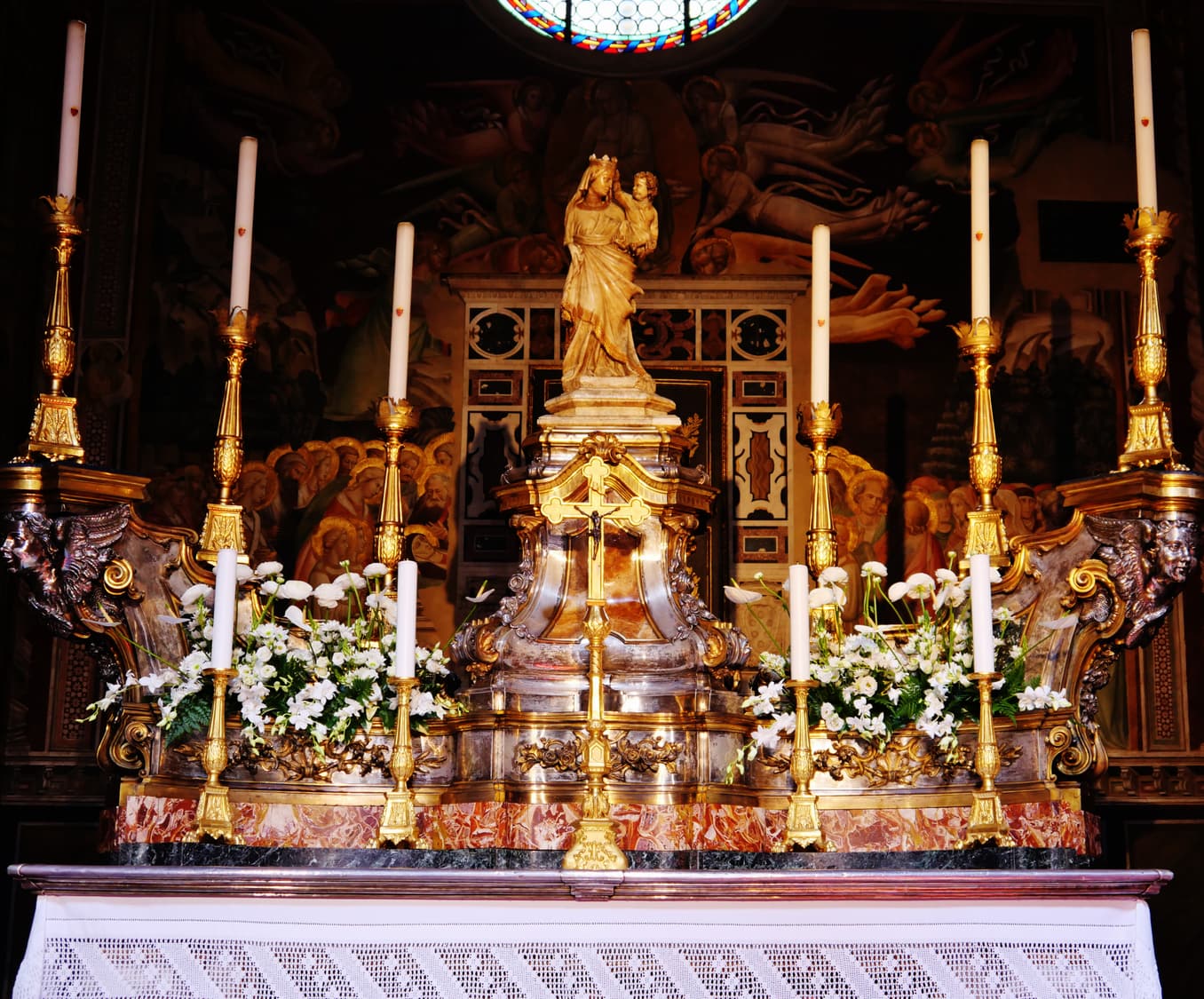
The present Chapel of the Sacra Cintola was built from 1386 to 1390 and received the relic in 1395. Agnolo Gaddi and his workshop painted its walls between 1392 and 1395 with stories of the Virgin and the belt’s journey to Prato. The cycle includes the empty tomb, Thomas receiving the belt, Michele’s marriage and voyage, and the final transfer to the church. The chapel’s bronze screen was fashioned by Maso di Bartolomeo and collaborators, while Giovanni Pisano’s Madonna and Child gives the space another major work of sacred art.
The cathedral’s exterior pulpit was created by Donatello and Michelozzo for the public exposition. During the solemn rite, the bishop shows the belt to those gathered inside and then from the pulpit to the crowd in Piazza del Duomo. The original dancing-child reliefs from the pulpit are preserved in the Cathedral Museum; replicas now face the square. The museum also preserves earlier reliefs illustrating Mary’s Dormition and the delivery of the belt to Thomas, as well as the fifteenth-century reliquary case that formerly held it.
Five canonical expositions are normally celebrated each year: Christmas, Easter, May 1, August 15, and September 8. The Assumption on August 15 is the feast most directly connected with the belt tradition. The September 8 Nativity of Mary brings the great historical procession and the most public outdoor exposition. Easter moves each year, and all liturgical times, access arrangements, and extraordinary expositions must be confirmed through the Diocese shortly before travel.
On ordinary days, pilgrims can pray before the chapel, but they should not expect the belt to be removed from its secure enclosure or available for a close view. Special guided visits sometimes open the normally restricted route from the chapel through the hidden passage between the cathedral’s two façades and onto Donatello’s pulpit. That route includes stairs and narrow passages and is not suitable for visitors with limited mobility. The normal cathedral visit and any museum visit operate separately.
A truthful pilgrimage holds faith and history together. Begin by asking Mary to strengthen the bonds of fidelity in families and within the Church. Remember St. Thomas, whose doubts and questions in Christian memory do not end in rejection but in encounter and witness. Then study the frescoes and museum objects as evidence of how one medieval city turned a Marian tradition into art, architecture, shared custody, and public prayer.
Do not describe the belt as scientifically authenticated clothing of the Virgin or the tradition as historical proof of the Assumption. The Diocese itself makes room for uncertainty about the object’s origin. That honesty does not empty the chapel of meaning. It protects the distinction between Catholic doctrine, received devotional tradition, material history, and personal faith.
The cathedral remains a working Roman Catholic church and the seat of the Diocese of Prato. Worship takes precedence over touring. Masses, funerals, solemnities, conservation work, and the exposition rites can change access. Check the cathedral or diocesan calendar before making a special journey, dress for a sacred space, and approach the chapel as a place of prayer rather than simply a display case.
Pray before the chapel that safeguards Prato’s Holy Belt tradition, study Agnolo Gaddi’s painted narrative, and understand the careful boundary between the Assumption, devotional tradition, and the relic’s material history.
The sacred connection
People and objects remembered here
These relationships are part of the destination record, with feast days and catalog qualifications shown where available.
the belt is venerated by tradition as hers and as a sign connected with her Assumption
Feast: August 15the ancient tradition says Mary gave him the belt as a sign of her Assumption
Feast: July 3titular patron of the cathedral
Feast: December 26Relic recorded in the catalog
What to notice
Look closely at the place and its story
Chapel of the Sacra Cintola
Pray before the secured reliquary in the chapel created specifically for Prato’s most important Marian devotion.
Agnolo Gaddi’s painted story
Read the tradition through frescoes of Mary, St. Thomas, Michele’s journey, and the belt’s arrival in Prato.
Donatello’s exterior pulpit
See the pulpit designed so the bishop could show the relic to pilgrims filling Piazza del Duomo.
Five annual expositions
Plan carefully for one of the canonical occasions, especially the Assumption or Prato’s September 8 procession.
Cathedral Museum
Encounter the original pulpit reliefs, earlier belt narratives, and the former fifteenth-century reliquary case.
Faith without exaggeration
Honor an eight-century devotion while preserving the Diocese’s own distinction between tradition and demonstrated provenance.
Feasts, anniversaries & celebrations
How to read this page
Sources, tradition, and what is verified
The destination record was last checked on 11/13/2026.
This page records the site’s tradition as “Roman Catholic — Diocese of Prato.” That wording describes the nature of the claim and keeps devotional tradition distinct from independently verified history.
Continue nearby