Why pilgrims come
Discover what makes Church of the Nativity of Jesus and the Madonna degli Agonizzanti a place of pilgrimage
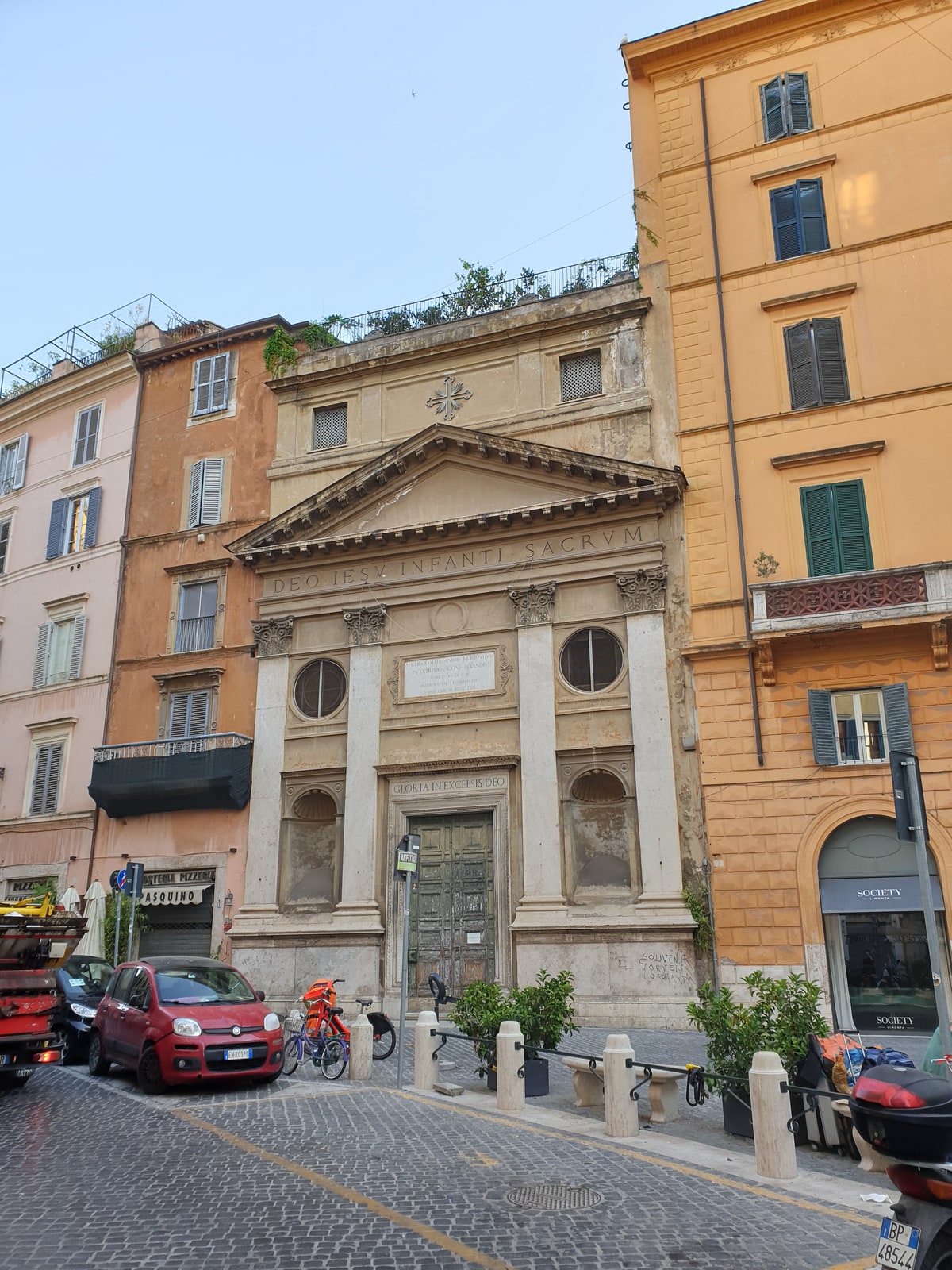
On Piazza Pasquino, a few steps from Piazza Navona, the small Church of the Nativity of Jesus preserves the original institutional home of the Madonna Addolorata degli Agonizzanti. The church was founded in 1692 for the Archconfraternity of the Company of the Nativity. Its members became known as the Agonizzanti because they prayed for people near death and for those condemned to die. The present neo-Renaissance appearance largely dates from an 1862 rebuilding by Andrea Busiri Vici. Its façade still announces the mystery at the church's heart: Gloria in excelsis Deo above the portal and Deo Iesu Infanti sacrum across the pediment.
The Madonna Addolorata degli Agonizzanti belongs to Rome's intensely remembered summer of 1796. According to contemporary devotional chronicles and the tradition preserved by the Diocese of Rome, several Marian images in and around the city were reported to move their eyes while the Papal States faced political and military pressure from Revolutionary France. The image associated with the Archconfraternity of the Agonizing was said to begin moving its eyes on 11 July and to continue intermittently until 2 December. The reports drew clergy and ordinary Romans, encouraged prayer, and gave rise to a devotion that endured after the immediate crisis passed.
The language matters. Catholic Tourist records an established Roman devotional tradition, historic testimony, and continuing public veneration; it does not claim that a moving image has been scientifically demonstrated or that every later healing attributed by devotees has received a formal Church judgment. The image is honored as Our Lady of Sorrows, directing prayer toward Mary's compassion at the Passion of Christ. Its ecclesial significance is found in the community that has preserved it, the liturgy of September 15, and the prayer it continues to inspire.
This is the image's traditional home, but it is not currently the dependable place to see it. The Diocese of Rome reported in September 2026 that the Piazza Pasquino church was closed for restoration and that the image had been moved to the Sanctuary of San Salvatore in Lauro. Earlier in the year ANSA described that transfer as the first exceptional public move in centuries. Travelers should therefore treat this destination as the historic origin of the devotion and verify the restoration status before approaching. For present public veneration, use the linked San Salvatore in Lauro destination and check the sanctuary's current announcements.
The church also bears a living international identity as the national church of the Democratic Republic of the Congo in Rome. That layer should not be eclipsed by the 1796 story. The building gathers the Nativity of Christ, prayer for the dying, Congolese Catholic life, and a Roman Marian devotion within one modest sanctuary. When it reopens, it should be entered not merely as the container of a famous image but as the home of communities that have prayed here across centuries.
Treat Piazza Pasquino as the historic origin of the devotion. Read the confraternity’s mission of prayer for the dying, notice the Nativity inscriptions, and then continue to San Salvatore in Lauro for the image’s current public veneration while restoration continues.
What to notice
Look closely at the place and its story
The image’s traditional home
Locate the church in which the Archconfraternity preserved the Madonna Addolorata degli Agonizzanti for centuries.
Prayer for the dying
Remember why the confraternity was called the Agonizzanti: members accompanied people near death and those condemned to die with prayer.
A careful 1796 remembrance
Learn the received testimony about the reported eye movements without presenting the tradition as a modern scientific proof.
The Nativity façade
Read the Latin inscriptions that dedicate this small church to the infant Jesus.
Congolese Catholic Rome
Recognize the church’s continuing identity as the national church of the Democratic Republic of the Congo.
Feasts, anniversaries & celebrations
How to read this page
Sources, tradition, and what is verified
The destination record was last checked on 9/20/2026.
This page records the site’s tradition as “Roman Catholic; Marian devotion preserved by the Archconfraternity of the Agonizing.” That wording describes the nature of the claim and keeps devotional tradition distinct from independently verified history.
Continue nearby