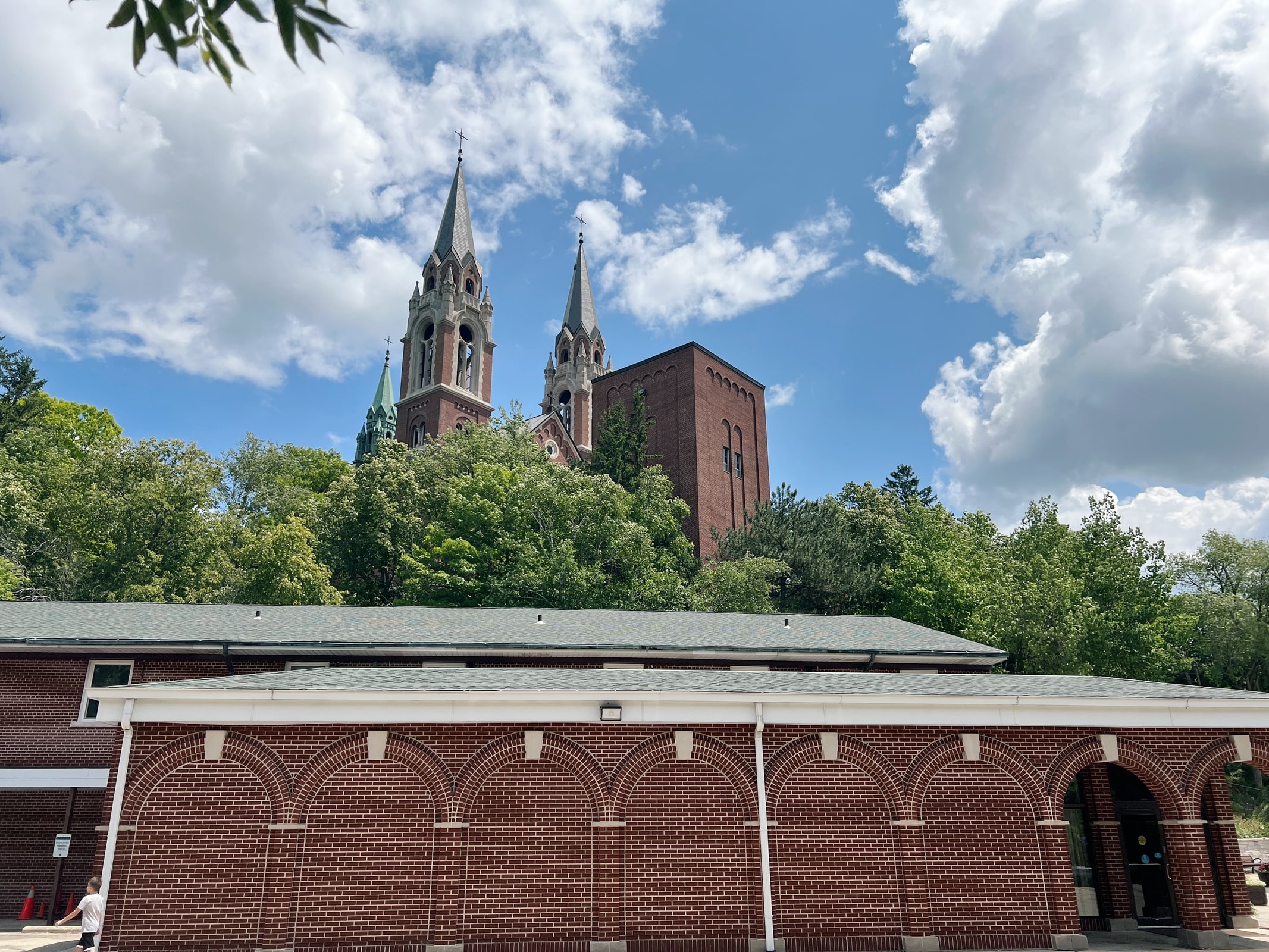
Why pilgrims come
Discover what makes Holy Hill Basilica and National Shrine of Mary Help of Christians a place of pilgrimage
Northwest of Milwaukee, twin towers rise above a wooded glacial hill that has drawn generations of Wisconsin Catholics into prayer. Holy Hill is the Basilica and National Shrine of Mary Help of Christians, a Discalced Carmelite sanctuary set within roughly 435 acres of forest. Its most memorable approach is not a driveway but a half-mile outdoor Way of the Cross: fourteen stations climbing the hill with nearly life-size stone figures until the pilgrim reaches the final station outside the lower church.
The hill’s Catholic story is layered with early local traditions, but its documented shrine life begins in the nineteenth century. A log chapel was dedicated to Mary Help of Christians on May 24, 1863. Pilgrimage grew, larger churches followed, and the Discalced Carmelites accepted care of the shrine in 1906. The present Romanesque church was dedicated on July 19, 1931. Pope Benedict XVI granted it the title of minor basilica in 2006, recognizing a place already known nationally for Marian devotion, reconciliation, retreat, and pilgrimage.
The outdoor Stations of the Cross give the landscape its distinctive spiritual grammar. Milwaukee sculptor Joseph Aszklar spent fourteen years creating the Bedford-stone figures, completing the ensemble in 1928. The scenes are not small plaques passed in a corridor. Figures close to human scale stand in chapels along the wooded ascent, asking the pilgrim to slow down, walk, look, and pray through Christ’s Passion with the whole body. The route culminates at the fourteenth station near the lower church, so the physical climb becomes a catechesis in suffering, burial, and hope.
That sequence matters. Holy Hill can be admired as architecture or landscape, especially in autumn, but the shrine is not primarily a scenic overlook. Begin with the Stations when weather, mobility, and daylight permit. Bring Scripture or a short form of the Way of the Cross. Allow quiet between the stations. Then enter the basilica for prayer before the Blessed Sacrament, Mass, or confession. The title Mary Help of Christians points beyond Mary to the help she gives by leading disciples toward her Son.
The basilica’s elevated nave and towers make the church visible across the countryside, while the lower church and shrine chapels provide more intimate places of prayer. Carmelite custody gives Holy Hill a contemplative center: prayer, silence, the Eucharist, and trust in Mary’s intercession are more important than collecting photographs from every vantage point. The official visitor guidance also describes the shrine as active year-round, not merely a seasonal heritage attraction.
Holy Hill is unusually well suited to a retreat rather than a rushed visit. The shrine operates simple overnight accommodations in the Old Monastery Inn and New Guest House. These are pilgrimage and retreat lodgings, not resort rooms, and the historic buildings are not wheelchair accessible. Reservations and current conditions must be confirmed directly with the shrine. An overnight stay allows a pilgrim to attend the daily liturgical rhythm, make confession, walk the grounds without haste, and experience the hill after day visitors have departed.
The official schedule currently lists daily Mass, multiple Sunday Masses, scheduled confession, and Tuesday Eucharistic adoration. Because schedules change for feast days, winter weather, retreats, and major pilgrimages, use the live shrine page immediately before travel rather than relying on a copied timetable. The grounds and basilica have their own daily access hours. Snow, ice, rain, heat, or fallen leaves can make the outdoor Stations difficult, and the ascent is not equally accessible to every pilgrim.
Visitors with limited mobility should not feel that missing the steep outdoor route makes the pilgrimage incomplete. Pray the Stations inside or in another accessible place, attend Mass, and ask the shrine about current accommodations. Families should supervise children closely on stairs and wooded paths. During liturgies, avoid intrusive photography and remember that the basilica is a church before it is a landmark.
Holy Hill pairs naturally with Marquette University’s St. Joan of Arc Chapel in Milwaukee and with the National Shrine of Our Lady of Champion farther north. Yet it offers something distinct: sacred geography shaped deliberately into prayer. The hill, forest, path, sculpted Passion, basilica, and Carmelite presence work together. A good visit does not end with the final station. It continues into the church, where the Passion just contemplated is joined to the Eucharist, and then into ordinary life, where the pilgrim is asked to carry the Cross with greater love.
Climb the wooded half-mile Way of the Cross, enter the basilica for Eucharistic prayer and reconciliation, and let the Carmelite shrine turn beautiful Wisconsin landscape into a pilgrimage with Christ and Mary.
What to notice
Look closely at the place and its story
The outdoor Way of the Cross
Walk fourteen wooded stations with nearly life-size Bedford-stone figures, completed by Joseph Aszklar in 1928 after fourteen years of work.
A climb that becomes prayer
Let the half-mile ascent slow the body and attention before reaching the fourteenth station outside the lower church.
Basilica of Mary Help of Christians
Enter the church not merely for its towers and views, but for Mass, the Blessed Sacrament, confession, and Marian prayer centered on Christ.
Discalced Carmelite custody
Receive the hill through the Carmelite values of silence, contemplation, Eucharistic worship, and trust in Mary’s intercession.
Stay for retreat
Reserve simple shrine lodging and allow the pilgrimage to extend beyond a day visit into the sanctuary’s daily rhythm.
A holy mountain in Wisconsin
See how forest, glacial height, sacred art, and architecture work together to lift the pilgrim toward prayer.
Feasts, anniversaries & celebrations
Holy Hill offers simple retreat lodging in the Old Monastery Inn and New Guest House. The shrine states that the historic lodging is not wheelchair accessible; reserve directly and confirm current availability.
Accommodation details ↗How to read this page
Sources, tradition, and what is verified
The destination record was last checked on 10/22/2026.
This page records the site’s tradition as “Roman Catholic — Discalced Carmelite Friars; Archdiocese of Milwaukee.” That wording describes the nature of the claim and keeps devotional tradition distinct from independently verified history.
Continue nearby