Why pilgrims come
Discover what makes St. Joan of Arc Chapel at Marquette University a place of pilgrimage
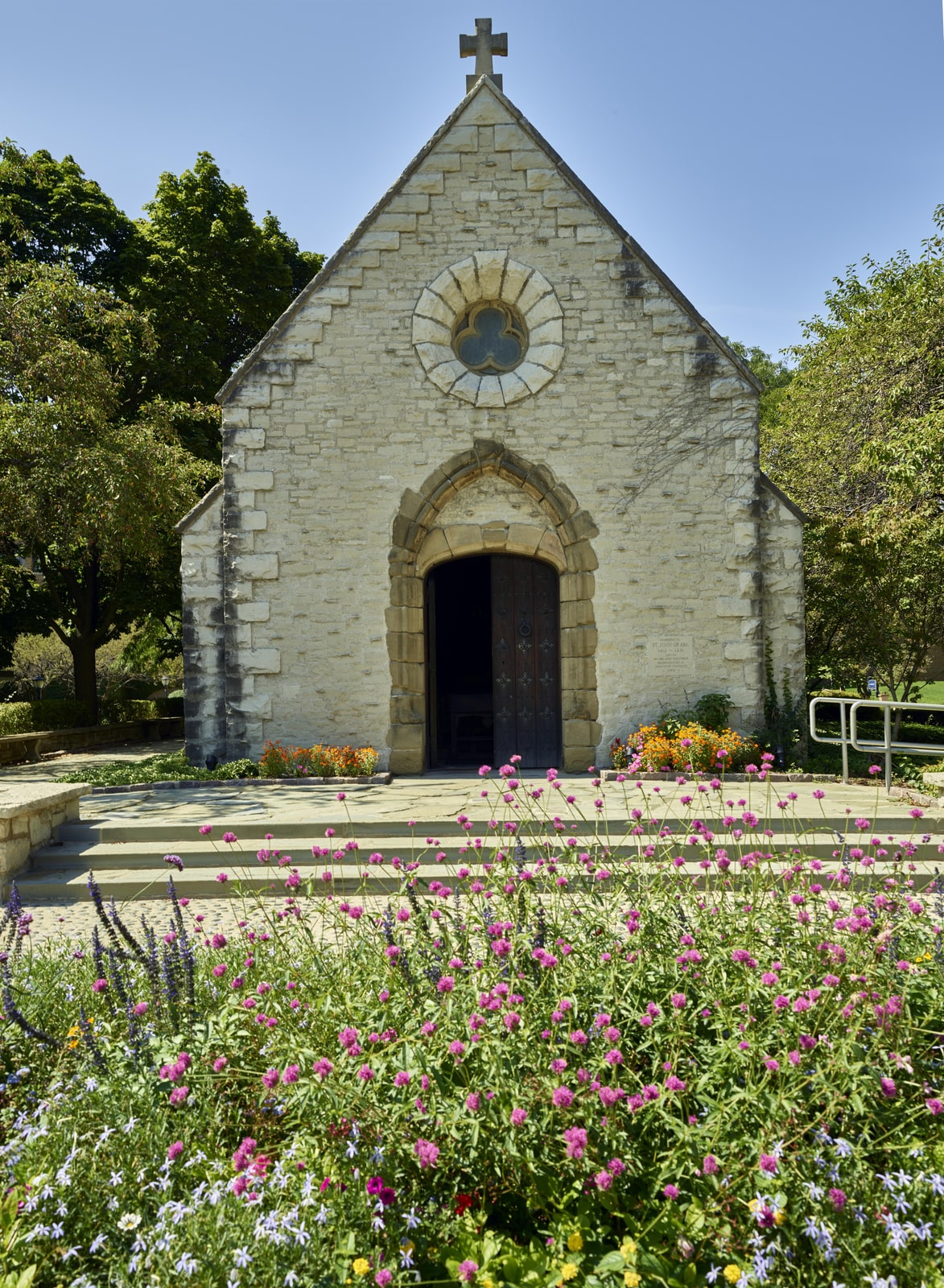
In the middle of Marquette University’s Milwaukee campus stands a Catholic chapel whose stone walls began their life in southeastern France around 1420. St. Joan of Arc Chapel is not a modern replica or a themed reconstruction. Much of the building is the medieval Chapelle de St. Martin de Seyssuel, carefully dismantled, transported across the Atlantic, rebuilt on Long Island, dismantled again, and finally reconstructed stone by stone at a Catholic university in Wisconsin. Its journey is extraordinary, but the chapel’s deepest continuity is simpler: after six centuries and three locations, it is still a place where people gather for Mass and prayer.
Marquette traces the chapel to the village of Chasse in the Rhône Valley, south of Lyon. The small Gothic church served local Christians for centuries before falling into disrepair. In the 1920s, French architect and historian Jacques Couëlle measured the building, photographed it, drew it, and numbered its stones. Gertrude Hill Gavin, an American collector and devotee of the recently canonized Joan of Arc, then acquired the chapel and moved it to her estate in Jericho, Long Island. France soon enacted stricter protections against the export of monuments of this kind, making the chapel’s passage to the United States especially unusual.
The building was originally dedicated to St. Martin and was not known as a Joan of Arc shrine in medieval France. Gavin renamed it for St. Joan, added French-style stained glass by Charles Connick, and furnished it with a thirteenth-century Gothic altar. In 1933 Pope Pius XI granted written permission for Mass to be celebrated there; Marquette preserves that letter in the nave. These are documented chapters in the chapel’s American Catholic history and explain how a neglected village chapel became an active place of worship again.
Gavin also installed the object now called the Joan of Arc Stone in a niche behind the altar. A devotional tradition says that Joan stood or knelt upon the stone in prayer, kissed it, and that it remains colder than the surrounding stones. Some versions also suggest that Joan prayed in or near the original chapel after meeting the future Charles VII in 1429. Marquette’s own historical page is appropriately cautious: Joan’s connection to the building has long been debated, the stone’s early provenance is unresolved, and a 1967 investigation found no clear account of how it first entered the chapel. Catholic Tourist therefore presents the stone as a cherished devotional tradition—not as a verified relic or archaeological proof that Joan worshipped inside this building.
That distinction does not diminish St. Joan herself. Born in Domrémy in 1412, she understood her mission through prayer, the sacraments, and the voices she attributed to St. Michael, St. Catherine, and St. Margaret. She helped rally France during the Hundred Years’ War, was captured, and faced a politically compromised ecclesiastical trial. On May 30, 1431, at nineteen, she was burned at the stake in Rouen while invoking the name of Jesus. A Church-authorized trial of nullity overturned the condemnation in 1456. Pope Benedict XV canonized her in 1920, and the Church celebrates her on May 30.
The chapel’s second American move began after a devastating 1962 fire ravaged the Long Island château to which it was attached. The chapel survived. Its new owners, Marc and Lillian Rojtman, wanted the building to continue as a place of worship and offered it to Marquette in 1964. Workers spent nine months dismantling and marking the stones before a fleet of trucks carried them to Milwaukee. Reconstruction began in 1965. The builders lengthened the nave and added electricity and radiant floor heating, so the present chapel should not be imagined as an untouched building frozen in 1420. It is a careful transplantation that preserves medieval fabric while honestly bearing the marks of adaptation.
Marquette dedicated the reconstructed chapel on May 26, 1966. It quickly became the spiritual heart of the university: a small space for weekday Mass, private prayer, vigils, grief, gratitude, and the formation of students. That living use matters more than the novelty of finding medieval stone in the American Midwest. The chapel is not a museum that happens to contain an altar; it is an active Catholic sacred space within a Jesuit university.
Pilgrims should begin with the altar and tabernacle rather than rushing immediately to the Joan Stone. Look closely at the original masonry, the Gothic proportions, Connick’s stained glass, and the medieval marks that survive on some stones. Then approach the niche behind the altar with the right category in mind: it is a place where generations have remembered Joan’s fidelity, while the specific physical association remains unproven. The most authentic way to honor her here is to imitate her attention to Christ, courage under pressure, and reliance on the sacraments.
The chapel currently publishes visitor hours from 10 a.m. to 4 p.m. Monday through Saturday and noon to 4 p.m. Sunday, but Marquette warns that hours can change without notice and lists special closures. During fall and spring semesters when classes are in session, the published Mass schedule is noon on Monday, Wednesday, and Friday; 10 p.m. on Tuesday and Thursday; and 10 a.m. on Saturday. These schedules are useful planning information, not a guarantee. Check the live visitor page immediately before travel, especially during university breaks, holidays, restoration work, or campus events.
The chapel stands on the south side of Marquette’s campus, west of Raynor Memorial Libraries, with visitor parking available in the 16th Street structure. It is small, and regular liturgies can reach capacity. Enter as a guest of a worshipping university community, dress modestly, keep voices low, ask before taking photographs during prayer or Mass, and never treat the sanctuary or the Joan Stone as props. No weddings or baptisms are held there. A thoughtful visit can be combined with the Church of the Gesu and other Marquette sacred spaces, but leave enough silence for this improbable little chapel to become what it was built to be: a place of encounter with God.
Step into a medieval French chapel now alive at a Jesuit university, pray at Mass if the academic calendar permits, and encounter St. Joan’s witness while keeping the beloved Joan Stone tradition distinct from established provenance.
The sacred connection
People and objects remembered here
These relationships are part of the destination record, with feast days and catalog qualifications shown where available.
What to notice
Look closely at the place and its story
Medieval France in Milwaukee
Read the numbered, reassembled stones as witnesses to a chapel begun around 1420 and moved twice before reaching Marquette.
A living Catholic chapel
Attend Mass when the university schedule permits and encounter the building as the prayerful heart of a Jesuit campus rather than a historical exhibit.
The Joan Stone—with honesty
Honor the tradition attached to the stone while remembering that Marquette says its provenance and Joan’s presence here remain unresolved.
The 1962 fire and second journey
Trace how the chapel survived the Long Island estate fire, was donated to Marquette, and traveled to Wisconsin in marked pieces.
Stained glass and Gothic altar
Study Charles Connick’s medieval-inspired windows and the thirteenth-century altar added during the chapel’s Long Island life.
A pilgrimage of courage
Let St. Joan’s fidelity to Christ, courage under trial, and sacramental life become the spiritual center of the visit.
Feasts, anniversaries & celebrations
How to read this page
Sources, tradition, and what is verified
The destination record was last checked on 10/16/2026.
This page records the site’s tradition as “Roman Catholic — Marquette University Campus Ministry; Archdiocese of Milwaukee.” That wording describes the nature of the claim and keeps devotional tradition distinct from independently verified history.
Continue nearby