Why pilgrims come
Enter a place shaped by prayer, community, and pilgrimage
Before Mont-Saint-Michel was a monument, a fortress, or one of France's most recognizable silhouettes, it was a place of prayer dedicated to St. Michael the Archangel. The official abbey history begins with a dramatic foundation tradition. In 708, the Archangel Michael reportedly appeared in dreams to Aubert, bishop of Avranches, and asked him to build a sanctuary on the rocky island then called Mont-Tombe. Aubert hesitated. The request came again. According to the medieval legend preserved by the site, the bishop still did not act, and on the third appearance Michael pressed a finger against Aubert's skull, leaving a deep mark that finally overcame his doubt. Aubert then established an oratory on the summit and sent envoys to the sanctuary of St. Michael on Monte Gargano in Italy for relics with which to dedicate it.
The repeated dreams and the mark on Aubert's skull belong to the received foundation legend, not to a contemporary historical record that can now be independently verified. That distinction is important, but it does not make the tradition disposable. It explains how medieval Christians understood this improbable sanctuary: as an answer to a heavenly summons, built where sea, sky, danger, and isolation made the struggle between faith and fear almost visible. The rock became Mont-Saint-Michel, the Mount of Saint Michael.
The documented monastic story took firmer shape in 966, when Richard I, duke of Normandy, installed Benedictine monks on the mount. Their abbey developed into one of medieval Western Europe's great pilgrimage destinations and intellectual centers. Construction of the Romanesque abbey church began, by tradition, in 1023 on a summit so narrow that builders had to create supporting crypts and platforms against the slopes of the rock. The result was not a single architectural campaign but centuries of audacity: Romanesque church, Gothic choir, cloister, refectory, guest rooms, chapels, defensive walls, and the celebrated group of thirteenth-century buildings called La Merveille—"the Marvel."
The architecture is inseparable from the pilgrimage. Medieval travelers crossed difficult roads and dangerous tidal flats to reach the sanctuary of the archangel. Monks copied and studied manuscripts within the abbey while pilgrims climbed through the village toward worship at the summit. The mount became a place where physical ascent expressed an interior one. Its narrow streets, stairs, gates, and terraces still preserve that vertical drama: the pilgrim moves from the mainland, through the fortified village, above the roofs, and finally into the abbey church and cloister.
Mont-Saint-Michel also survived war. During the Hundred Years' War, English forces repeatedly besieged it, especially between 1423 and 1434, but never captured the mount. Its resistance strengthened its symbolic place in French memory. The abbey's religious community declined in later centuries, however, and after the French Revolution the complex was converted into a prison. Clergy and political prisoners were held within the former monastery until the prison closed in 1863. The state classified the abbey as a historic monument in 1874 and undertook the long restoration that helped rescue the buildings from ruin.
The site is therefore not merely a picturesque medieval village. It holds several different histories at once: an ancient sanctuary of St. Michael, a Benedictine abbey, a school of manuscripts and learning, a military stronghold, a prison, a national monument, and once again a living place of Christian prayer. Since 2001, members of the Monastic Fraternities of Jerusalem have maintained a regular liturgical presence in the abbey. Their daily offices and Mass restore the most important sound to these immense rooms: prayer.
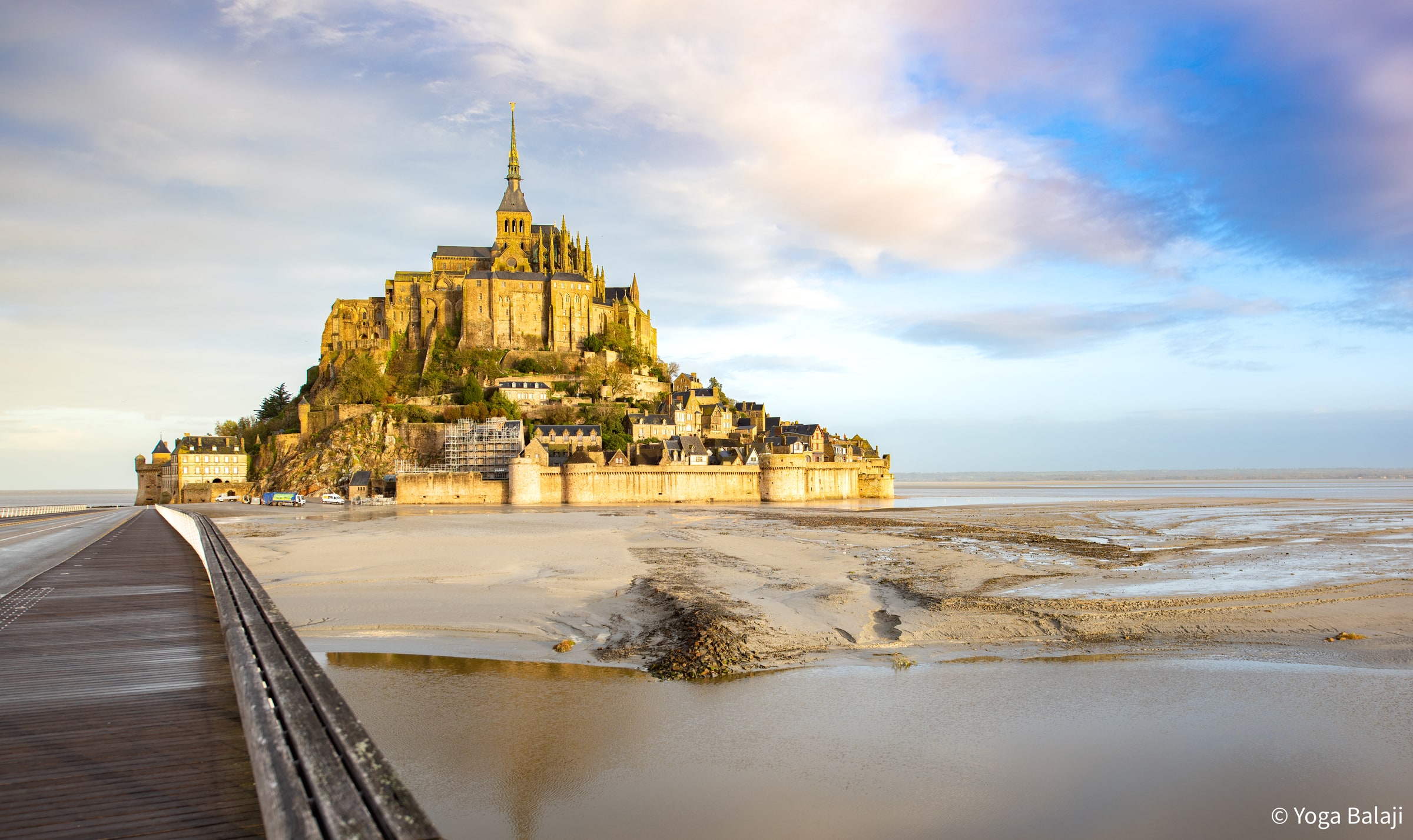
The tides remain part of the experience, but modern access needs to be described accurately. Mont-Saint-Michel is no longer a place that ordinary visitors can reach only at low tide. A pedestrian bridge and the free "Le Passeur" shuttle connect the mainland visitor area with the mount throughout normal conditions. During the strongest spring tides, the sea can completely surround the rock and briefly transform it again into an island. The water may recede many kilometres across the bay and return with extraordinary speed. Walking the tidal flats alone is dangerous; the official abbey and destination authorities advise using an accredited guide.
For a Catholic pilgrim, the best visit is more than an architectural tour. Cross the bridge slowly enough to see the mount emerge as a destination rather than a photograph. Climb through the village, enter the abbey, and leave time for silence in the church. If possible, join the community for Lauds, Mass, or Vespers; current liturgies and meeting points should be reconfirmed directly with the sanctuary. The ascent contains many steep streets and stairs, and the abbey itself is not wheelchair accessible, so travelers with mobility limitations should review the current access guidance before planning.
The foundation legend ends with a reluctant bishop finally responding to a call he could no longer ignore. That is why the story remains so powerful even when told with historical care. Mont-Saint-Michel asks what we do with a holy invitation that interrupts our plans. Aubert's hesitation makes the tale human; the sanctuary rising above the sea gives his eventual response a physical form. Stone by stone and century by century, a doubtful beginning became a place that still directs the eyes upward.
Approach Mont-Saint-Michel as a sanctuary before treating it as a monument. The ascent traces more than thirteen centuries: Aubert’s dramatic foundation tradition, the Benedictine abbey established in 966, the Romanesque church, La Merveille, the wartime fortress, the prison years, and the restored life of prayer. Join the monastic liturgy if possible and let the climb toward the abbey become an intentional pilgrimage.
The sacred connection
People and objects remembered here
These relationships are part of the destination record, with feast days and catalog qualifications shown where available.
titular patron and subject of the sanctuary foundation tradition
Feast: September 29What to notice
Look closely at the place and its story
Aubert’s three dreams
Learn the foundation legend in which Bishop Aubert hesitated twice before St. Michael reportedly left a mark on his skull during a third appearance.
Notre-Dame-sous-Terre
Look for the early sanctuary level beneath the later church, where the mount’s long architectural history becomes visible.
The abbey church
Enter the Romanesque and Gothic church built on the narrow summit above crypts and structural platforms.
La Merveille and the cloister
See the thirteenth-century Gothic complex whose stacked halls, refectory, guest spaces, and cloister earned the name “the Marvel.”
Living monastic prayer
Join Lauds, Mass, or Vespers when possible and remember that the abbey is again a living sanctuary, not only a heritage monument.
The tidal island
Watch the bay with caution and respect: powerful spring tides can completely surround the mount and transform the landscape within hours.
Feasts, anniversaries & celebrations
How to read this page
Sources, tradition, and what is verified
The destination record was last checked on 9/17/2026.
This page records the site’s tradition as “Catholic; Benedictine foundation and contemporary monastic liturgy.” That wording describes the nature of the claim and keeps devotional tradition distinct from independently verified history.
Continue nearby