Why pilgrims come
Understand the Marian devotion rooted in Sainte-Anne-d’Auray
In a small Breton village northwest of Vannes, the mother of the Virgin Mary is remembered not merely as the patroness named above a church door, but as the one who called a farming family to recover a forgotten place of prayer. The Basilica and Sanctuary of Sainte-Anne-d’Auray grew from the reported apparitions of St. Anne to Yvon Nicolazic between 1623 and 1625. Four centuries later, pilgrims still come to pray before St. Anne, honor the grandparents of Jesus, join the great Breton pardon, and bring the needs of families to God.
The story begins at Ker Anna—“the village of Anne,” according to the devotional tradition—where Nicolazic farmed land at Bocenno. The sanctuary’s official history says that in August 1623 he first perceived St. Anne’s presence. On the night of July 25–26, 1624, he reported hearing her identify herself: “I am Anne, mother of Mary.” She asked that a chapel once dedicated to her be rebuilt on the site. Catholic Tourist presents these events as the sanctuary and Church receive them: an established Catholic apparition tradition that nourishes devotion, while private revelation never replaces the Gospel or requires the assent owed to public revelation.
Nicolazic did not act alone or immediately. He consulted his parish priest, faced hesitation, prayed, and returned to the field. The decisive event came during the night of March 7, 1625. Guided by a torch, Nicolazic and companions unearthed a damaged wooden statue of St. Anne in the Bocenno field. The discovery transformed a private experience into a public pilgrimage. The first Mass connected with the renewed devotion was celebrated on July 26, 1625, and a chapel was blessed in 1628.
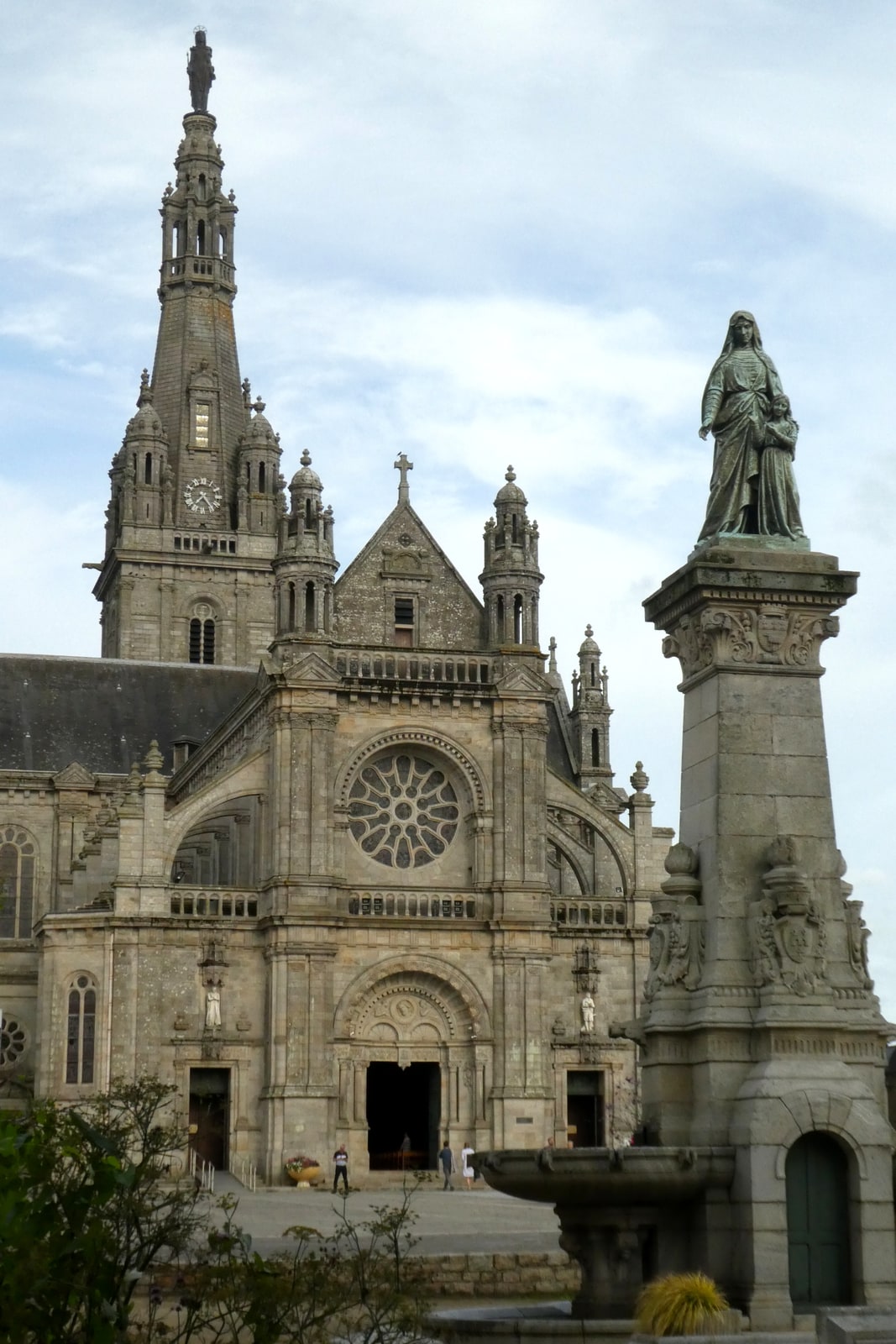
The little sanctuary could not contain the pilgrimage that followed. The present basilica was begun in 1866 and consecrated on August 8, 1877. Its scale should not obscure the field beneath the story: the church stands where the statue was found. Inside, a bas-relief marks that discovery, and the tomb of Yvon Nicolazic keeps the humble visionary within the pilgrimage he helped begin. The sanctuary also preserves the tomb of Pierre de Kériolet, a seventeenth-century Breton nobleman whose conversion and penitential life became intertwined with Sainte-Anne-d’Auray.
This is also a sanctuary of memory. Its treasury contains ex-votos and gifts left by pilgrims across centuries—objects that turn private gratitude into a visible archive of prayer. The cloister, memorial spaces, and the surrounding sanctuary grounds tell stories of Breton Catholic identity, war, mourning, healing, vocation, and family life. Read those offerings as testimony rather than decoration: each represents someone who believed a grace had been asked for or received.
The defining annual gathering is the Grand Pardon of Sainte-Anne-d’Auray on July 25 and 26. In Brittany, a pardon is not simply a festival; it is a penitential and communal pilgrimage centered on Mass, processions, confession, prayer, and the patronal feast. The sanctuary also marks March 7, the anniversary of the statue’s discovery. Pope St. John Paul II visited on September 20, 1996, praying with an immense crowd and confirming the sanctuary’s place in the Catholic life of Brittany. In 2025 the Church marked the four-hundredth anniversary of the beginning of the pilgrimage with a papal legate.
Pilgrims should begin in the basilica before exploring the larger complex. Pray near the tomb of Nicolazic, find the relief recalling the statue’s discovery, and allow the liturgy to give the apparition story its proper center in Christ. Then visit the fountain and the spaces that preserve votive memory. Families may naturally ask St. Anne’s intercession for marriages, children, grandparents, and the transmission of faith across generations.
The sanctuary publishes a full daily rhythm of Mass, Lauds, the Rosary, Vespers, confession, and seasonal visits, but times change with the liturgical year and pilgrimage season. Use the official schedule linked below immediately before traveling. The Grand Pardon draws very large crowds and requires advance planning. Outside the principal feast, the sanctuary can be quieter, making room for prayer and careful attention to the history.
Sainte-Anne-d’Auray makes a good western-France pilgrimage anchor with Querrien, Pontmain, Mont-Saint-Michel, and the sites associated with St. Louis de Montfort. But it deserves more than a quick regional stop. Its real invitation is domestic and intergenerational: faith received, forgotten, rediscovered, and handed on. A visit is complete not when every monument has been photographed, but when the pilgrim has entrusted a family—one’s own or another’s—to the grandmother of Jesus and returned to the sacraments with renewed hope.
Pray where Yvon Nicolazic reported St. Anne’s call and where the lost statue was found, then encounter a living Breton sanctuary shaped by family prayer, ex-votos, sacramental worship, and the Grand Pardon.
The sacred connection
People and objects remembered here
These relationships are part of the destination record, with feast days and catalog qualifications shown where available.
What to notice
Look closely at the place and its story
The Bocenno field and rediscovered statue
Stand where the sanctuary says the damaged statue of St. Anne was unearthed on March 7, 1625, turning Nicolazic’s private experience into public pilgrimage.
The tomb of Yvon Nicolazic
Pray near the farmer who reported the apparitions and persisted through doubt until the chapel was rebuilt.
The basilica and living liturgy
Let Mass, confession, the Rosary, and the Liturgy of the Hours keep the apparition story centered on Christ and sacramental life.
Treasury of ex-votos
Read centuries of votive gifts as a visible archive of gratitude, petition, family memory, and Breton faith.
The Grand Pardon
On July 25–26 the sanctuary becomes the center of a great Breton pilgrimage of penance, procession, worship, and communal identity.
Prayer across generations
Ask St. Anne’s intercession for grandparents, parents, children, vocations, and the faithful transmission of the Gospel.
Feasts, anniversaries & celebrations
How to read this page
Sources, tradition, and what is verified
The destination record was last checked on 10/22/2026.
This page records the site’s tradition as “Roman Catholic — Diocese of Vannes.” That wording describes the nature of the claim and keeps devotional tradition distinct from independently verified history.
Continue nearby