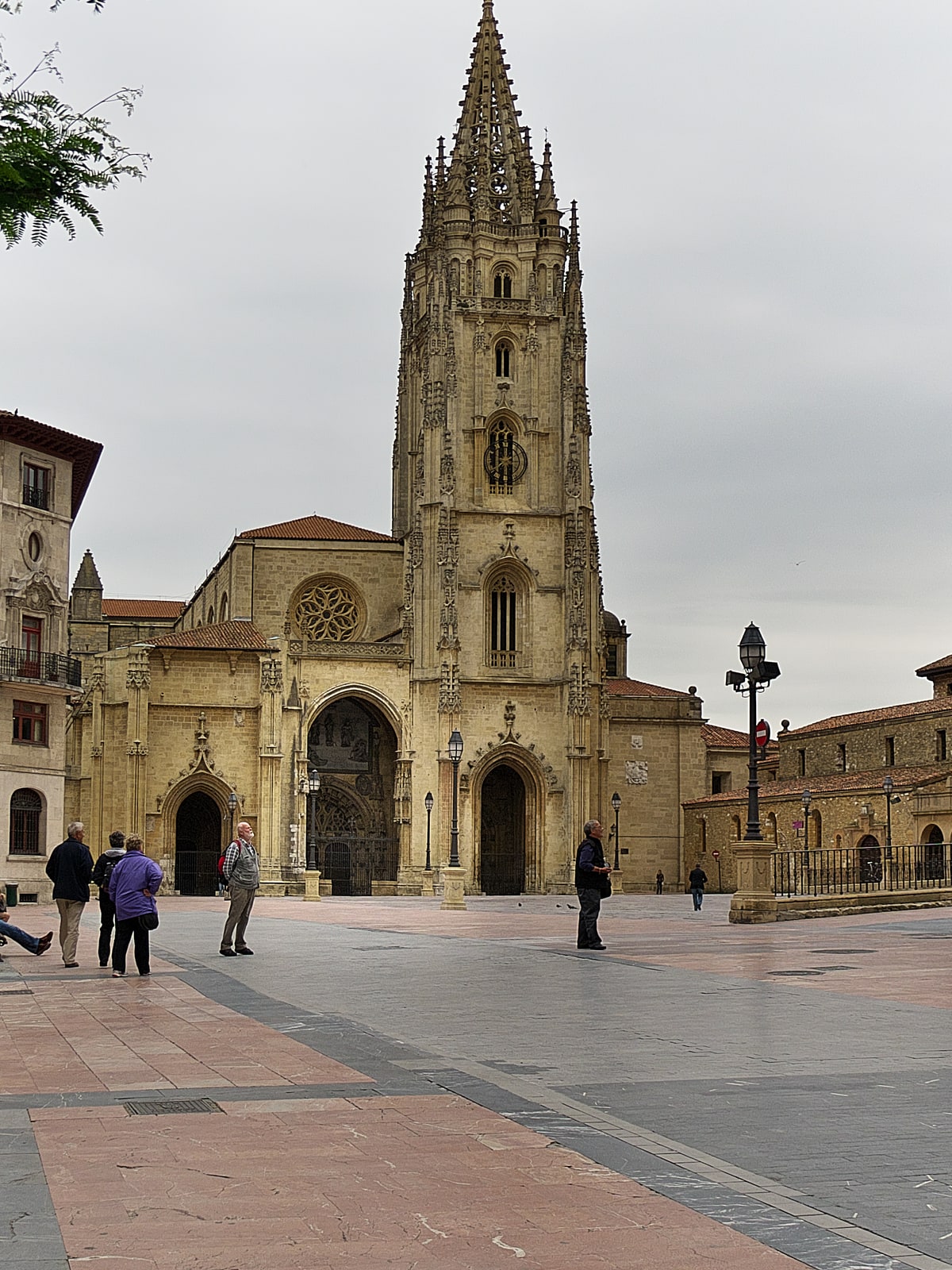
Why pilgrims come
Encounter a place shaped by the memory of Christ’s Passion
When Peter entered Christ’s empty tomb, John 20:6–7 says that he saw the linen burial cloths and, set apart from them, the soudarion that had covered Jesus’ head. Catholic tradition in Oviedo identifies a small, stained linen preserved in the cathedral’s Cámara Santa with that face cloth. Unlike the Shroud of Turin, the Sudarium bears no human image: it is a rectangular, undyed linen measuring approximately 85.5 by 52.6 centimetres, marked by blood and other fluids.
Its securely documented story begins in medieval Spain. On 13 March 1075, King Alfonso VI, bishops and members of the royal court witnessed the solemn opening of the Arca Santa. The inventory produced that day named “de sudario Domini”—the Sudarium of the Lord. The cathedral recounts an older tradition in which an ark of relics left Jerusalem during the Persian invasion of 614, passed through North Africa, Cartagena, Seville and Toledo, and was eventually hidden on Monsacro before reaching Oviedo. That itinerary belongs to received tradition rather than an uninterrupted documentary chain. The Cámara Santa itself was once attributed to Alfonso II; archaeological evidence cited by the cathedral now places its construction under Alfonso III, between 866 and 910.
A cathedral-associated forensic team has interpreted the stains as human type-AB blood mixed in places with fluid consistent with severe pulmonary edema. Its reconstruction proposes that the cloth covered the head of a crucified man who had suffered facial trauma and puncture wounds, first while the body was upright and again after it was lowered. Researchers have also proposed correspondences with stains on the Shroud of Turin. These findings are intriguing, but they do not conclusively identify the cloth as Jesus’ or prove that the two relics touched the same person. A modern scientific review notes that the AB-typing claims were not published in a peer-reviewed forensic study, that microbial contamination can complicate ancient blood typing, and that the proposed stain correspondences have not received broad independent forensic validation.
For pilgrims, the Sudarium is not simply a puzzle to solve. It is a meditation on the Passion and the empty tomb: a witness preserved by centuries of Christian devotion that directs attention beyond itself to the crucified and risen Christ.
Begin with the scene in John’s Gospel: Peter enters the empty tomb and finds the head cloth apart from the other linens. Then enter the Cámara Santa as a medieval pilgrim would—not merely to inspect an artifact, but to meditate on Christ’s Passion and Resurrection. Oviedo’s custody of a cloth called the Sudarium of the Lord is documented from 1075. The older route from Jerusalem, the proposed reconstruction of a crucified man’s wounds, the reported AB blood type and suggested parallels with the Shroud of Turin form a compelling devotional and research history, but none conclusively authenticates the cloth as Jesus’.
The sacred connection
People and objects remembered here
These relationships are part of the destination record, with feast days and catalog qualifications shown where available.
Passion relic · Documented in Oviedo since 1075; identification with Christ’s burial cloth is received tradition, not conclusively authenticated
The cathedral says the original is displayed during Holy Week, Easter week, and September 14–21. Recheck the official calendar before travel.What to notice
Look closely at the place and its story
John 20:7 and the empty tomb
Read the Gospel account of the head cloth found apart from the other burial linens—the passage with which Christian tradition associates the Sudarium.
A cloth without an image
Notice the distinction from the Shroud of Turin: this smaller, undyed linen bears stains but no image of a body or face.
The record of 1075
Follow the secure historical trail to the solemn opening of the Arca Santa before Alfonso VI, bishops and court, when an inventory named “de sudario Domini.”
What researchers have proposed
Cathedral-associated investigators read the blood-and-fluid patterns as consistent with a crucified man suffering pulmonary edema, facial trauma and puncture wounds, and have proposed parallels with the Shroud of Turin.
What the evidence cannot prove
Ancient blood typing can be confounded by contamination, the AB claim lacks normal peer-reviewed forensic publication, and stain correspondences have not been broadly validated. The identity of the cloth remains unproven.
The Cámara Santa and the Camino
Enter the UNESCO-listed medieval treasury that made Oviedo a pilgrimage center, then stand where the Camino del Salvador ends and the Camino Primitivo begins.
Feasts, anniversaries & celebrations
How to read this page
Sources, tradition, and what is verified
The destination record was last checked on 9/16/2026.
This page records the site’s tradition as “Catholic; cathedral treasury and medieval pilgrimage tradition.” That wording describes the nature of the claim and keeps devotional tradition distinct from independently verified history.
Continue nearby