Why pilgrims come
Discover what makes Pontifical Sanctuary of the Holy House of Loreto a place of pilgrimage
The spiritual center of Loreto is not the vast Renaissance basilica but the small masonry room enclosed within it. The Pontifical Sanctuary describes the Holy House as three walls venerated by ancient Catholic tradition as the front portion of Mary’s home at Nazareth, joined there to the cave now honored at the Basilica of the Annunciation. Loreto therefore leads a pilgrim into the mystery of the Incarnation: the place where Mary heard the angel’s greeting and gave her assent to God.
The history must be told with its evidence boundaries intact. Devotional tradition speaks of angels carrying the house from Nazareth. A historical interpretation preserved by the sanctuary proposes that Christians removed the masonry after the loss of the Holy Land, bringing it first to the Adriatic region and then to the hill near Recanati in 1294. Archaeological and architectural arguments are part of the sanctuary’s case for a Palestinian origin, but Catholic Tourist presents the translation narratives as received tradition and interpretation rather than pretending that every stage can be independently reconstructed.
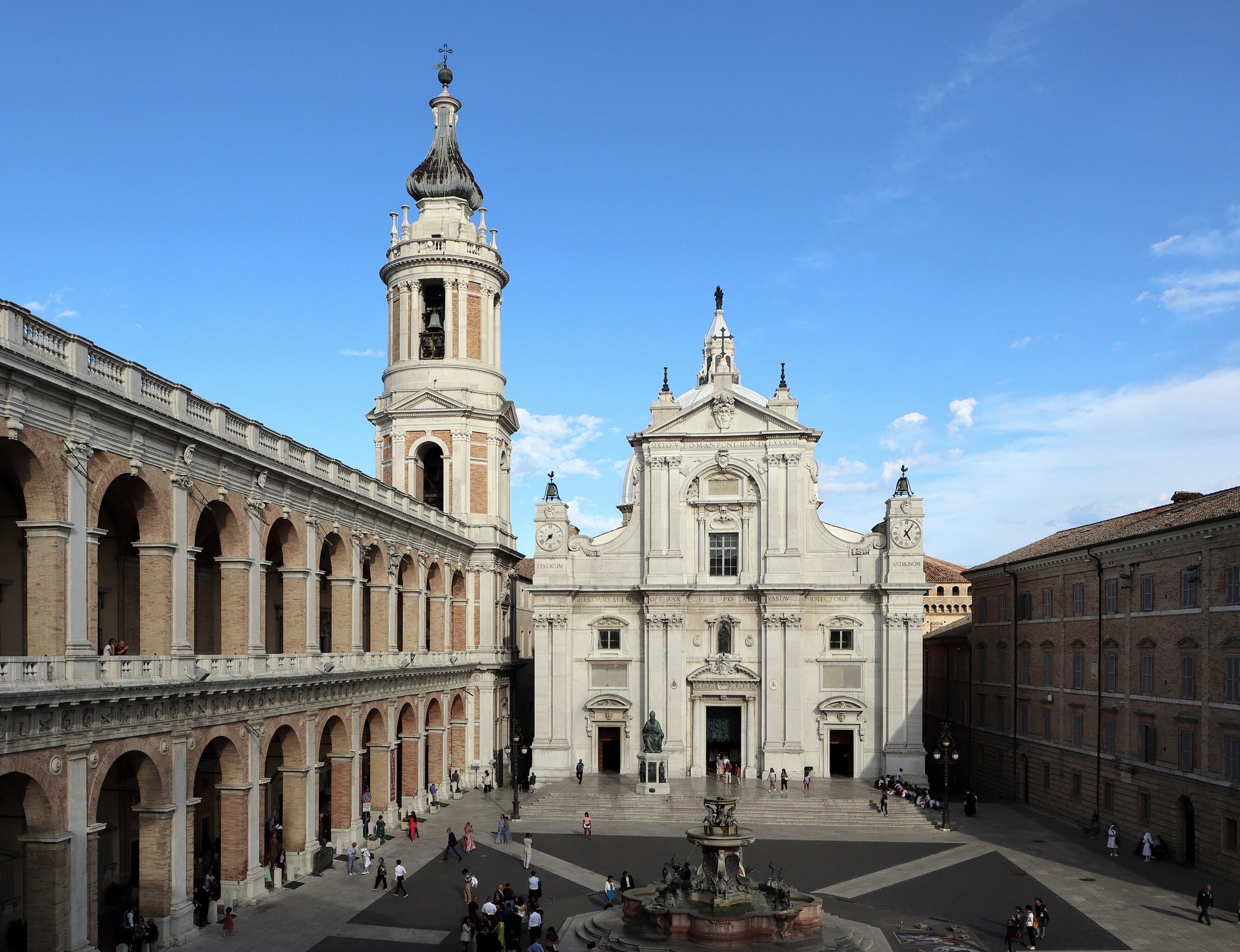
The basilica was built around the house between 1469 and 1587. Its fortress-like exterior, dome, Apostolic Palace, museum, and the Renaissance marble screen designed as a precious enclosure all direct attention back toward those three rough walls. The present statue of Our Lady of Loreto dates from 1922, replacing an earlier image lost in the 1921 fire.
Loreto also belongs to the pilgrimage story of St. Thérèse of Lisieux. In November 1887, fourteen-year-old Thérèse traveled through Italy with her father Louis and her sister Céline on the way to Rome, where she hoped to ask Pope Leo XIII for permission to enter Carmel. Céline later recalled that she and Thérèse received Holy Communion close to the altar inside the Holy House. Thérèse would describe the marble enclosure as a casket surrounding a pearl—an image the sanctuary still uses when explaining the house.
Approach Loreto as a house of prayer rather than a puzzle to solve. Attend Mass, receive reconciliation when available, enter the Holy House quietly, and contemplate the hidden life of the Holy Family. Remember the young Thérèse receiving the Eucharist here while carrying a vocation whose fulfillment she could not yet see.
Enter the Holy House as a place of the Annunciation and Incarnation, then remember fourteen-year-old St. Thérèse receiving Communion here during her 1887 journey to Rome. Loreto is best approached through Mass, confession, and quiet prayer rather than as a contest over competing translation theories.
The sacred connection
People and objects remembered here
These relationships are part of the destination record, with feast days and catalog qualifications shown where available.
received Holy Communion in the Holy House during her 1887 pilgrimage to Rome
Feast: October 1Architectural contact relic · Ancient Catholic tradition and veneration
The Holy House forms the devotional center of the sanctuary.What to notice
Look closely at the place and its story
The Holy House
Enter the house venerated as Mary’s home and contemplate the Annunciation and Incarnation.
Marble enclosure
Study the Renaissance marble screen surrounding the ancient masonry at the center of the basilica.
Our Lady of Loreto
Pray before the sanctuary’s revered Madonna within the Holy House.
Pontifical Museum
Visit the official Pontifical Museum of the Holy House in the Apostolic Palace for the sanctuary’s art, treasury, and historical collections.
St. Thérèse at fourteen
Remember Thérèse and Céline receiving Holy Communion close to the altar during their November 1887 pilgrimage.
Feasts, anniversaries & celebrations
How to read this page
Sources, tradition, and what is verified
The destination record was last checked on 9/29/2026.
This page records the site’s tradition as “Catholic.” That wording describes the nature of the claim and keeps devotional tradition distinct from independently verified history.