Why pilgrims come
Visit the resting place and legacy of St. Matthew the Apostle and Evangelist
Salerno Cathedral is one of Italy's great apostolic pilgrimage churches. Beneath its sanctuary, in the center of a luminous Baroque crypt, rests the sepulcher traditionally venerated as the tomb of St. Matthew the Apostle and Evangelist. The cathedral is not merely dedicated to the city's patron: its architecture, art, calendar, and civic memory all turn around his presence.
The church took shape during the Norman transformation of southern Italy. Robert Guiscard founded the cathedral after the conquest of Salerno, working with Archbishop Alfano I. The crypt was already complete in March 1081, when the cathedral records say that the relics of St. Matthew and other saints were deposited there. Pope Gregory VII consecrated the upper church in July 1084 while taking refuge in Salerno. His own tomb now stands within the cathedral, adding the memory of a reforming pope to the apostolic shrine below.
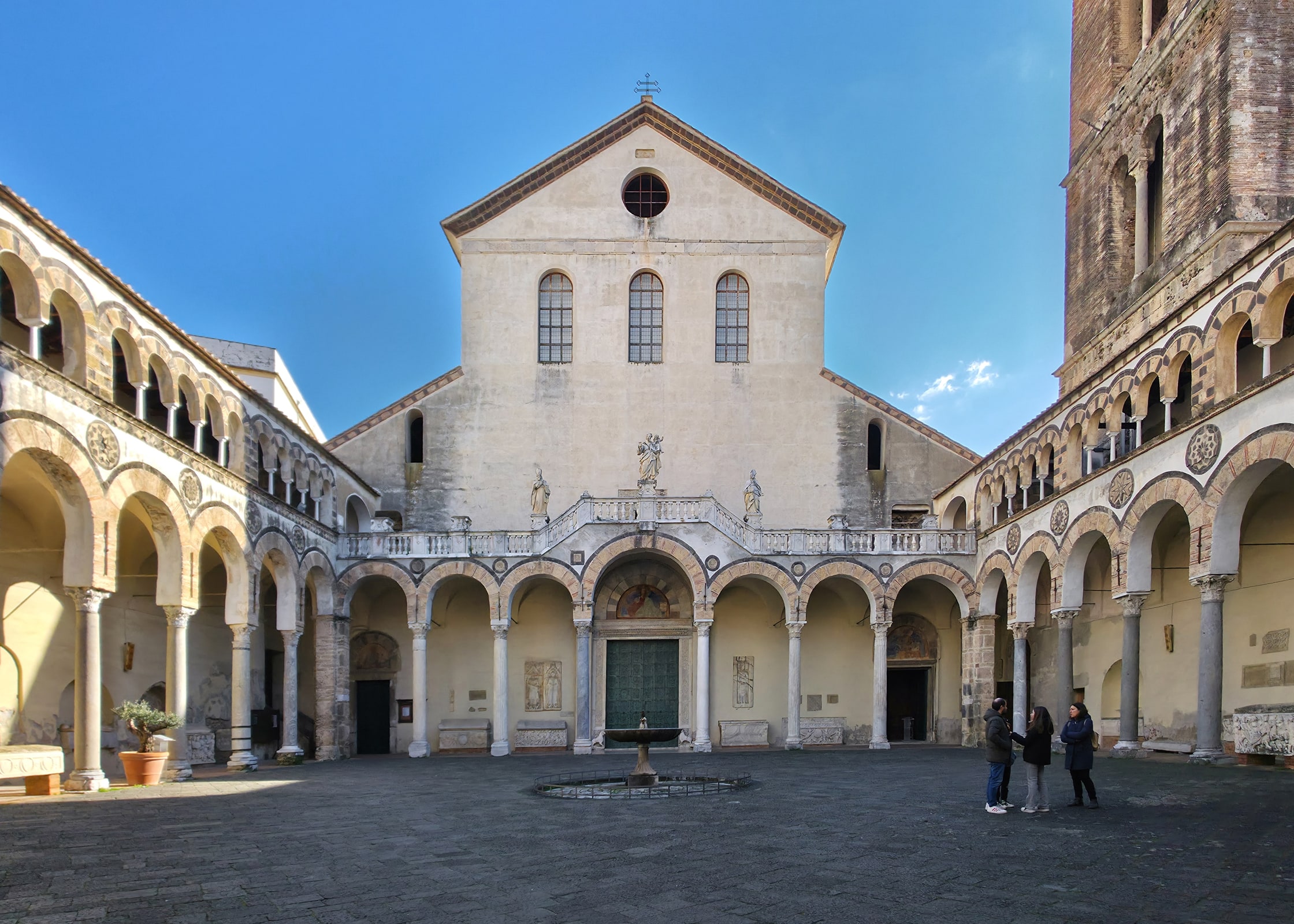
The approach prepares a pilgrim gradually. Medieval lions flank the entrance. Beyond them, a broad quadriportico rises on twenty-eight reused columns beneath arches that reflect Mediterranean and Islamic architectural forms. Roman sarcophagi line the atrium, turning it into a kind of civic pantheon. The bronze door, made in Constantinople in the late eleventh century, and the twelfth-century bell tower recall the cathedral's place within the connected Christian world of the medieval Mediterranean.
Inside, the great medieval ambos, mosaic pavement, side-apse mosaics, Gothic sculpture, and later Baroque chapels reveal a church repeatedly rebuilt without losing its original center. The Chapel of the Treasury preserves a relic traditionally identified as the arm of St. Matthew together with silver statues used in the patronal celebration. The tomb of Pope St. Gregory VII is another important place of prayer. Visitors should not hurry through the upper church simply to reach the crypt; its layers explain how Salerno received, guarded, and publicly honored its sacred memory.
The crypt is the heart of the pilgrimage. Its present appearance comes chiefly from the early seventeenth-century reconstruction directed by Domenico Fontana and his son Giulio Cesare. Polychrome marble, stucco, frescoes, and a double altar organize the whole space around Matthew's sepulcher. A small opening at the northern altar permits a view toward the tomb. The crypt also preserves the remains of Salernitan martyrs and a dense painted program connecting the Gospel, the city's saints, and local history.
Above the central tomb stand two back-to-back bronze figures of St. Matthew made by Michelangelo Naccherino in 1606. The double arrangement allowed worship at altars facing both directions. In each figure the Evangelist writes with a book on his knee while an angel offers him an inkwell. The sculpture turns inspiration into a physical gesture: the Gospel is received, written, and handed on. It is a fitting image for a city that venerates both the apostle's relics and the Word associated with his name.
The Church's feast of St. Matthew falls on September 21, and in Salerno it becomes the great patronal celebration of the city. The annual program ordinarily includes a solemn pontifical Mass and a procession of the silver statues through the historic center, with additional liturgies and devotions in the days beforehand. Exact hours change each year and must be checked with the cathedral or archdiocese. The scale of the celebration is important: Matthew is not remembered here as an archaeological possession but as a patron whose Gospel and intercession continue to shape a living local Church.
Catholic Tourist follows the cathedral's own language while preserving a clear evidence boundary. The site unquestionably contains a centuries-old tomb and an uninterrupted public cult of St. Matthew; the identification of the relics rests on ecclesial tradition and documented medieval translation, not on modern forensic proof. A good visit holds those truths together. Descend to the crypt with the Gospel in mind, pray for grace to answer Christ's call as Matthew did, and then return to the city above carrying the summons that changed a tax collector into an apostle.
Begin in the medieval atrium and upper church, pray at Pope St. Gregory VII’s tomb, then descend deliberately to the crypt and St. Matthew’s sepulcher. Read Matthew’s call before visiting and leave time for silence rather than treating the crypt as a decorative room.
The sacred connection
People and objects remembered here
These relationships are part of the destination record, with feast days and catalog qualifications shown where available.
principal tomb and relic veneration; patron of Salerno
Feast: September 21tomb in the cathedral
Feast: May 25Apostolic bodily relics · Ecclesiastically preserved and publicly venerated; identification rests on historic Catholic tradition rather than modern forensic proof
The crypt is normally part of the cathedral visit. Treasury access and the display or procession of the arm relic may follow separate schedules.What to notice
Look closely at the place and its story
Tomb of St. Matthew
Pray at the sepulcher around which the entire crypt is organized, traditionally venerated as the resting place of the apostle and evangelist.
Naccherino’s double St. Matthew
See the paired 1606 bronze figures above the tomb, each showing the Evangelist writing as an angel offers the inkwell.
The medieval quadriportico
Enter through a Mediterranean courtyard of reused columns, raised arches, Roman sarcophagi, and a great Norman-era bell tower.
Byzantine bronze doors and medieval ambos
Read the cathedral as a meeting point of Constantinople, Norman southern Italy, mosaic workshops, and the Latin Church.
Tomb of Pope St. Gregory VII
Remember the reforming pope who consecrated the cathedral, died in Salerno, and rests in the church he dedicated.
September 21 in Salerno
The apostle’s universal feast becomes the city’s patronal celebration through solemn liturgy, relic veneration, and procession.
Feasts, anniversaries & celebrations
How to read this page
Sources, tradition, and what is verified
The destination record was last checked on 9/21/2026.
This page records the site’s tradition as “Roman Catholic; metropolitan cathedral and shrine of St. Matthew the Apostle and Evangelist.” That wording describes the nature of the claim and keeps devotional tradition distinct from independently verified history.
Continue nearby