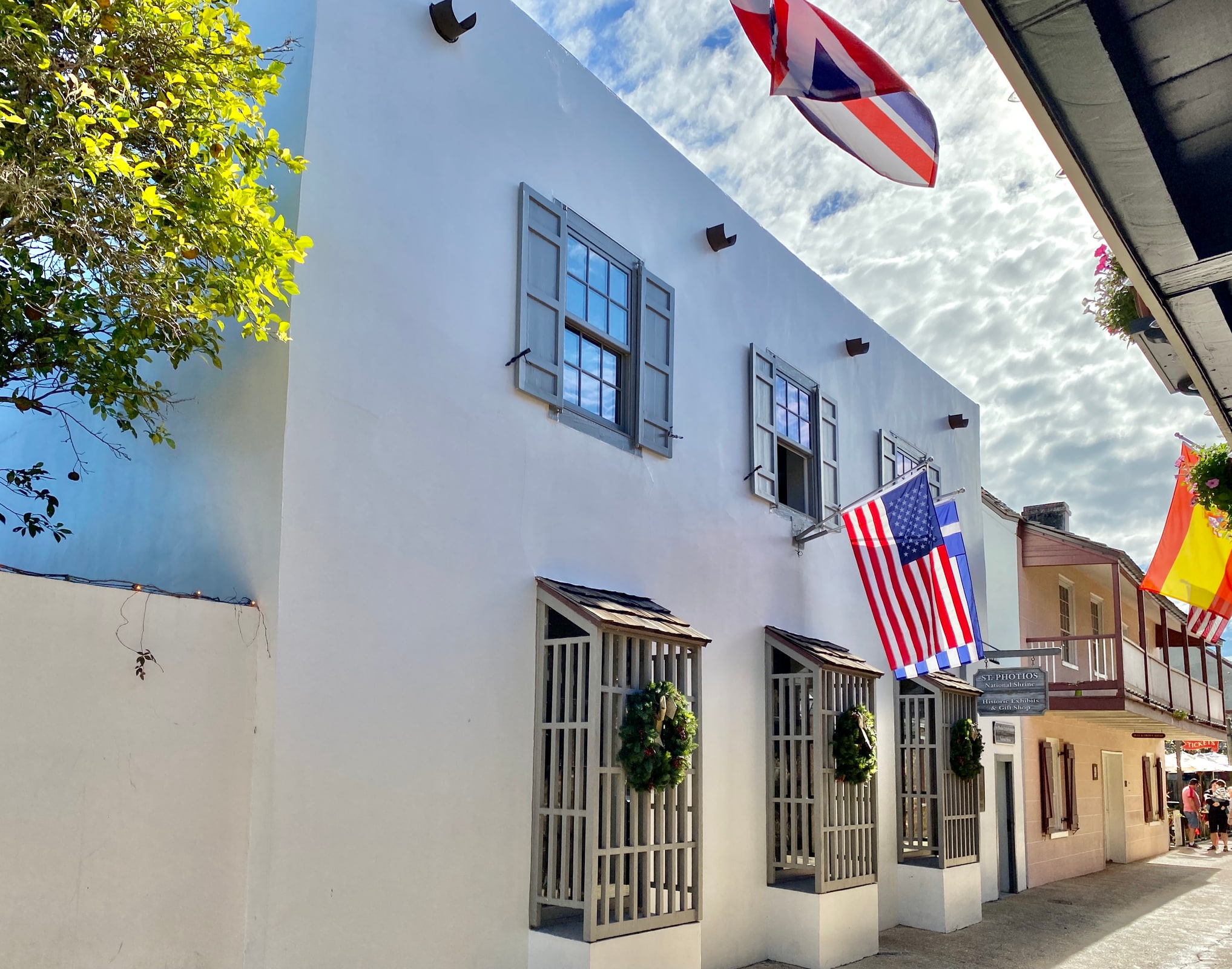
Why pilgrims come
Discover the sacred objects and Catholic memory preserved here
Behind a modest doorway on St. George Street, St. Photios Greek Orthodox National Shrine joins an American immigrant story to an unusually concentrated collection of relics from the ancient Church. The shrine occupies the reconstructed Avero House, where survivors of the failed New Smyrna colony found refuge after reaching St. Augustine in 1777. The institution commemorates the Greeks who arrived in Florida in 1768 and the generations of immigrants who followed them. It is the first national shrine of the Greek Orthodox Archdiocese of America.
The route through the house begins as history. Exhibits interpret the Greek settlers' passage through indentured labor, suffering, flight, and eventual settlement in St. Augustine. The story resists a romanticized founding myth: the colonists endured severe conditions at New Smyrna before survivors left for St. Augustine. The Avero House became associated with their communal worship, and the restored shrine now asks visitors to remember migration through both hardship and faith.
At the end of the museum rooms stands the Chapel of St. Photios. Five domes and Byzantine-style frescoes by George Filippakis, with Constantine and John Filippakis, turn the small space into a visual proclamation of the communion of saints. Visitors may light a candle and pray. The chapel is named for St. Photios the Great, the ninth-century Patriarch of Constantinople remembered in the Orthodox Church as a theologian, missionary patron, and defender of the faith.
The chapel also preserves twenty-one relics. Three—associated with Saints Euphemia, Theodora, and Solomoni—were placed in the altar at its 1985 consecration. A reliquary in the narthex holds bone fragments identified with eighteen saints of the early Church. The shrine's own published account names Sts. Peter, Paul, Titus of Crete, Helena, Constantine, Savvas, Anthony, John Chrysostom, Basil the Great, Gregory Nazianzen, Gregory of Nyssa, Cyril of Alexandria, Cyril of Jerusalem, Nicholas of Myra, Ambrose, Haralambos, and John of Damascus among those available for public veneration.
The relics have a striking Catholic-Orthodox history. The shrine states that the fragments were obtained through Vatican channels and that each bears a papal seal. Here “papal” means the seal of the Roman Catholic papacy, not an “Orthodox pope.” The seals document the Catholic custody and ecclesiastical authentication under which the fragments were transferred; they do not amount to modern scientific proof that each fragment can be attributed to a named saint. Catholic Tourist therefore describes the identities as ecclesiastically attested and traditionally venerated, while preserving the precise limits of the evidence.
For Catholics, this makes St. Photios a particularly meaningful place of encounter. Sts. Peter and Paul belong to the undivided apostolic inheritance of East and West; the Cappadocian Fathers, St. John Chrysostom, St. Cyril of Jerusalem, and the other saints represented here are honored across ancient Christian traditions. A Catholic visitor may enter, pray, light a candle, and respectfully venerate the relics. The shrine is Greek Orthodox rather than a Roman Catholic parish, so visitors should honor Orthodox practice and should not presume sacramental participation.
The shrine is open to the public and explicitly describes itself as a place where all may remember their immigrant ancestors. Current published hours are daily from 10:00 a.m. to 5:00 p.m., with free admission and donations welcomed. Hours can change for services, special events, or holidays. Give the museum and chapel at least an hour, resist treating the reliquary as a curiosity cabinet, and let the first Greek settlers' story lead into prayer for Christian unity, migrants, and all who seek refuge.
Move from the difficult story of America’s first Greek settlers into the frescoed chapel, then pray before relics that visibly join the ancient churches of East and West.
The sacred connection
People and objects remembered here
These relationships are part of the destination record, with feast days and catalog qualifications shown where available.
patron and namesake of the shrine chapel
Feast: February 6bone fragment traditionally identified with the apostle in the narthex reliquary
Feast: June 29SaintSt. Paul the Apostlebone fragment traditionally identified with the apostle in the narthex reliquary
Feast: June 29bone fragment traditionally identified with the apostolic disciple in the narthex reliquary
Feast: August 25Bone fragments in a sealed ecclesiastical reliquary · Ecclesiastically attested and traditionally identified; transferred through Vatican channels with papal seals, not scientifically authenticated
Visit during shrine hours and follow staff and Orthodox devotional practice.Bone fragments deposited in a consecrated altar · Ecclesiastically attested and traditionally identified
The altar is a sacred liturgical space, not a visitor exhibit.What to notice
Look closely at the place and its story
Apostles in an Orthodox chapel
Venerate relic fragments traditionally associated with Sts. Peter, Paul, and Titus alongside Fathers honored by East and West.
The Avero House story
Follow Greek colonists from the failed New Smyrna settlement to refuge and worship in St. Augustine.
Five frescoed domes
Enter a compact Byzantine sacred world painted by George, Constantine, and John Filippakis.
A precise relic trail
Understand that papal seals indicate Roman Catholic custody and authentication—not an Orthodox pope and not modern scientific proof.
Feasts, anniversaries & celebrations
How to read this page
Sources, tradition, and what is verified
The destination record was last checked on 9/29/2026.
This page records the site’s tradition as “Greek Orthodox national shrine, historic immigrant memorial, Byzantine chapel, and early-Christian reliquary.” That wording describes the nature of the claim and keeps devotional tradition distinct from independently verified history.