Why pilgrims come
Enter a place shaped by prayer, community, and pilgrimage
Rosano belongs in St. Carlo Acutis's exhibition collection, but the reported phenomenon is not a transformation of consecrated bread or wine. It concerns a life-size statue of the Sacred Heart of Jesus at the Benedictine Abbey of Santa Maria, said to have wept and bled on repeated occasions between 1948 and 1950. Catholic Tourist therefore keeps the exhibition connection while identifying the destination accurately as a monastery and Sacred Heart devotional site rather than silently labeling it a Eucharistic miracle.
The statue was given to the community in 1948 in fulfillment of a wartime vow. According to the account reproduced by the Carlo Acutis exhibition from a letter of Bishop Luciano Giovannetti, drops resembling tears were first observed during Vespers on April 4, 1948, the Sunday after Easter. Reports of blood followed in June and recurred through 1950. Nuns, priests, visitors, and the abbess, Mother Ildegarde Cabitza, left testimony; cloths and medical analyses were kept in the monastery archive.
The episode also passed through ecclesiastical scrutiny. The exhibition account says Dominican Father Luigi Romoli questioned the community as a visitor sent by the Holy Office. The statue was removed to a secret location in November 1950 and returned to Rosano in 1952. Bishop Giovannetti later framed the events as a call to fidelity, reparation, prayer, conversion, and renewed devotion to the Sacred Heart. This page follows that pastoral emphasis and does not convert reported laboratory work or eyewitness testimony into an unqualified scientific verdict.
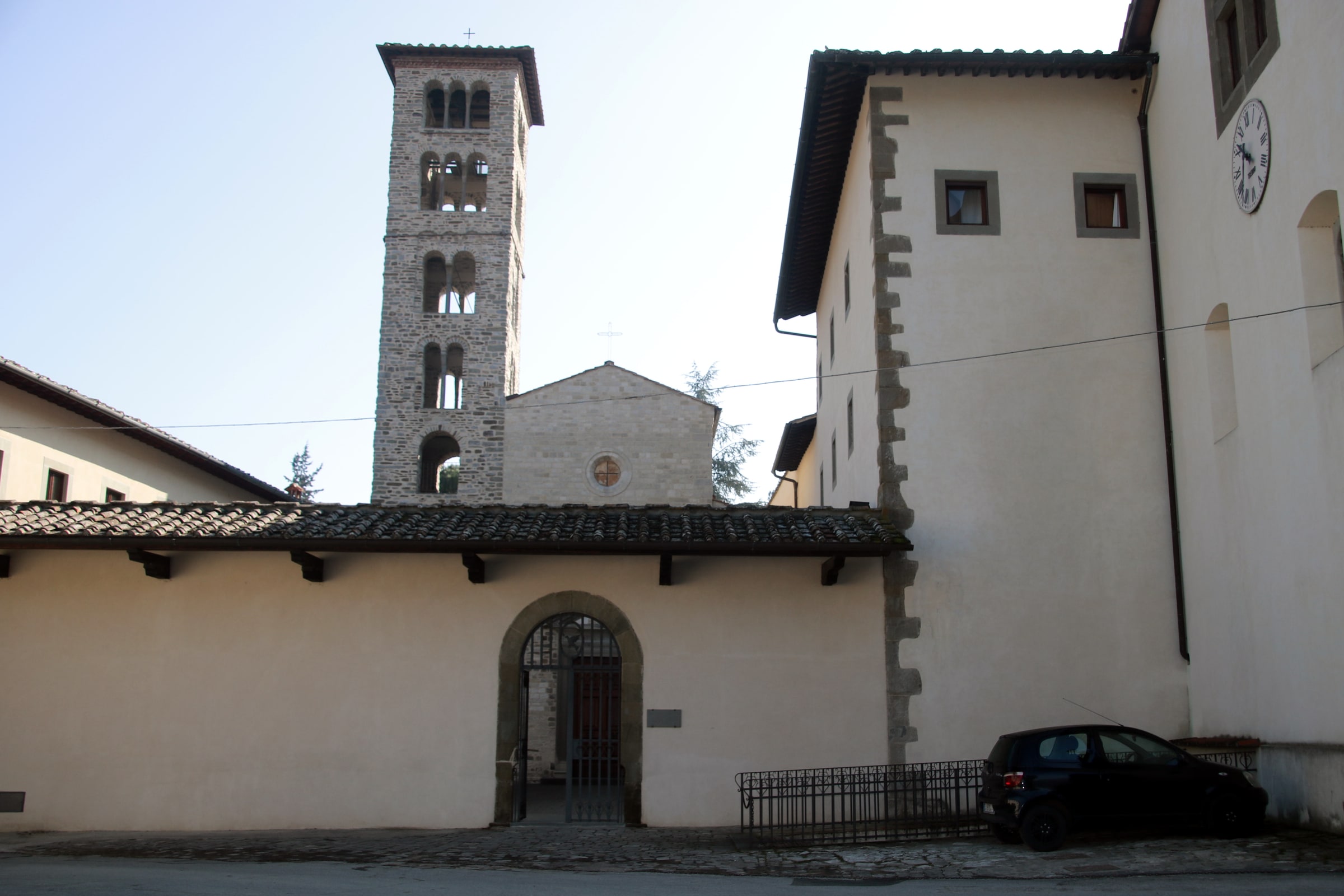
The abbey is itself a major Catholic destination. Traditionally founded in 780, it remains a cloistered Benedictine community and is often described as one of Tuscany's oldest continuously active women's monasteries. The church preserves a Romanesque crypt and a monumental twelfth-century painted cross attributed to the Master of Rosano, one of the oldest surviving painted panels in Italian art.
Because this is a cloistered monastery, a pilgrim should not assume museum-style access to the community, archive, or every devotional object. Public worship takes place in the church, and the regional visitor service currently lists weekday and Sunday Masses, but those times must be confirmed before travel. Silence, the enclosure, and the Benedictine rhythm of prayer are part of the place—not obstacles to be bypassed.
Rosano lies just east of Florence near Pontassieve and the Arno. It can form a thoughtful pilgrimage with Sant’Ambrogio in Florence: one stop centered on historic Eucharistic devotion, the other on the Sacred Heart, Benedictine prayer, and the careful discernment of reported phenomena.
Come for the Benedictine abbey, its church and prayer, the historic painted cross, and the Sacred Heart devotion. Receive the reported 1948 phenomena with the reserve modeled by the monastic community.
The story & the place today
What happened here—and what a pilgrim can find now
Each record separates the devotional tradition from the present-day visitor evidence. A mapped locality remains visible even when an exact shrine or surviving object has not yet been verified.
The Eucharistic tradition associated with Rosano
Catholic Tourist maps Rosano as the geographical setting of a Eucharistic tradition documented in the St. Carlo Acutis exhibition. The place-specific historical and visitor audit is still in progress; this account records a devotional tradition rather than making an independent ecclesial, historical, or scientific judgment.
Rosano, Italy; precise church or event location awaiting verification
Still being researched
No present-day veneration site has yet been verified
Still being researched
Visitor note: The mapped point represents the associated locality, not confirmed church access.
Church wording: Documented in the St. Carlo Acutis exhibition; no separate Church judgment has yet been verified for this catalog record. — Recognition wording awaiting a place-specific Church-source audit
This pin preserves the geographical and devotional history while the exact event site, any surviving object, and current public commemoration are researched. It should not be read as confirmation that an active shrine exists at the pin.
What to notice
Look closely at the place and its story
Sacred Heart statue
Understand the reported 1948–1950 phenomena through the attributed episcopal account and its call to prayer and reparation.
A living Benedictine enclosure
Encounter a monastery whose continuous prayer is more important than access to every room or object.
The Master of Rosano’s cross
See a monumental twelfth-century painted cross, among the oldest major panels in Italian art.
Romanesque crypt
Receive the deep architectural history beneath the later monastic complex.
How to read this page
Sources, tradition, and what is verified
The destination record was last checked on 9/22/2026.
This page records the site’s tradition as “Roman Catholic; Benedictine monastic life and Sacred Heart devotion.” That wording describes the nature of the claim and keeps devotional tradition distinct from independently verified history.
Continue nearby