Why pilgrims come
Encounter the Eucharistic tradition and its surviving evidence
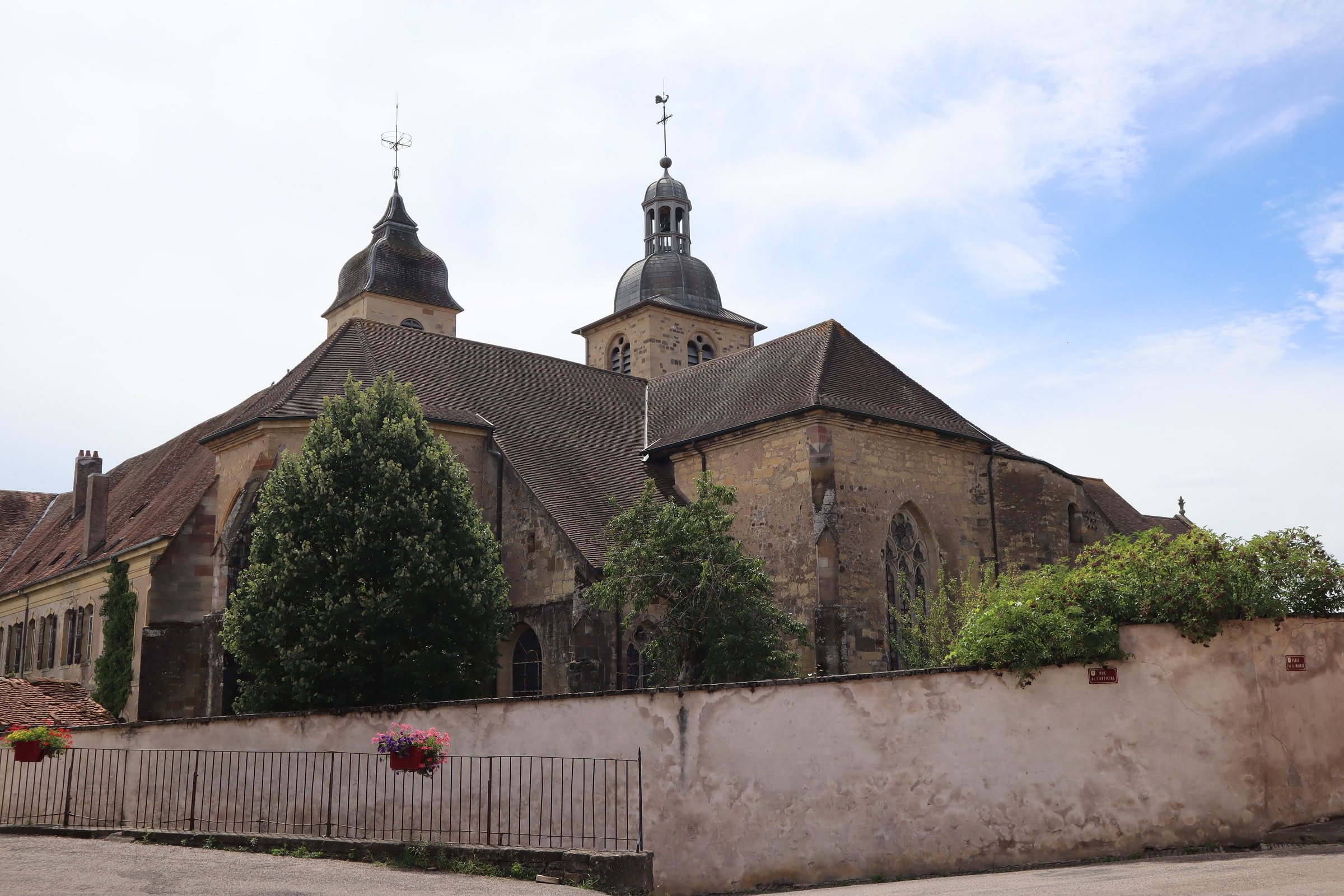
Faverney is one of the rare Eucharistic destinations where the reported event, the surviving church, a venerated Host, the canonical record, and an annual pilgrimage still converge. The exact destination is the former Benedictine abbey church now known as the Basilica of Notre-Dame-la-Blanche. Its Pentecost pilgrimage remembers the fire of 1608 and the preservation of an ostensory containing two consecrated Hosts.
On Saturday, May 24, 1608, the monks prepared a temporary repository near the choir screen for the extended Pentecost exposition. The vessel was not only an ostensory for the Eucharist. The local municipal account and the Diocese of Saint-Claude’s pilgrimage history say that a crystal tube held a finger relic of St. Agatha, while a silver lunette above it held two Hosts consecrated that morning. Lamps and candles burned beside an altar dressed with fabric.
During the night, fire consumed the temporary altar and its furnishings. When the church was opened on Monday morning, the sanctuary was filled with smoke and the altar lay in ashes. A young novice then pointed upward: the ostensory was reported suspended above the burned remains without visible support. Clergy and residents gathered, and Masses were celebrated while the vessel remained aloft.
Accounts commonly describe the suspension as lasting about thirty-three hours. One modern diocesan notice rounds the duration to nearly thirty-six hours. Catholic Tourist uses “about thirty-three hours,” the duration repeated by the 2008 centenary homily and local historical summaries, while acknowledging that modern retellings are not numerically identical. During a Mass, the vessel was reported to move and descend onto a corporal prepared beneath it; the two Hosts were found intact.
Unlike many later devotional summaries, the archival trail can be named precisely. Besançon’s Mémoire Vive catalog identifies manuscript 829 as the record of the inquiry ordered by the archiepiscopal council on May 29, 1608. Pierre Chevroton and Jean Morelot, assisted by secretary Bon Monnier, gathered testimony and closed the record at Vesoul on June 4. The manuscript also contains acts concerning canonical recognition on June 9 and the later grant of one Host to the collegiate church at Dole.
A printed declaration by Archbishop Ferdinand de Rye was issued in 1608 and survives in a public-domain copy cataloged by the Besançon digital heritage portal. These records support the Church’s historical judgment about the event. They do not amount to a modern experiment capable of reproducing or scientifically proving a supernatural cause, and this page does not pretend otherwise.
The two Hosts then acquired different histories. One was granted to Dole and did not survive the upheavals of the French Revolution. The other remained tied to Faverney and is still presented by local and diocesan sources as preserved in the basilica. The object now venerated is therefore one of the two Hosts associated with the 1608 event, not both, and the St. Agatha relic that shared the original vessel should not be confused with the Host itself.
The basilica preserves more than the event’s memory. Its Romanesque nave, Gothic choir, Chapel of the Holy Host, memorial inscriptions, and a carved ex-voto offered by Dole in 1622 place the devotion within the long history of the abbey. The municipal heritage guide notes the chapel’s dedication and the artistic memorials; the town’s history traces the religious foundation to the early medieval period and the later Benedictine community.
Monastic life at the old abbey ended during the Revolution and the former conventual buildings are not simply open public extensions of the basilica. A later Benedictine presence began at the separate Priory of Notre-Dame de Bethléem outside the historic abbey complex. Pilgrims should not confuse that present priory with the basilica or assume access to private former-abbey property.
The annual pilgrimage remains active on Pentecost Monday. The Diocese of Saint-Claude’s 2026 program, organized with the Archdiocese of Besançon, included confession, solemn Mass, teaching, a visit to the museum and abbey, and a Eucharistic procession. The 2025 report similarly records Mass, adoration, teaching, and procession. The precise program changes yearly, but the continuity of public worship is well documented.
The Holy Host is not guaranteed to be exposed every day. Current accounts associate public veneration especially with the Pentecost pilgrimage. Visitors outside that celebration should contact the parish of Faverney-Amance, attend the ordinary liturgy, and ask respectfully about the Chapel of the Holy Host and any current manner of veneration. Photography of the Host or liturgy must never be assumed.
The best visit proceeds from the architecture to the chapel, from the fire narrative to the surviving inquiry, and from historical evidence to Eucharistic prayer. Faverney’s importance lies not in a dramatic image isolated from context, but in a four-century relationship among testimony, ecclesial judgment, the community’s preservation of the Host, and a pilgrimage that still gathers around Pentecost.
Pray in the surviving abbey church where the 1608 event was reported, then read the Chapel of the Holy Host, archival inquiry, and annual Pentecost pilgrimage as one continuous Eucharistic memory.
The story & the place today
What happened here—and what a pilgrim can find now
Each record separates the devotional tradition from the present-day visitor evidence. A mapped locality remains visible even when an exact shrine or surviving object has not yet been verified.
The Holy Hosts preserved in the Faverney fire
During Pentecost exposition at the Benedictine abbey church, fire destroyed a temporary altar while the ostensory containing two consecrated Hosts and a relic of St. Agatha was reported suspended above the ashes for about thirty-three hours before descending onto a prepared corporal.
Abbey Church of Notre-Dame, now the Basilica of Notre-Dame-la-Blanche, Faverney
One surviving consecrated Host associated with the 1608 event
Basilica of Notre-Dame-la-Blanche, Faverney
Annual pentecost monday diocesan pilgrimage verified
Visitor note: Active basilica; public veneration is especially associated with Pentecost Monday and must be confirmed
Church wording: Canonically investigated and declared in 1608; continuing diocesan Eucharistic pilgrimage — Archiepiscopal council and Archbishop Ferdinand de Rye of Besançon
The archiepiscopal inquiry was ordered May 29 and closed June 4, 1608; canonical acts and the declaration survive in archival records. One Host was later granted to Dole and did not survive the Revolution.
The sacred connection
People and objects remembered here
These relationships are part of the destination record, with feast days and catalog qualifications shown where available.
a finger relic of St. Agatha shared the 1608 reliquary-ostensory with the two consecrated Hosts
Feast: February 5Venerated Eucharistic species · Received and venerated through the 1608 archiepiscopal inquiry, subsequent ecclesial custody, and continuing diocesan pilgrimage; not independently scientifically tested by Catholic Tourist
Public exposition is not guaranteed outside the annual pilgrimage. Contact the parish and obey every Blessed Sacrament and photography restriction.First-class relic tradition · Recorded in the municipal and diocesan accounts of the 1608 reliquary-ostensory
Ask the basilica or parish whether the relic is presently accessible; do not confuse it with the surviving Host.What to notice
Look closely at the place and its story
The surviving abbey church
Stand in the same sacred building where the temporary Pentecost altar burned in 1608.
The Chapel of the Holy Host
Read the chapel and its memorial art as the basilica’s continuing center of Eucharistic remembrance.
A named canonical record
Connect the received event to the inquiry ordered in May 1608 and the declaration preserved in Besançon’s public archive.
One Host, not two
Distinguish the Host that remained at Faverney from the one granted to Dole and later lost during the Revolution.
Pentecost Monday pilgrimage
Join the living rhythm of Mass, teaching, adoration, confession, and Eucharistic procession when the annual program permits.
Feasts, anniversaries & celebrations
How to read this page
Sources, tradition, and what is verified
The destination record was last checked on 9/29/2026.
This page records the site’s tradition as “Roman Catholic minor basilica, Eucharistic pilgrimage, and former Benedictine abbey.” That wording describes the nature of the claim and keeps devotional tradition distinct from independently verified history.
Continue nearby