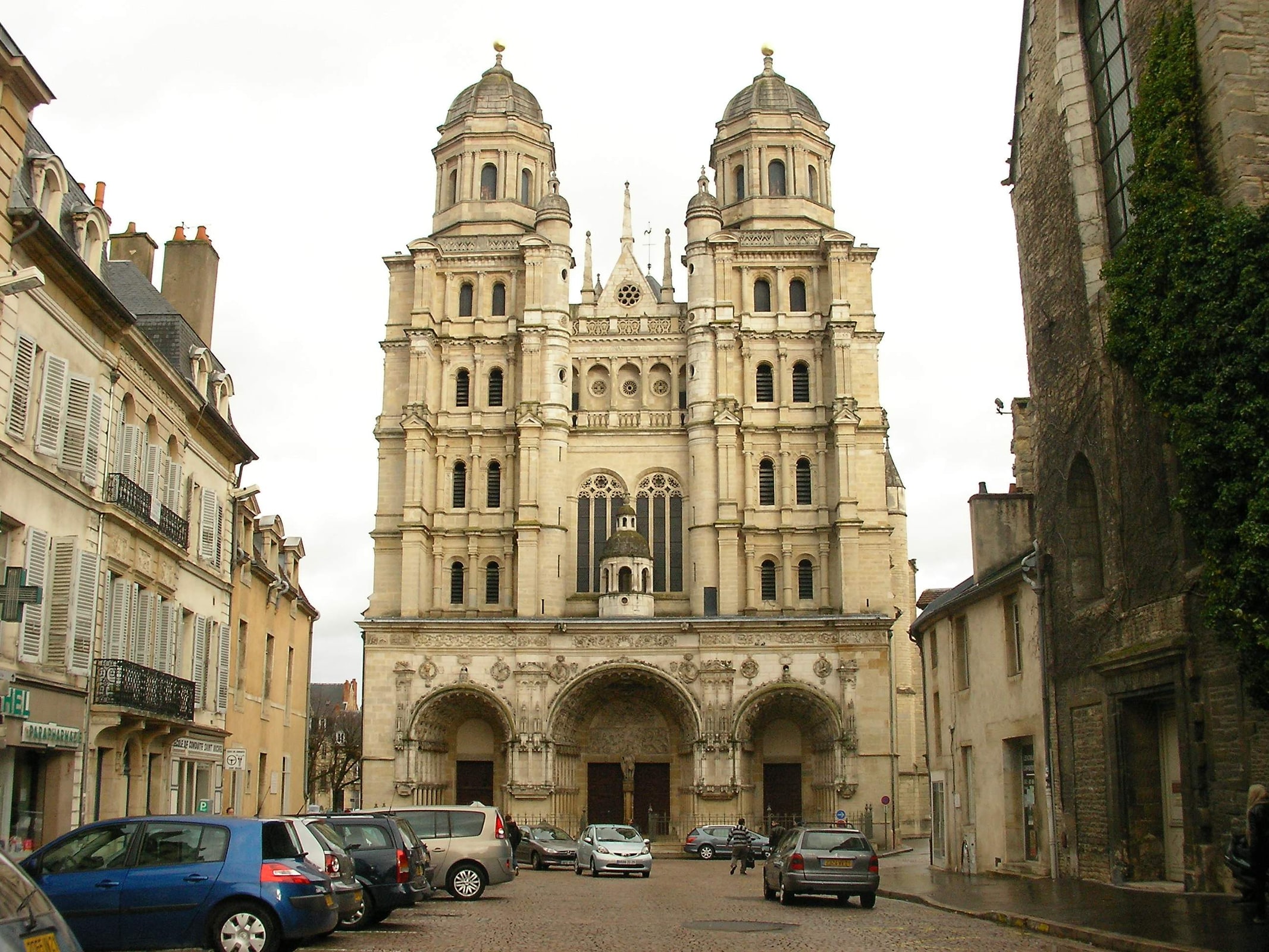
Why pilgrims come
Encounter the Eucharistic tradition and its surviving evidence
Dijon’s Eucharistic story is not a claim that a miraculous Host can still be seen. The object described in the received account was destroyed during the French Revolution. The present Catholic destination is the Church of Saint-Michel, where the Host was kept during its final years and where an annual Mass of reparation preserves the memory of its destruction. That distinction is essential for an honest pilgrimage page.
The event itself was reported far from Dijon. The Diocese of Dijon’s historical account begins in Monaco in 1430. A woman acquired an ostensory that was probably stolen and that still contained a large consecrated Host. When she tried to detach the Host with a knife, blood was reported to appear and an image of Christ with the instruments of the Passion was said to form on it. These are claims transmitted by Catholic historical and devotional sources; Catholic Tourist does not present them as the result of modern scientific testing.
Pope Eugene IV later gave the Host to Philip the Good, Duke of Burgundy. Philip in turn entrusted it to Dijon, where it became one of the city’s most important objects of devotion. It was kept at the ducal Sainte-Chapelle, a building that once stood beside the Palace of the Dukes of Burgundy but was demolished in the nineteenth century. Dijon’s municipal medieval heritage dossier confirms that the Sainte-Chapelle conserved the Holy Host and that it inspired a large annual procession.
The distinction between the historic Sainte-Chapelle and the current Church of Saint-Michel prevents a common misunderstanding. Saint-Michel was not the original 1430 event site and it was not the principal shrine throughout the Host’s centuries in Dijon. It entered the story at the Revolution. On January 18, 1791, according to the diocesan account, the Host was transferred from the Sainte-Chapelle to Saint-Michel and placed in the tabernacle of the Virgin’s altar.
Revolutionary authorities requisitioned Saint-Michel on February 9, 1794, for use as a Temple of Reason. On February 10, five municipal agents burned the Host in front of the church. The exact point of the destruction is not documented. A star in the pavement outside Saint-Michel now carries the memory, but it should be described as a memorial marker rather than archaeological proof of the precise spot.
The Host therefore no longer survives. There is no reliquary, monstrance, or consecrated species from the 1430 account available for pilgrims to view at Saint-Michel. A responsible visit is about Eucharistic reparation, historical memory, and prayer in the church that sheltered the Host before its destruction—not about promising access to an object that disappeared in 1794.
After Catholic worship resumed, a former canon of the Sainte-Chapelle founded a perpetual annual Mass of reparation at Saint-Michel. The first was celebrated on February 10, 1826, at ten in the morning. The Diocese of Dijon continues to document the observance. In 2024, worshippers marked the anniversary with Mass and placed a white rose on the pavement star outside the church.
That living observance gives the destination its present pilgrimage meaning. The date is fixed on February 10, but the hour and pastoral program must be confirmed each year with the Parish of Saint-Michel or the Diocese of Dijon. Outside the annual Mass, visitors can pray in the church, reflect on the Eucharist, and look for the memorial star without treating the pavement marker as if it were the vanished Host.
Saint-Michel has another important Catholic connection. St. Elizabeth of the Trinity, the Dijon Carmelite canonized in 2016, prayed in the church and is closely associated with its Eucharistic life. Diocesan coverage of the reparation Mass notes the presence of her relics at Saint-Michel. Her relationship to the church enriches a visit, but her relics and the destroyed Dijon Host are different objects with different histories.
The church itself is a major work of Dijon architecture. Its long construction history is visible in the union of late Gothic structure and Renaissance façade. The current building offers a surviving sacred place through which pilgrims can approach a story whose earlier physical center—the Sainte-Chapelle—has disappeared.
The best pilgrimage follows the chronology rather than collapsing it. First remember Monaco, where the 1430 event was reported. Then recognize the lost Sainte-Chapelle as the Host’s long Dijon sanctuary. Enter Saint-Michel as the final place of custody and the present church of reparation. Finally, pause at the exterior star as a memorial to destruction, not as a substitute relic.
The story also offers a sober lesson about evidence. The diocesan article supplies a detailed ecclesial narrative and the municipal heritage dossier independently establishes the Host’s place in medieval Dijon processional life. The current annual Mass is verifiable as a living practice. None of that allows Catholic Tourist to reconstruct every event of 1430 experimentally or to establish the exact pavement point of the 1794 burning.
Pilgrims should check current opening and liturgical arrangements before traveling. Saint-Michel is an active Catholic church, not only a museum. Respect Mass, funerals, confession, and parish activity; ask before photographing liturgy or relics; and do not expect the annual reparation observance to occur at the same hour every year.
Dijon’s page therefore preserves both devotion and loss. The reported Host shaped the city’s Catholic memory for centuries, was deliberately destroyed in a period of religious persecution, and survives today only through documentary history, the church that sheltered it, the pavement memorial, and a Mass first established in 1826. That is less sensational than claiming a surviving object—and far more meaningful for a pilgrim who wants to understand what is actually present.
Visit Saint-Michel as the final place of custody and the living church of reparation, while remembering that the 1430 event began in Monaco and the Host’s long Dijon shrine was the now-lost Sainte-Chapelle.
The story & the place today
What happened here—and what a pilgrim can find now
Each record separates the devotional tradition from the present-day visitor evidence. A mapped locality remains visible even when an exact shrine or surviving object has not yet been verified.
The reported Holy Host of Dijon and its destruction
A Host associated with a reported 1430 event in Monaco was given to Philip the Good and venerated for centuries at Dijon’s Sainte-Chapelle. Moved to Saint-Michel in 1791, it was burned by municipal agents in front of the church on February 10, 1794.
Monaco (reported 1430 event); later venerated at the Sainte-Chapelle of Dijon
The Holy Host formerly venerated at Dijon; no surviving object
No surviving object; annual memorial and reparation at Saint-Michel Church, Dijon
Annual february 10 reparation mass verified
Visitor note: Active parish church and exterior pavement memorial; no Host survives for veneration
Church wording: Received diocesan tradition with a continuing annual Mass of reparation — Diocese of Dijon and historic Church of Dijon
Transferred from the Sainte-Chapelle to Saint-Michel in 1791 and burned after Saint-Michel was requisitioned as a Temple of Reason in 1794. The annual reparation Mass began in 1826.
The sacred connection
People and objects remembered here
These relationships are part of the destination record, with feast days and catalog qualifications shown where available.
prayed at Saint-Michel and is represented there by relics documented in diocesan coverage
Feast: November 8What to notice
Look closely at the place and its story
Saint-Michel’s final custody
Pray in the church where the Host was kept from 1791 until its destruction in 1794.
The lost Sainte-Chapelle
Remember the demolished sanctuary where Dijon’s Holy Host had been venerated for centuries.
The pavement star
Read the exterior marker as a memorial to the burning, not proof of its undocumented exact location.
Annual reparation
Join the February 10 Mass when the current parish schedule permits.
St. Elizabeth of the Trinity
Connect Saint-Michel’s Eucharistic memory with the Dijon Carmelite saint who prayed here.
Feasts, anniversaries & celebrations
How to read this page
Sources, tradition, and what is verified
The destination record was last checked on 9/29/2026.
This page records the site’s tradition as “Roman Catholic parish church and annual Eucharistic reparation observance.” That wording describes the nature of the claim and keeps devotional tradition distinct from independently verified history.
Continue nearby