Why pilgrims come
Encounter the Eucharistic tradition and its surviving evidence
Blanot’s Eucharistic destination is a small Romanesque village church, not the better-known Blanot in Saône-et-Loire. The correct site is the Church of Saint-Andoche and Saint-Thyrse in Blanot, Côte-d’Or. Correcting that distinction moves the Catholic Tourist map more than eighty kilometers northwest and places the 1331 account in the church and community that actually preserve its memory.
The received account is set on Easter Sunday, March 31, 1331. Hugues de la Baume, the vicar of Blanot, was distributing Communion during the first Mass. A cloth was held beneath the communicants, following a practice intended to protect the Eucharist from falling to the ground. When Jacquette, widow of Regnaut d’Effours, received Communion, Thomas Caillot reportedly saw a small fragment of the Host fall onto the cloth.
According to the account repeated by the St. Carlo Acutis exhibition and a Catholic parish treatment published in 2024, the priest approached to recover the fragment. The fragment was then said to disappear, leaving what appeared to be a drop or stain of blood. Hugues took the cloth into the sacristy and attempted to wash it, but the red mark was reported to become larger and more vivid rather than disappear.
The priest then cut away the marked portion of the cloth and placed it in a reliquary. That detail matters: the object associated with Blanot today is a piece of the Communion cloth, not a complete Host that remains visibly present. Visitors should not confuse the cloth, its stain, and the consecrated fragment described in the medieval narrative.
The received tradition names Bishop Pierre Bertrand of Autun and his official Jean Jarossier in connection with an inquiry conducted in the year of the event. It also attributes indulgences for pilgrims to Pope John XXII. The Diocese of Dijon’s archive inventory is especially useful because it confirms that a specific Blanot dossier exists: it lists principal documents concerning the 1331 event, a twenty-one-leaf register, an 1887 act establishing the feast of the Holy Host of Blanot, a 1901 study, and a photograph.
That archival inventory does not mean every medieval act has been digitized or independently examined by Catholic Tourist. The surviving dossier contains several chronological layers: a medieval event account, later copies and summaries, nineteenth-century restoration of the devotion, and modern heritage reporting. This page therefore records the ecclesial tradition and present custody without claiming a modern scientific authentication of the stain or an uninterrupted chain proven at every point.
An academic study by historian Delphine Lannaud treats Blanot as a medieval rural Eucharistic devotion that declined by the middle of the eighteenth century and was renewed in the nineteenth century. That history helps explain why the current tradition includes both medieval claims and later institutional rebuilding. The 1887 diocesan provision is part of that renewal, not evidence that the event occurred for the first time in the nineteenth century.
Local memory says the cloth was hidden in a nearby house when the church was attacked during the French Revolution and later returned. This custody episode should be presented as received local history. The public archive inventory and heritage records support the continuing existence of the dossier and object tradition, but they do not by themselves establish every hand through which the cloth passed.
The present church is likely twelfth century. Patrimoine du Morvan describes a low rectangular building with a Romanesque apse, a modest bell tower, a surrounding cemetery, and an interior reached by descending several steps. Its unusual sunken feeling has prompted comparisons with a crypt. The same regional heritage record says that a cloth relic is kept in a glass tube in the sacristy and continues to attract visitors.
The church is dedicated to St. Andoche and St. Thyrse, early Burgundian martyrs associated with nearby Saulieu; local descriptions also invoke their companion St. Felix. Their history is separate from the 1331 Eucharistic account, but it places the church within Burgundy’s much older Christian memory. A pilgrim can connect Blanot with the Basilica of Saint-Andoche in Saulieu, while keeping the saints’ relic tradition distinct from the marked cloth at Blanot.
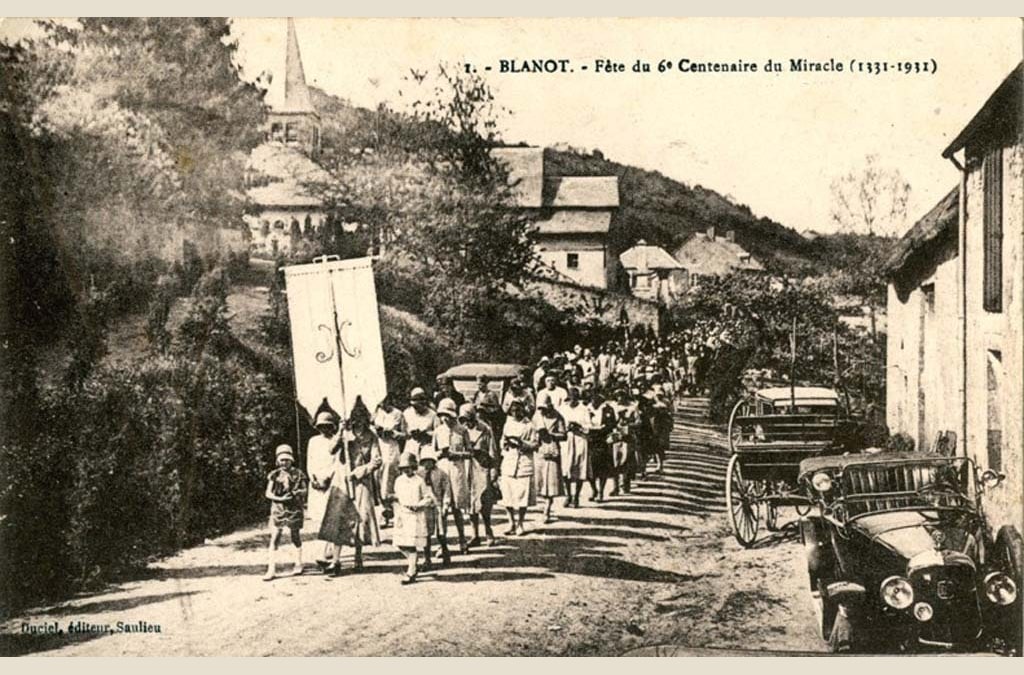
The strongest documented public celebration is the Feast of Corpus Christi, or Fête-Dieu. The St. Carlo exhibition and the 2024 parish account both describe special annual honor given to the cloth on that feast. A public-domain photograph from 1931 shows a Corpus Christi procession leaving the church during the six-hundredth anniversary year, providing unusually direct visual evidence of the devotion’s modern history.
Catholic Tourist does not assume that the same procession, exposition, or access arrangement occurs every year. Corpus Christi is movable, and a small rural church may have limited staffing. Pilgrims should consult the current diocesan Mass directory, local parish, municipality, or Pays Arnay-Liernais tourism office before traveling, especially if seeing the cloth is the purpose of the visit.
Routine access to the sacristy reliquary is not guaranteed. The regional heritage record says that the church can be visited and that parking is available, but this is not the same as a promise that the object will be exposed or that a key holder will be present. Respect locked areas, ask before entering the sacristy, and never photograph the cloth or liturgy without permission.
The best visit begins with the building. Descend into the church, notice the Romanesque scale and the martyrs named in its dedication, and then place the Easter 1331 narrative within the actual space of Communion. If access to the cloth is possible, remember that the object is a small piece of linen connected by received tradition to the event; it is not a spectacle and should be approached with the same reverence the community gives the Eucharist.
Blanot’s importance lies in the continuity of place. Unlike sites where the event church vanished or the object was destroyed, the same village church remains, a cloth is still locally kept, an archival dossier is cataloged, and the Corpus Christi devotion has left a visible historical record. At the same time, responsible pilgrimage requires limits: the material has not been scientifically authenticated by Catholic Tourist, the primary dossier has not all been inspected here, and current public access must be confirmed.
That combination—precise geography, a surviving church, a carefully described object, a named documentary trail, and honest uncertainty—makes Blanot much more than a one-line miracle marker. It becomes a coherent pilgrimage destination where medieval Eucharistic devotion, nineteenth-century renewal, local guardianship, and present-day visitor responsibility can all be understood together.
Descend into Blanot’s Romanesque church, place the 1331 account in its actual liturgical setting, and approach the locally preserved cloth through the parish’s rules rather than assuming automatic sacristy access.
The story & the place today
What happened here—and what a pilgrim can find now
Each record separates the devotional tradition from the present-day visitor evidence. A mapped locality remains visible even when an exact shrine or surviving object has not yet been verified.
The reported Eucharistic event and marked cloth of Blanot
During Easter Communion at the village church, a fragment of the Host was reported to fall onto a Communion cloth and leave a red mark when the priest attempted to recover it. A cut portion of the cloth is still locally kept as the event relic.
Church of Saint-Andoche and Saint-Thyrse, Blanot, Côte-d’Or
A marked portion of the Communion cloth associated with the received account
Church sacristy, Blanot, according to regional heritage reporting
Corpus christi veneration reported confirm annually
Visitor note: Church visit reported possible; access to the sacristy object and any exposition must be confirmed
Church wording: Received diocesan tradition with a cataloged archival dossier and later renewed feast — Historic Diocese of Autun; later Diocese of Dijon custody and documentation
The Diocese of Dijon archives catalog a twenty-one-leaf dossier, later studies, and an 1887 provision establishing the feast. Academic history distinguishes the medieval devotion from its nineteenth-century renewal.
The sacred connection
People and objects remembered here
These relationships are part of the destination record, with feast days and catalog qualifications shown where available.
co-patron of the church and early Burgundian martyr associated with nearby Saulieu
Feast: September 24co-patron of the church and companion martyr of St. Andoche
Feast: September 24Venerated Eucharistic-event cloth · Preserved in local ecclesial custody and supported by diocesan archival and regional heritage records; not independently scientifically authenticated by Catholic Tourist
Contact the parish or local tourism office before traveling. Never enter the sacristy or photograph the object without permission.What to notice
Look closely at the place and its story
The correct Blanot
Stand in the Côte-d’Or village church where the 1331 event was reported—not the separate Blanot in Saône-et-Loire.
A sunken Romanesque interior
Descend the steps into a church whose compact architecture has been compared to a crypt.
The marked cloth
Distinguish the cut Communion cloth kept in local custody from the Host fragment described in the narrative.
A layered dossier
Read the medieval account, nineteenth-century renewal, and modern heritage record as related but distinct evidence.
Corpus Christi memory
Connect the cloth with the procession tradition recorded in the 1931 public-domain photograph and later parish reporting.
Feasts, anniversaries & celebrations
How to read this page
Sources, tradition, and what is verified
The destination record was last checked on 9/29/2026.
This page records the site’s tradition as “Roman Catholic rural church, Eucharistic pilgrimage, and Burgundian martyr devotion.” That wording describes the nature of the claim and keeps devotional tradition distinct from independently verified history.
Continue nearby