Why pilgrims come
Discover what makes Cathedral Basilica of San Juan Bautista a place of pilgrimage
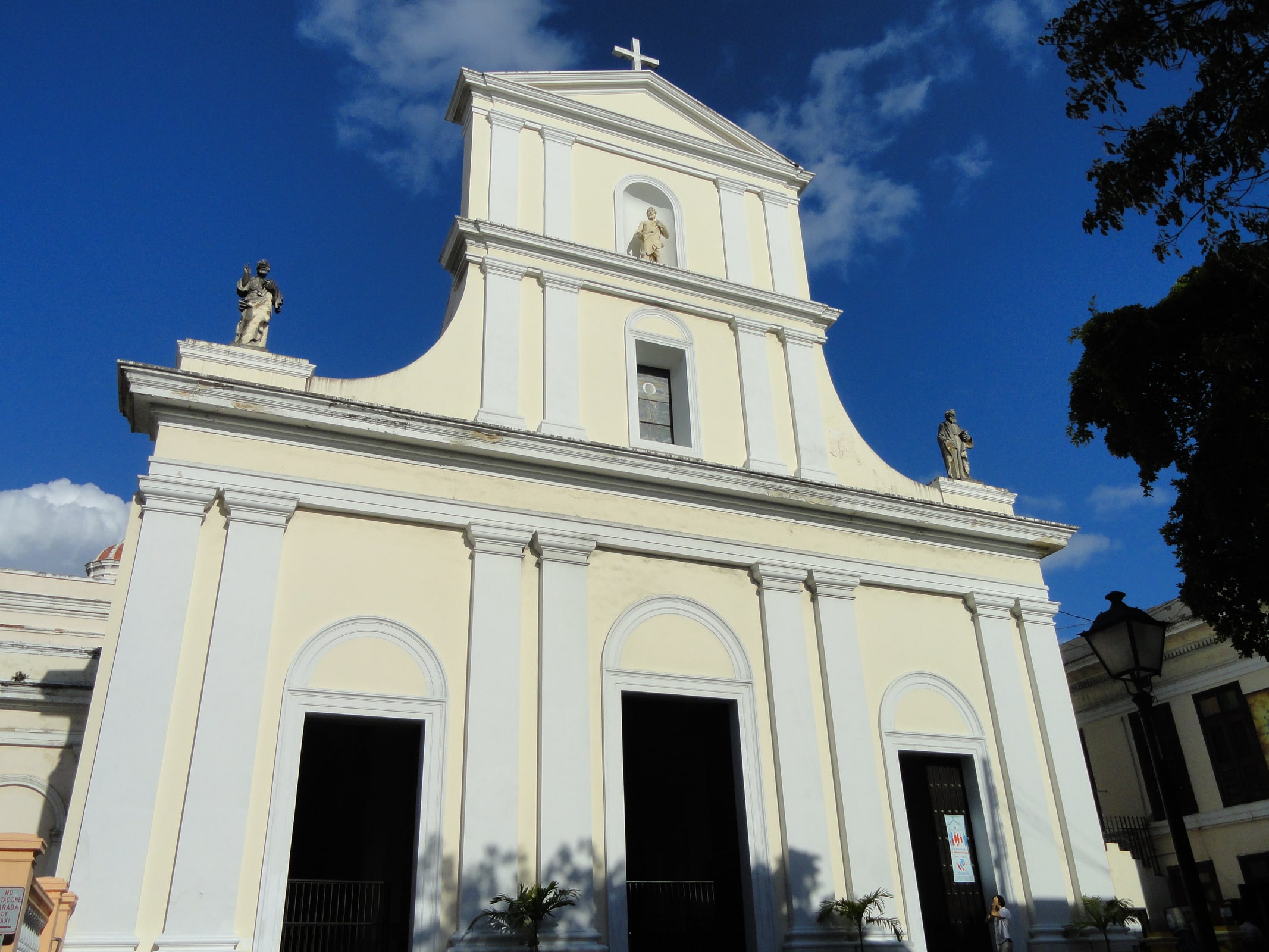
The Cathedral Basilica of San Juan Bautista is the living Catholic heart of Old San Juan and one of the oldest cathedral foundations in the Americas. The Diocese of Puerto Rico was erected in 1511, and the first cathedral church on the island was established in 1521. That early wooden building did not survive: a hurricane destroyed it in 1526, and construction in stone began in the following decade. The church pilgrims enter today is therefore not an untouched building from 1521, but a sacred place shaped by five centuries of rebuilding, earthquake damage, restoration, liturgy, and Puerto Rican Catholic life.
Its most famous historical memorial is the white-marble tomb of Juan Ponce de León. The explorer and first governor of Puerto Rico died in Havana in 1521 after being wounded during an expedition to Florida. His remains were initially placed in the crypt of nearby San José Church, where they rested for roughly three and a half centuries. In 1908 they were transferred to the cathedral. This distinction matters: San José preserves the memory of his earlier burial, while the cathedral holds his present tomb.
The cathedral is more than a colonial monument. It remains the metropolitan church of the Archdiocese of San Juan and a place of daily worship. It is also the National Shrine of Our Lady of Divine Providence, patroness of Puerto Rico. The devotion took deep root on the island under Bishop Gil Esteve in the nineteenth century, and Pope Paul VI declared Our Lady of Divine Providence Puerto Rico’s principal patroness in 1969. Her feast is celebrated on November 19. Pilgrims should allow the Marian shrine to interpret Puerto Rican Catholic identity rather than treating the cathedral only as the resting place of a famous conquistador.
The cathedral also preserves a reliquary associated with St. Pius, a Roman martyr from the catacombs. As with all catacomb-saint traditions, the devotion should be approached through the cathedral’s own interpretation and not embellished beyond the documentation on site. Together with the baptistery, chapels, sacred art, and archiepiscopal setting, the relic shrine reveals a church formed by both local devotion and the wider communion of the Catholic Church.
Architecturally, the building tells its history in layers. Gothic, Renaissance, Baroque, and later Neoclassical interventions coexist because the cathedral was repaired and enlarged rather than constructed in one campaign. The restrained façade opens into a luminous interior where tomb, altar, Marian devotion, and parish worship share one space. Look for the difference between the historical fabric and later restorations; the building’s importance lies precisely in that continuity through change.
A strong pilgrimage begins with Mass or quiet prayer, continues at the shrine of Our Lady of Divine Providence, and then visits Ponce de León’s tomb with historical sobriety. From there walk a few minutes to San José Church. The two churches belong together: San José retains an unusually early Dominican and Gothic inheritance, while the cathedral embodies the continuing metropolitan Church and the later transfer of Ponce de León’s remains.
Published schedules can change for Holy Days, cathedral celebrations, funerals, restoration work, and Old San Juan events. The cathedral currently publishes weekday, Saturday, and Sunday Masses on its official site. Check the same-day schedule before traveling, dress for an active church, and do not enter restricted chapels or interrupt worship for photography.
Pray in Puerto Rico’s metropolitan cathedral, honor Our Lady of Divine Providence, and read Ponce de León’s present tomb together with his former burial place at nearby San José Church.
The sacred connection
People and objects remembered here
These relationships are part of the destination record, with feast days and catalog qualifications shown where available.
titular patron of the cathedral and city
Feast: June 24documented historical burial
ecclesiastically venerated
What to notice
Look closely at the place and its story
Our Lady of Divine Providence
Pray before Puerto Rico’s patroness and place the cathedral within the island’s living Marian identity.
Ponce de León’s present tomb
See the documented 1908 resting place while remembering that his remains were first interred at San José Church.
Five centuries in layers
Read the cathedral as a rebuilt and restored sacred place rather than an untouched 1521 structure.
St. Pius reliquary
Approach the catacomb-saint devotion through the cathedral’s own ecclesial interpretation.
A living metropolitan church
Let the Eucharist and present worship—not colonial celebrity—remain the center of the visit.
Feasts, anniversaries & celebrations
How to read this page
Sources, tradition, and what is verified
The destination record was last checked on 10/5/2026.
This page records the site’s tradition as “Roman Catholic — Archdiocese of San Juan de Puerto Rico.” That wording describes the nature of the claim and keeps devotional tradition distinct from independently verified history.
Continue nearby