Why pilgrims come
Encounter the Eucharistic tradition and its surviving evidence
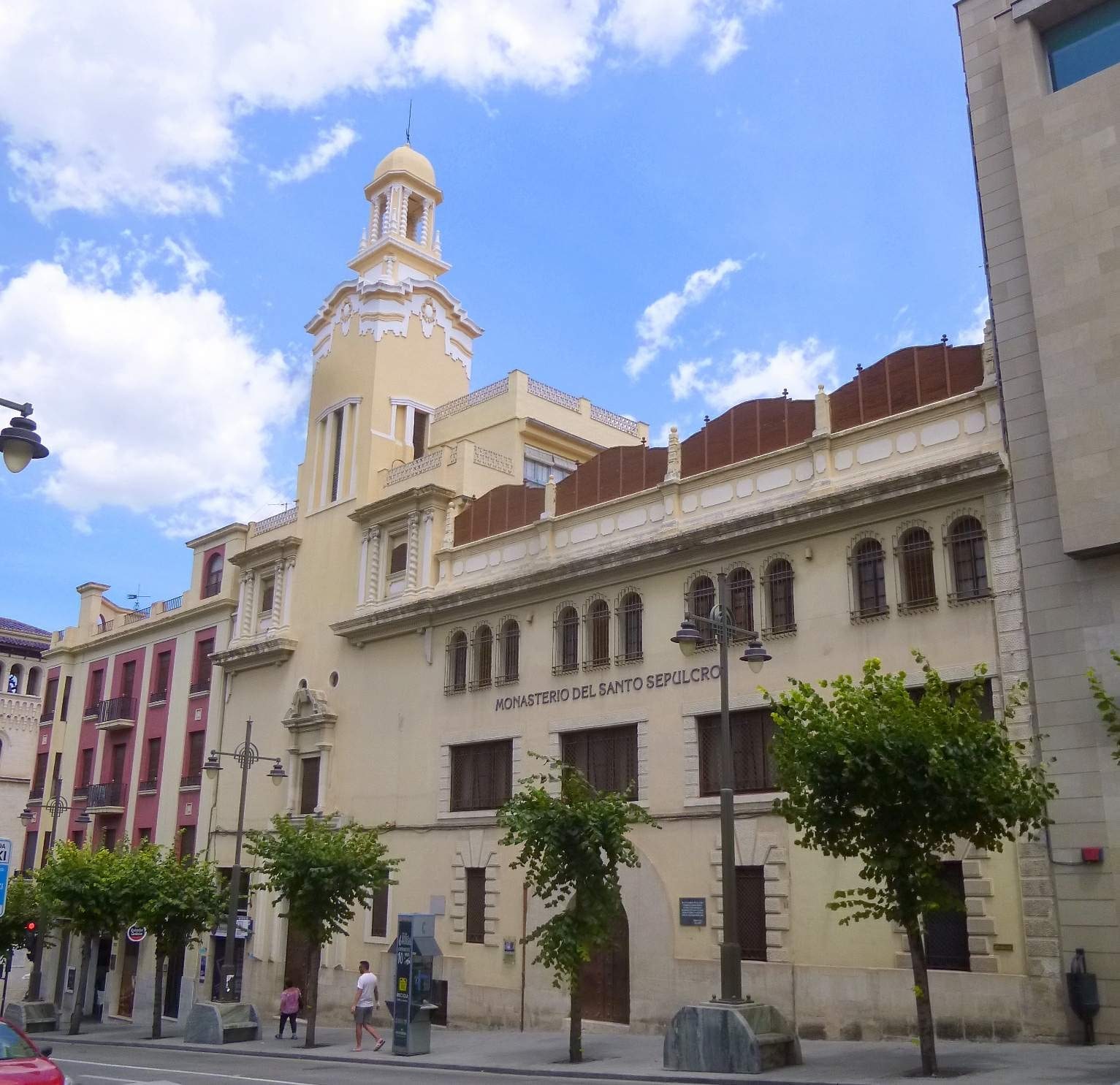
Alcoy’s 1568 Eucharistic story belongs at the Church and Monastery of the Holy Sepulchre, known locally through the devotion of the Jesuset del Miracle. The complex is not merely a later memorial somewhere in the city: it was built over the house and stable where stolen sacred objects and consecrated Hosts were recovered. Today the church preserves the venerated image of the Child Jesus associated with the finding and sustains perpetual Eucharistic adoration.
The story begins in Alcoy’s former parish church of Santa María, not in the present Holy Sepulchre church. On January 29, 1568, a cloth worker named Joan or Juan Prats stole a silver vessel, sacred objects, and consecrated Hosts from the parish tabernacle. The contemporary parish stood near today’s Placeta de la Mare de Déu; the later Church of Santa María elsewhere in Alcoy should not be mistaken for the original building.
The next morning the priest discovered the open tabernacle and the town began searching. On January 31, after an earlier search had failed, the farmer Joan Esteve searched Prats’s stable and recovered the stolen objects. The official local association says that the theft and recovery are supported by two notarial acts and municipal and notarial records. This documentary core is stronger than a purely oral legend.
The miraculous interpretation requires more care. The association’s received account says the stolen vessel originally held about forty Hosts. Prats allegedly confessed that he had consumed all of them, yet three were said to have been found in the recovered vessel. That apparent reappearance became the Eucharistic center of the devotion. St. Carlo Acutis’s exhibition gives a shorter form of the same tradition, but its compressed retelling can sound internally inconsistent unless the confession and the claimed recovery are explained in sequence.
A second tradition concerns a small image of the Child Jesus owned by Prats’s neighbor, the widow María Miralles. The local account says the figure had formerly stood upright with its hand raised; after the recovery it appeared bent, with its fingers pointing down toward the place where the objects had been hidden. A later act from 1627 is cited as describing the changed posture. The image was eventually given to the Holy Sepulchre church and continues to be venerated in its own chapel as the Jesuset del Miracle, patron of Alcoy’s children.
These layers should not be presented as if they had identical evidentiary weight. The theft, search, recovery, public vow, and building history are rooted in local documentary records. The unexplained survival or reappearance of three Hosts and the movement of the statue belong to the city’s longstanding Catholic devotional tradition. Catholic Tourist found no online decree in which the Holy See or a diocesan tribunal formally defines every element of the later narrative as a supernatural miracle.
The town acted quickly to preserve the place. Within months, the former stable was cleaned and adapted as a chapel. Alcoy acquired the adjoining property with the intention of building a larger church. St. John of Ribera, then Archbishop of Valencia, blessed the site for the present church and monastery in January 1596. A community of Discalced Augustinian nuns arrived in December 1597 and remained until 2013.
The monastery’s dedication to the Holy Sepulchre interprets the local tradition through Christ’s burial and Resurrection. The association explains that the name recalled the period during which the sacred species were believed to have lain hidden before their recovery. The surviving complex is also important as one of Alcoy’s principal historic religious buildings, with an old interior behind twentieth-century exterior work.
Custody has changed without ending the prayer of the place. After the Augustinian nuns left, Carmelite Messengers cared for the church for several years. Since 2018 a community of the Servants of the Lord and the Virgin of Matará, part of the Institute of the Incarnate Word, has served there. Visitors are entering a living convent and chapel, not an unattended monument.
The strongest sign of continuity is perpetual adoration. The Jesuset association says the chapel has offered perpetual Eucharistic adoration since October 5, 2017. During the day, access is through the main entrance on Calle San Blas; at night, registered adorers use the religious community’s parlor entrance on Calle Santo Tomás. Pilgrims should contact the sisters or a central Alcoy parish before relying on access, especially after dark.
Alcoy’s civic-religious vow also survives. On January 6, 1569, the town council promised an annual solemn celebration on January 31 in thanksgiving for the recovery. The observance continues in a contemporary festival cycle, often concentrated on the final Sunday of January, with a solemn Mass, prayers, music, and local participation. The association publishes a fresh Concordia program each year; it is the best source for that year’s dates rather than an old travel listing.
No original 1568 Host is advertised for public veneration today. The page therefore does not tell pilgrims they will see a preserved miraculous Host or scientific specimen. The spiritual and material witnesses now identified are the place of recovery, the received documentary tradition, the venerated Jesuset image, and the church’s continuing adoration.
The monastery also preserves a devotional copy of the Shroud of Turin. Its own history connects the cloth with a sixteenth-century commission and a tradition that it accompanied the Christian fleet at Lepanto before reaching Alcoy. That is a distinct devotional object and a separate historical claim; it should not be confused with the Hosts of 1568. Current display is not guaranteed, so request information rather than promising that the cloth will be visible.
For a coherent visit, begin by understanding that the theft church and the recovery shrine are different places. Pray at the Holy Sepulchre where the objects were found, spend time in adoration, and look for the Jesuset chapel only when the community permits access. Then continue to central Alcoy’s current Santa María church as a way of remembering the parish community that first raised the alarm, without claiming that the modern building is the sixteenth-century structure.
The photograph on this page shows the Holy Sepulchre complex itself. It was released to the public domain by its photographer through CC0 and has been resized and letterboxed for Catholic Tourist without generative alteration.
Alcoy rewards a slower reading than the label “Eucharistic miracle of 1568.” It is a story of sacrilege and recovery, civic repentance, a child-sized sacred image, St. John of Ribera’s church-building, centuries of enclosed religious life, and a present chapel where the Eucharist is still adored. The honest pilgrimage holds historical record and devotional interpretation together without pretending they are the same kind of evidence.
Pray where Alcoy remembers the 1568 recovery of stolen consecrated Hosts, venerate the Jesuset del Miracle image, and encounter a living chapel of perpetual Eucharistic adoration.
The story & the place today
What happened here—and what a pilgrim can find now
Each record separates the devotional tradition from the present-day visitor evidence. A mapped locality remains visible even when an exact shrine or surviving object has not yet been verified.
Theft and recovery of consecrated Hosts at Alcoy
After consecrated Hosts and sacred objects were stolen from Alcoy’s former Santa María parish church on January 29, townspeople recovered the objects in Joan Prats’s stable on January 31. The local devotional account says three Hosts were found even though Prats claimed to have consumed all of them, and associates the finding with the changed posture of a neighboring Child Jesus image.
Former Santa María parish church (theft) and Joan Prats’s house and stable, now within the Holy Sepulchre complex (recovery)
The Jesuset del Miracle image and the Eucharistic memory of the recovered consecrated Hosts
Church and Monastery of the Holy Sepulchre, Alcoy
Annual local observance rooted in the January 31, 1569 civic vow, with a current festival program commonly centered on the final Sunday of January
Visitor note: Perpetual adoration is maintained; access to the church, Jesuset chapel, and historical objects must be confirmed with the religious community
Church wording: Documented local theft-and-recovery history with a longstanding Catholic miraculous tradition and annual archdiocesan observance — Archdiocese of Valencia, the living religious community, and the Asociación Jesuset del Miracle Alcoy
The recovery site became a chapel within months and the present church-monastery was begun under St. John of Ribera in the 1590s.
The sacred connection
People and objects remembered here
These relationships are part of the destination record, with feast days and catalog qualifications shown where available.
archbishop who blessed the site and founded the religious community associated with the present complex
Feast: January 14What to notice
Look closely at the place and its story
The recovery site
Stand at the complex built over the house and stable where the stolen sacred objects were found in January 1568.
Jesuset del Miracle
Encounter the Child Jesus image whose changed posture belongs to Alcoy’s received account of the discovery.
Perpetual adoration
Let the current Eucharistic prayer of the chapel—not sensationalism—be the center of the visit.
The civic vow
Learn why Alcoy promised in 1569 to commemorate the recovery every January 31.
St. John of Ribera’s foundation
Read the 1590s church and monastery as a lasting Catholic response to the event.
A separate Shroud tradition
Ask whether the monastery’s devotional Turin Shroud copy is accessible, while keeping its Lepanto tradition distinct from the Eucharistic event.
Feasts, anniversaries & celebrations
How to read this page
Sources, tradition, and what is verified
The destination record was last checked on 9/29/2026.
This page records the site’s tradition as “Catholic; Archdiocese of Valencia; local Jesuset del Miracle devotion.” That wording describes the nature of the claim and keeps devotional tradition distinct from independently verified history.
Continue nearby