Why pilgrims come
Discover what makes Mater Admirabilis Chapel and Fresco at Trinità dei Monti a place of pilgrimage
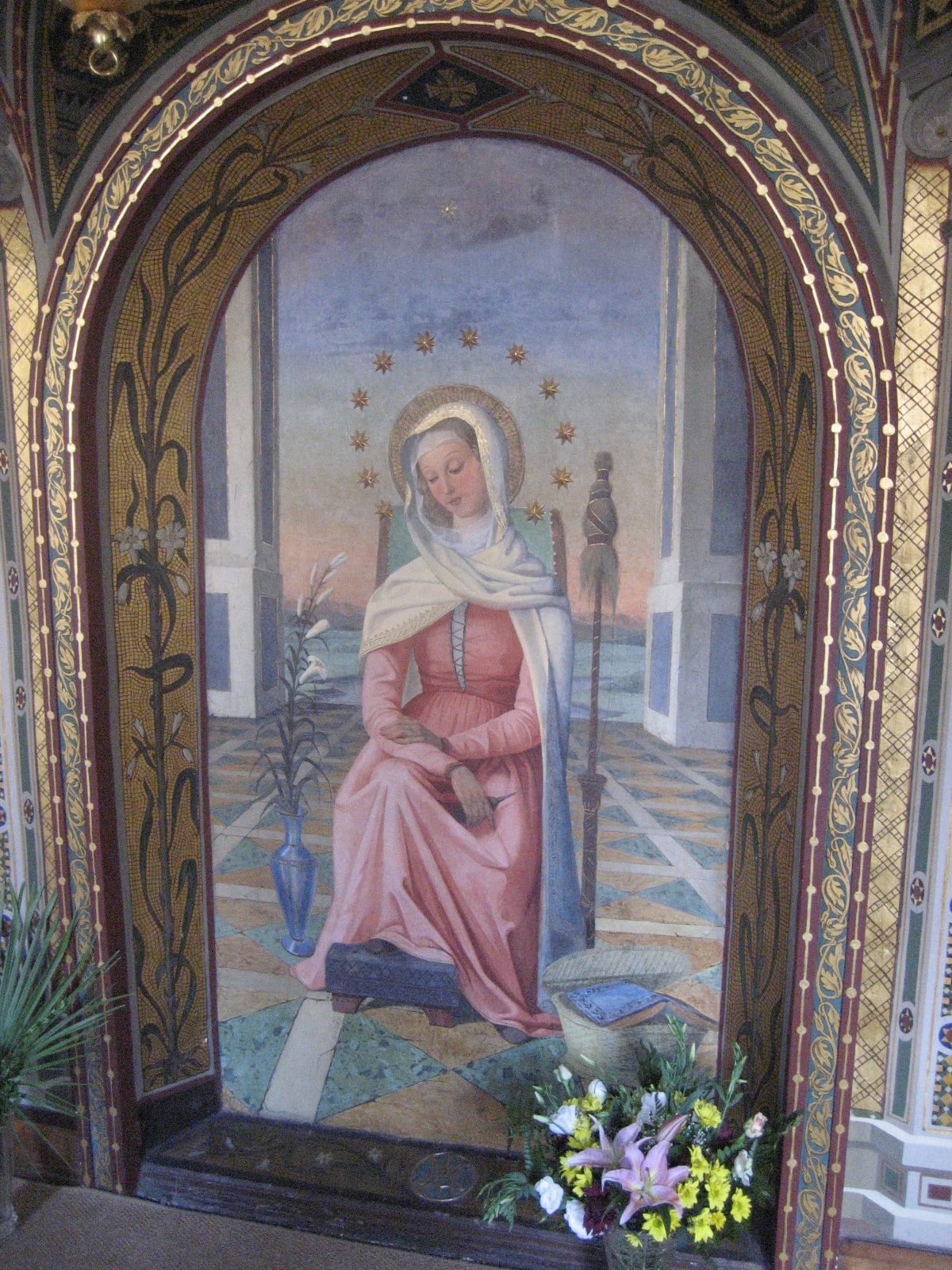
At the top of Rome’s Spanish Steps, a gate beside the church of Trinità dei Monti opens onto a quieter pilgrimage than the famous piazza below. Inside the convent is a chapel built around a fresco of the Virgin Mary as a young woman. She sits in recollection between prayer, study, and work: an open book rests nearby, a lily evokes purity, and a spindle and basket recall the hidden labor of ordinary life. This is Mater Admirabilis—Mother Most Admirable—an image that has shaped generations of students, alumnae, and Religious of the Sacred Heart around the world.
The fresco was painted in 1844 by Pauline Perdrau, then a young postulant of the Society of the Sacred Heart. Perdrau later explained that the image had lived in her imagination since childhood. A nurse had encouraged her to picture the young Mary at the Temple in Jerusalem, quietly spinning and working in the presence of God. At Trinità dei Monti, Perdrau asked permission to place that vision on a corridor wall leading toward the sisters’ cloister. Her superior hesitated because Perdrau had not been trained in fresco technique, but eventually allowed the project.
Perdrau prepared the wall and worked for months. When the image was completed, its colors appeared so strong that it was covered with cloth while the surface dried. The Society of the Sacred Heart’s official account records that, when the covering was removed, the colors had softened into the harmonious pink, blue, and ivory tones seen today. Perdrau regarded that change as a miracle. Catholic Tourist preserves the testimony without overstating it: the change belongs to the image’s received devotional tradition, but it is not presented here as a scientifically established event or a separately defined supernatural miracle.
The decisive public moment came on October 20, 1846, when Pope Pius IX visited Trinità dei Monti. Struck by the fresco, he blessed the image under the title Mater Admirabilis. The corridor became a chapel and the date became the feast of Mater Admirabilis within the worldwide Sacred Heart family. The pope’s blessing and the devotion that followed are documented history; they should not be confused with a formal ecclesiastical judgment on every miraculous claim associated with the image.
The title spread far beyond Rome. Reproductions of Mater Admirabilis became a familiar presence in Sacred Heart schools and communities across the world. For students, the image is not merely a school emblem. Mary’s posture holds together contemplation and action: the book, lily, and workbasket invite a life in which intellectual formation, prayer, purity of heart, and useful work belong together. On October 20, Sacred Heart communities traditionally celebrate with prayer, gatherings, and the color pink drawn from the fresco.
The chapel also opens an important path into the history of women’s religious life and Catholic education. The Society of the Sacred Heart was founded by St. Madeleine Sophie Barat in 1800. The sisters came to Trinità dei Monti in the nineteenth century and made the image part of a living educational spirituality. Though the current custody and animation of the Trinità dei Monti complex have changed, the fresco remains inseparable from the Society’s memory and mission.
Pilgrims should distinguish the Mater Admirabilis Chapel from the public church immediately beside it. Access is through the convent gate at Piazza Trinità dei Monti 3, on the left side of the church. The official site currently lists the chapel as open for prayer and visits Monday through Friday from 9 a.m. to 6 p.m. and Saturday from 9 a.m. to 3 p.m., with Sunday closed. These hours can change for community life, liturgies, private events, or conservation, so consult the live official page shortly before visiting and announce yourself at the porter’s lodge when directed.
Do not hurry past the image after taking a photograph. Notice the lowered eyes, the book, the lily, and the tools of work. They propose a specifically Christian integration of silence and responsibility: Mary is attentive to God without withdrawing from the duties placed before her. Students may bring decisions about study or vocation; parents and teachers may pray for the young people entrusted to them; anyone overwhelmed by noise or constant activity may ask for the calm needed to recognize what is essential.
Trinità dei Monti makes it possible to connect this small chapel with a rich walking pilgrimage through central Rome. Sant’Andrea delle Fratte, associated with the conversion of Alphonse Ratisbonne before Our Lady of the Miraculous Medal, is only a short walk away. Santa Maria del Popolo, with the Cerasi Chapel’s paintings of St. Peter and St. Paul, lies beyond the Piazza del Popolo. The churches of the Gesù, Sant’Agostino, and Santa Maria sopra Minerva extend the route toward the tombs of saints and the Catholic history of the city.
A fitting prayer here is not for spectacle but for interior unity: that work may become service, study may lead to wisdom, and silence may make room for God. Mater Admirabilis is powerful precisely because the young Mary is shown doing nothing outwardly dramatic. Her hidden attention teaches the pilgrim that holiness is also formed in classrooms, workshops, corridors, and ordinary duties faithfully received.
Enter the convent beside Trinità dei Monti to pray before Pauline Perdrau’s original Mater Admirabilis fresco, an image of Mary uniting contemplation, study, and ordinary work.
What to notice
Look closely at the place and its story
Pauline Perdrau’s original fresco
Encounter the 1844 image painted by a young Sacred Heart postulant from a childhood vision of Mary at prayer, study, and work.
Named by Pope Pius IX
Remember the papal visit of October 20, 1846, when Pius IX blessed the image under the title Mater Admirabilis.
The softened colors
Receive Perdrau’s testimony that the colors softened while the fresco was covered, while respecting the distinction between devotional tradition and formally authenticated miracle.
Prayer, study, and work
Read the book, lily, spindle, and workbasket as an invitation to unite contemplation with the responsibilities of ordinary life.
A worldwide Sacred Heart devotion
Recognize the original behind images cherished in Sacred Heart schools and communities across the world.
A hidden chapel above the Spanish Steps
Leave the crowded piazza and enter through the convent gate for a quieter encounter with Mary in the heart of Rome.
Feasts, anniversaries & celebrations
How to read this page
Sources, tradition, and what is verified
The destination record was last checked on 10/25/2026.
This page records the site’s tradition as “Roman Catholic — Trinità dei Monti; devotion of the Society of the Sacred Heart.” That wording describes the nature of the claim and keeps devotional tradition distinct from independently verified history.
Continue nearby