Why pilgrims come
Discover what makes Santa Maria del Popolo and the Cerasi Chapel a place of pilgrimage
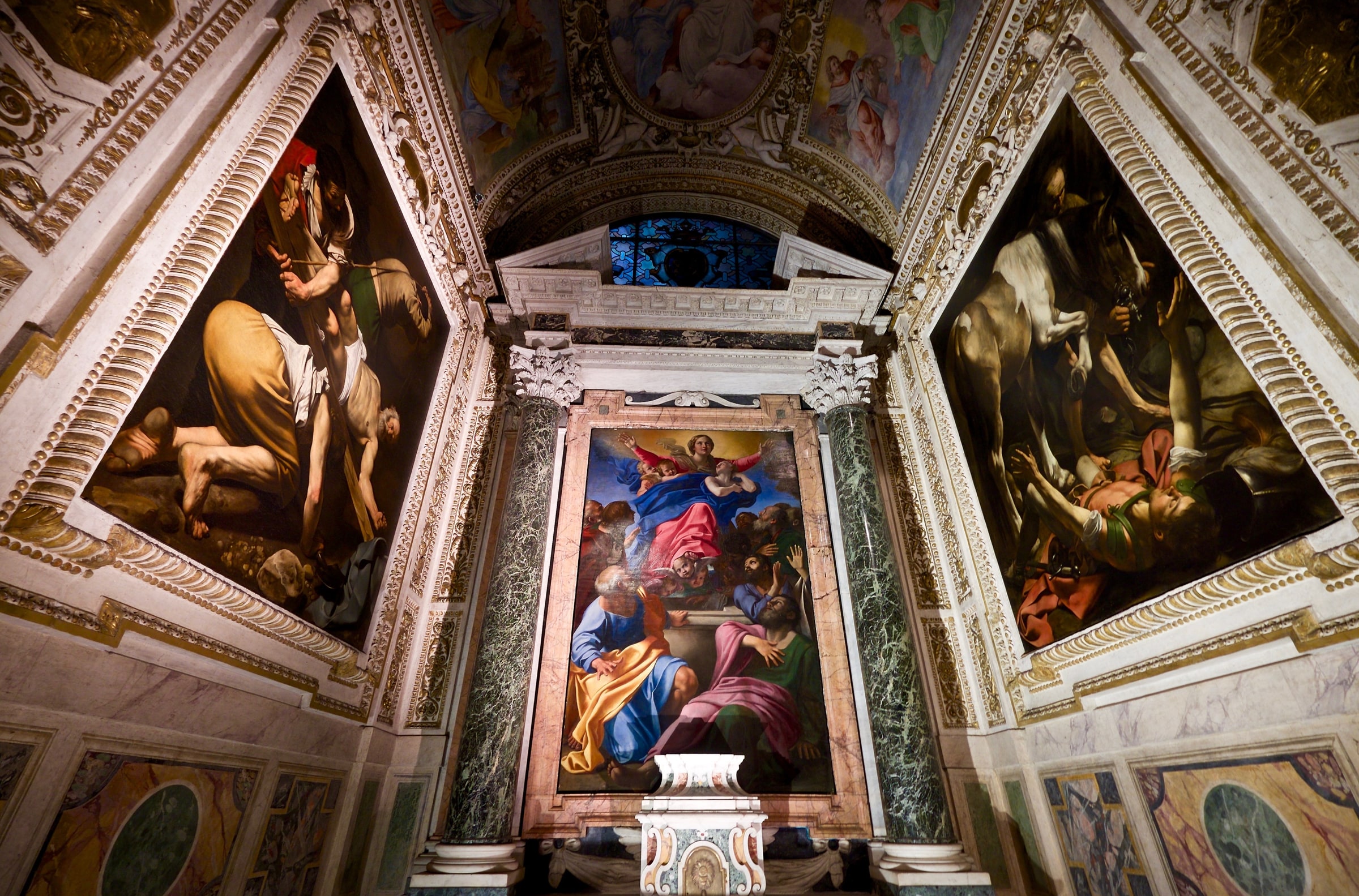
At the northern gate of historic Rome, Santa Maria del Popolo holds one of the most concentrated encounters with sacred art in the city. In the small Cerasi Chapel, Caravaggio’s Conversion of Saint Paul faces his Crucifixion of Saint Peter. The two apostles who define so much of Christian Rome appear not in public triumph but at the decisive limits of discipleship: Paul overwhelmed by the call of Christ, Peter giving his life for the Lord he once denied.
The Conversion on the Way to Damascus, painted around 1600–1601, places Saul on the ground with his arms raised into an unseen encounter. Christ does not appear bodily in this installed version. Divine action is carried principally through light, while the horse and groom seem almost unaware of what is happening beneath them. The composition makes conversion inward and immediate: a crowded space becomes the threshold of an entirely new life.
Directly across the chapel, the Crucifixion of Saint Peter shows workmen raising the apostle’s inverted cross. Caravaggio avoids a distant heroic spectacle. Heavy bodies, rough feet, strained backs, earth, timber, and Peter’s lucid gaze make martyrdom physically near. Standing between the two paintings, a pilgrim sees vocation and perseverance together—Paul receiving his mission and Peter completing his.
The placement is not accidental. Tiberio Cerasi, treasurer to Pope Clement VIII, commissioned the chapel and its paintings in September 1600. Annibale Carracci’s Assumption of the Virgin occupies the altar between Caravaggio’s canvases. Mary’s glorification therefore forms the luminous center, while Peter and Paul flank the chapel as Rome’s apostolic witnesses. The three paintings were made for this intimate architectural setting and should be read together rather than as isolated museum masterpieces.
An important historical qualification strengthens the story. The canvases now in the chapel are Caravaggio’s second treatments of the subjects. A first Conversion, painted on cypress wood, survives in the Odescalchi collection; the first version of Peter’s martyrdom is lost. The precise reasons for the replacement remain debated, and the familiar word “rejected” can imply more certainty than the documents allow. The present paintings were in the chapel by 1605 and remain where their full spatial dialogue can still be experienced.
The basilica deserves more than a hurried Caravaggio stop. Its fifteenth-century rebuilding, Renaissance chapels, Pinturicchio frescoes, monuments by Andrea Bregno, and the Chigi Chapel designed by Raphael and completed with works by Bernini place several centuries of Roman Catholic patronage within one living church. The high altar and choir continue the Marian identity announced by the church’s dedication.
Visit as a pilgrim before visiting as an art lover. Read Acts 9 before entering the Cerasi Chapel. Stand quietly between Peter and Paul, notice the Assumption at the center, and ask two questions: where is Christ calling me to rise, and what faithfulness will that call require? Photography and tour-group access can change, and liturgy always takes priority. Verify current opening conditions through Rome’s official visitor information before travel.
Read Acts 9 before entering, then stand between the two Caravaggios: Paul receives the call of Christ on one wall and Peter completes his witness on the other. Let Carracci’s Assumption at the altar keep the chapel’s Marian and liturgical center visible.
The sacred connection
People and objects remembered here
These relationships are part of the destination record, with feast days and catalog qualifications shown where available.
What to notice
Look closely at the place and its story
Paul’s conversion through light
Caravaggio leaves Christ unseen in the installed version and makes illumination, gesture, and compressed space carry the encounter.
Peter’s martyrdom across the chapel
Turn physically from Paul’s beginning to Peter’s final witness in the facing Crucifixion of Saint Peter.
Carracci’s Assumption at the center
Read all three altar-wall paintings together: Mary’s Assumption between Rome’s two apostolic patrons.
The second-version story
Understand that the installed canvases are Caravaggio’s second treatments; the first Paul survives while the first Peter is lost.
The Chigi Chapel
Continue to Raphael’s architecture and mosaics and Bernini’s later contributions without reducing the basilica to one famous room.
Feasts, anniversaries & celebrations
How to read this page
Sources, tradition, and what is verified
The destination record was last checked on 9/24/2026.
This page records the site’s tradition as “Roman Catholic basilica, Marian church, and apostolic sacred-art pilgrimage.” That wording describes the nature of the claim and keeps devotional tradition distinct from independently verified history.
Continue nearby