Why pilgrims come
Discover what makes Sanctuary-House of St. Catherine of Siena a place of pilgrimage
The most intimate place connected with St. Catherine of Siena is not a convent but her family home in Fontebranda. Catherine belonged to the Dominican Third Order and lived her consecration in the world. The sanctuary therefore reveals something central about her vocation: contemplation, service, and courageous action grew from ordinary domestic rooms and the streets of Siena.
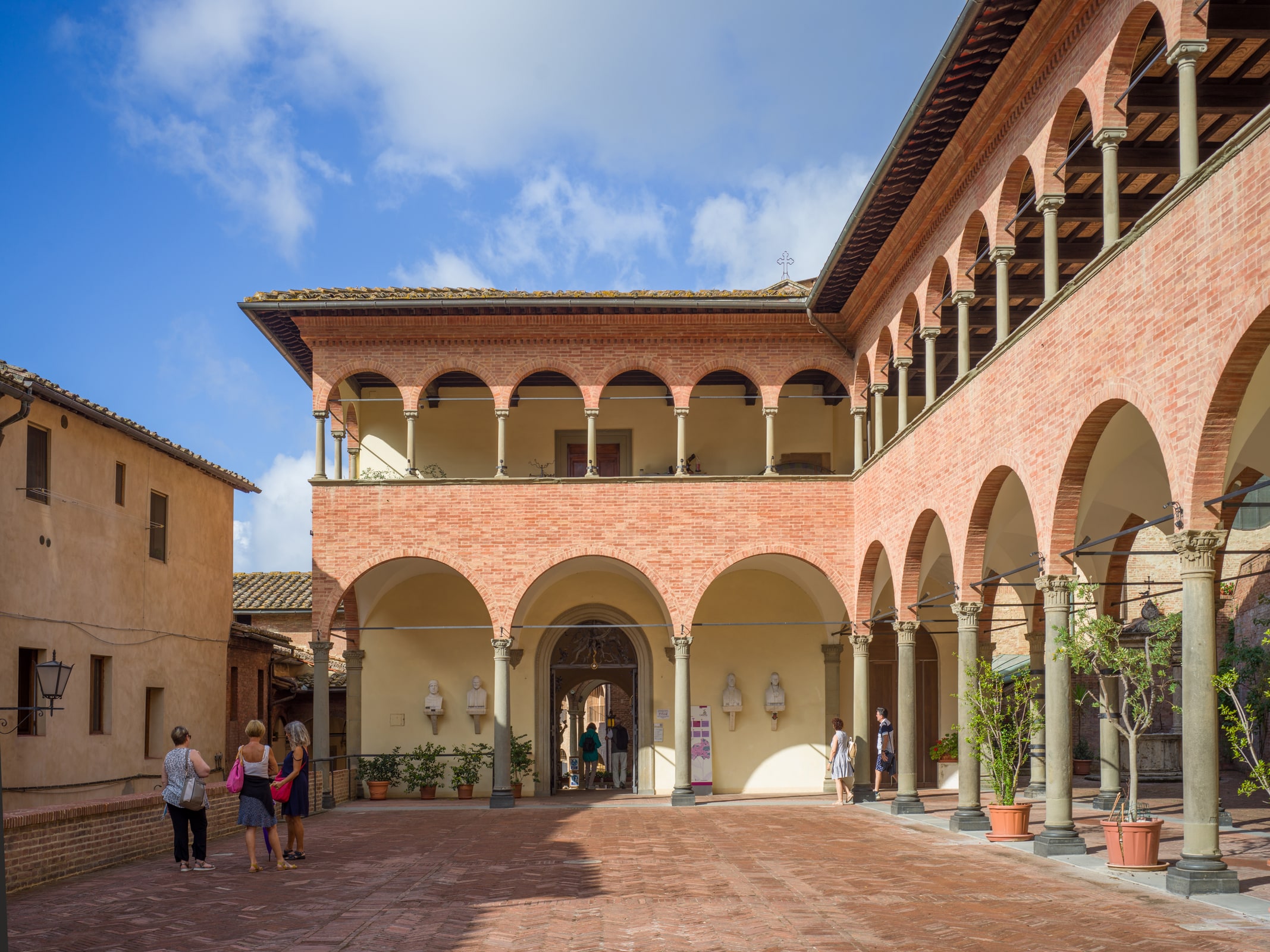
In the first half of the fourteenth century the house was rented to Catherine’s father, Jacopo Benincasa, a cloth dyer, as both workshop and home for his large family. After Catherine’s canonization, Siena purchased the property in 1466 so that it would remain open for public veneration. A lay confraternity gradually transformed the house into the present complex of porticoes, church, chapels, and oratories.
The Kitchen Oratory occupies the space of the family kitchen. The Bedroom Oratory descends toward the small cubicle associated with Catherine’s prayer and rest and preserves personal objects and relics remembered by the sanctuary, including the silk bag used when her head was brought from Rome to Siena. These rooms make her sanctity concrete without pretending that every later decoration belonged to her lifetime.
The Church of the Crucifix preserves the painted cross before which Catherine received the stigmata in Pisa in 1375. The event did not occur in Siena: the crucifix was transferred here in 1565 and installed in the church built for its veneration. That distinction matters. The sanctuary is the custodian of the object and memory, not the geographical site of the original event.
The Portico dei Comuni was built after Pius XII proclaimed Catherine a patron of Italy in 1939. Its civic scale expresses how a young laywoman from a dyer’s household became a Doctor of the Church and a patron of Europe. Yet the small rooms remain more eloquent than the honors. They show prayer forming a person capable of serving the sick, accompanying prisoners, addressing rulers, and laboring for peace and the unity of the Church.
Visit slowly and in sequence: the domestic oratories, the Church of the Crucifix, and then San Domenico nearby. Together they distinguish the saint’s home, her spiritual formation, and the principal relic shrine where her head is venerated.
Move from the domestic rooms to the Church of the Crucifix, then continue to San Domenico. The route explains Catherine as a lay Dominican whose hidden prayer became public service to Church and society.
The sacred connection
People and objects remembered here
These relationships are part of the destination record, with feast days and catalog qualifications shown where available.
family home, formative place, sanctuary and relic custody
Feast: April 29Saint relics and contact objects · Ecclesiastically preserved and publicly venerated within the sanctuary tradition
Access varies by room, liturgy, and sanctuary arrangements. Confirm before travel.What to notice
Look closely at the place and its story
The Benincasa home
Enter the domestic world in which Catherine’s lay Dominican vocation first took shape.
Kitchen and Bedroom Oratories
See how later generations preserved rooms associated with prayer, family life, service, and penance.
Crucifix of the stigmata
Venerate the cross brought from Pisa while preserving the true geography of the 1375 event.
A universal call to holiness
Understand why Catherine’s life outside a convent became a powerful witness to sanctity in the world.
Feasts, anniversaries & celebrations
How to read this page
Sources, tradition, and what is verified
The destination record was last checked on 9/22/2026.
This page records the site’s tradition as “Roman Catholic; Dominican spirituality and sanctuary of St. Catherine of Siena.” That wording describes the nature of the claim and keeps devotional tradition distinct from independently verified history.
Continue nearby